Comparing Vial Label Quotes: Make the Exclusions Visible
One vial-label quotation gives a single attractive total. Another has five lines, including a sample and delivery charge. The second offer looks more expensive before anyone has checked whether the first includes the same work. That is a poor moment to choose a printer.
I would compare the promised purchase before comparing the price. Give every supplier the same base brief, then mark what each offer includes, excludes or leaves unresolved. A short, explicit difference list is more useful than a spreadsheet that makes unlike offers look identical.
Freeze one comparison brief
For custom peptide vial labels, identify the actual container, finished label dimensions, approved or proposed artwork revision, construction, supply format and quantity per design. Add the destination and the date you need stock available. Distinguish a requested arrival date from a supplier-confirmed commitment.
Give the brief a reference and date. If the quantity split changes halfway through the comparison, send the revision to every supplier whose offer remains under consideration. Otherwise, the buyer can mistake a change in the enquiry for a difference in supplier pricing.
Unknown requirements should stay visible. You may not yet know which film or adhesive reference is suitable. In that case, ask each supplier to identify its proposed construction and the evidence needed before release. Do not write an invented specification simply to make the comparison sheet complete.
Put four statuses beside every cost line
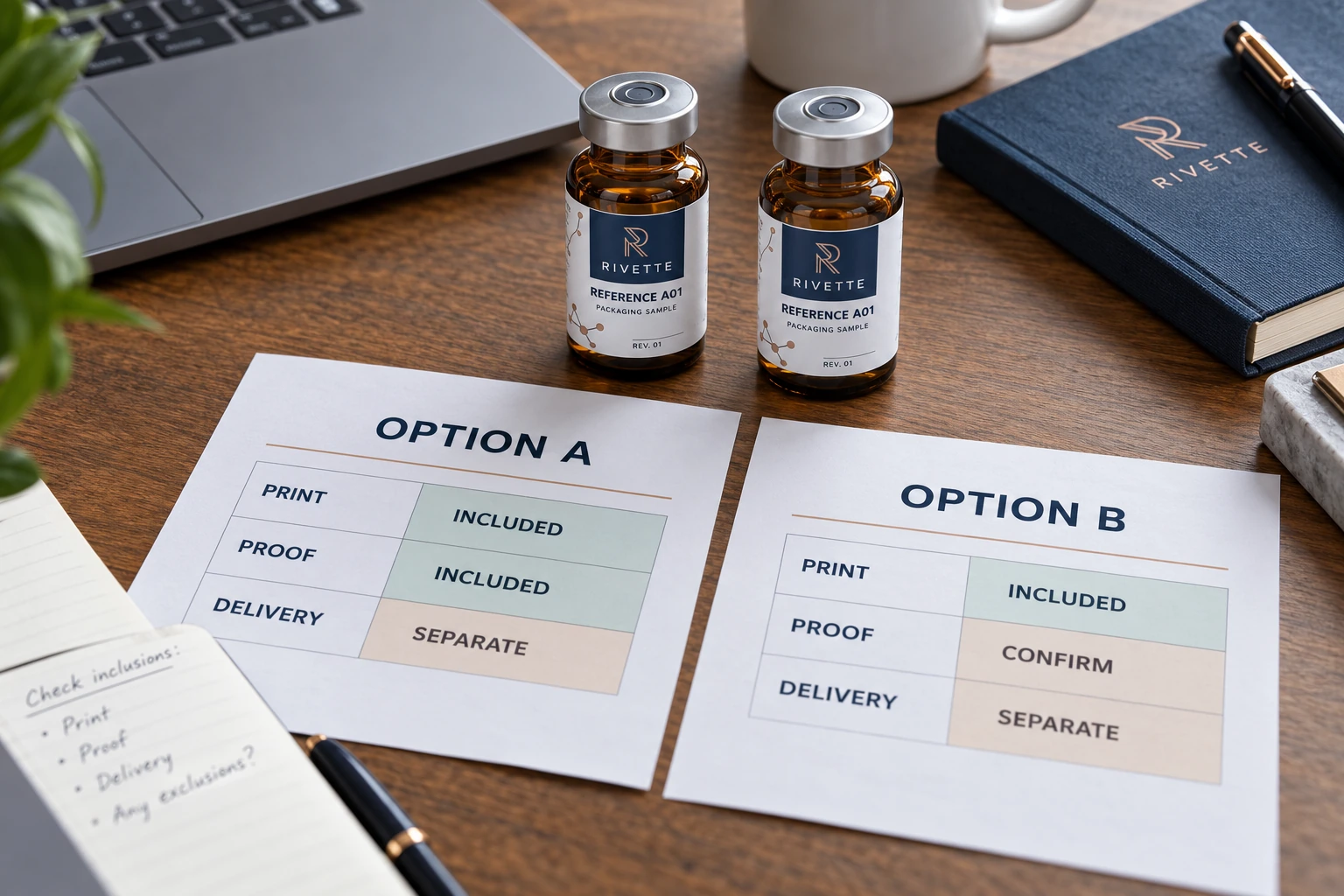
Use included, separately priced, excluded and unconfirmed. An empty cell is unconfirmed. It is not free. Keep the supplier’s own wording beside your normalized description so that a tidy spreadsheet does not silently add a promise the supplier never made.
| Purchase item | Question to resolve | What belongs in the comparison |
|---|---|---|
| Printed labels | Which construction and quantity per design? | Identified proposal and quantity split |
| Artwork preparation | What work is included, and what requires approval? | Scope, revision basis and any separate charge |
| Proof or sample | Digital review, physical print or application trial? | Deliverable and what it represents |
| Roll or sheet presentation | Which packing and machine inputs are included? | Confirmed format and outstanding requirements |
| Transport | To which destination, on which stated basis? | Quoted charge, exclusions and estimated timing |
This is a purchasing worksheet, not a universal list of supplier fees. Some work may genuinely be included in a price. The useful question is whether the supplier confirms that inclusion for this particular job. Do not add hypothetical charges merely to make a low quotation look suspicious.
Keep alternatives in a separate column
A supplier may propose a different finish, a different quantity or a construction it can supply more readily. That can be a good solution. It is still an alternative, rather than proof that the same specified job costs less.
Record the base offer and the alternative separately. Name the change, its practical consequence and the review needed to accept it. If one option uses a clear face and another uses white film, matching the label dimensions does not make the appearance equivalent. Ask what sample or proof will represent the proposed result.
The same applies to quantities. A larger order may have a lower quoted unit price while requiring a greater cash commitment. The small-batch cost-per-design guide addresses that inventory decision. Here, keep quantity changes visible so they do not disappear inside a supplier comparison.
Two buyers can reasonably choose different offers
Consider an illustrative first-order buyer whose artwork is incomplete. One printer quotes production only and asks for a finished file. Another identifies the artwork work it will undertake before presenting a production proof. The buyer needs to compare the missing design task, responsibility and timing, rather than reward the shortest quotation automatically.
Now consider an illustrative repeat buyer with a released file and an accepted specification. Extra concept development may have little value. A supplier offering a clearly defined repeat production job could be the better fit, even if another proposal includes a longer list of services.
Neither situation establishes a general rule about cheap or expensive suppliers. A detailed quote can contain unnecessary work. A concise quote can be complete. The deciding factor is whether the offer covers the task this buyer actually needs, with its important conditions understood.
Compare timing and payment on their own terms
Write down what starts the production clock. Is the quoted period measured from the enquiry, payment, artwork approval or another confirmed milestone? Keep sample preparation, production and transit separate. A fast production estimate is not automatically a fast arrival commitment.
Record quotation validity, payment milestones and any unresolved destination charges as stated by the relevant party. If something depends on information not yet available, mark it as an estimate or an open item. Do not convert it into a fixed landed total for the sake of a neat ranking.
For RP Labels, the confirmed guidance is a starting quantity of 100 pieces subject to each design and specification, free artwork and digital proof support, typical sample preparation of 1–2 days after confirmation, and typical production of 10–12 days after final approval. Transport is confirmed separately. Those facts help frame an enquiry; the accepted project quotation still needs its own scope and dates.
Ask one consolidated clarification
Send the supplier a short list of unresolved items against the same brief reference. Ask it to confirm the construction, included work, separate amounts and conditions. Consolidate the answers into the offer record instead of scattering them across several informal messages.
Choose a supplier only after the material differences are understood. If a less expensive alternative remains uncertain on a requirement that matters to your packing job, obtain the missing review before treating the apparent saving as available. If the requirement does not matter to your project, remove unnecessary work with the supplier’s agreement.
Questions about comparing label quotations
Does an empty price line mean the service is included?
No. Ask whether it is included, separate, excluded or awaiting specification. Preserve the written response with the quotation rather than filling the cell from assumption.
Should I reject a supplier that proposes a different material?
Not automatically. Review it as an identified alternative with its own conditions and sample needs. A suitable alternative can win the order, but it should not be presented as an unchanged specification.
Can I compare only the cost per label?
Only after scope and quantities are comparable. Also consider the total commitment, work still needed and the labels you expect to use. A unit price does not describe the complete purchasing obligation.
What should I send for a comparable proposal?
Send the container and label dimensions, artwork status, quantity per design, proposed finish, supply requirements, destination and required date. Identify which parts need a supplier proposal instead of pretending they are settled.
Bring the unresolved scope into the enquiry
Use the project quote form to submit that shared brief and the specific inclusion or exclusion questions you need answered. You can anonymize other suppliers’ documents; their confidential prices are not necessary to explain your requirement. The next useful result is a defined offer you can assess, rather than another headline price to copy into the top row.