Vial Label Acceptance Sampling: Agree the Release Rule Before Delivery
A handful of good labels is not yet a release rule
The delivery is on the bench. Someone unrolls a few labels, compares them with the artwork and finds nothing obviously wrong. That is useful screening. Whether it supports releasing the whole order is a different question, and it should have an agreed answer before the cartons arrive.
I would begin with the decision the inspection must support, then define the lot, the unit being inspected and the characteristic being checked. Only then should the responsible quality person select an appropriate sampling or inspection approach. Starting with an attractive sample count leaves the important assumptions hidden.
This is a purchasing brief for agreeing that work. It does not supply a statistical plan, reproduce standard tables or establish a universal acceptable defect allowance for vial labels.
Decide what the result is allowed to mean
A visual check may be intended to catch an obvious wrong design before unloading. Another check may support a formal decision about accepting a defined production lot. A third may investigate a specific suspected issue. Those tasks need different instructions, even when all involve looking at printed labels.
ASQ’s explanation of acceptance sampling describes plans as including sample sizes and associated acceptance or nonacceptance criteria. It also distinguishes classification data from measured data. Counting labels that do not meet a stated requirement is a different activity from recording an actual dimension for each inspected specimen.
The procurement consequence is straightforward: write the requirement and the proposed decision beside the sample request. A dimension, a wrong SKU and a cosmetic mark should not disappear into an undefined category called poor quality. The quality owner must determine how each relevant characteristic is handled.
Build the lot and inspection brief first
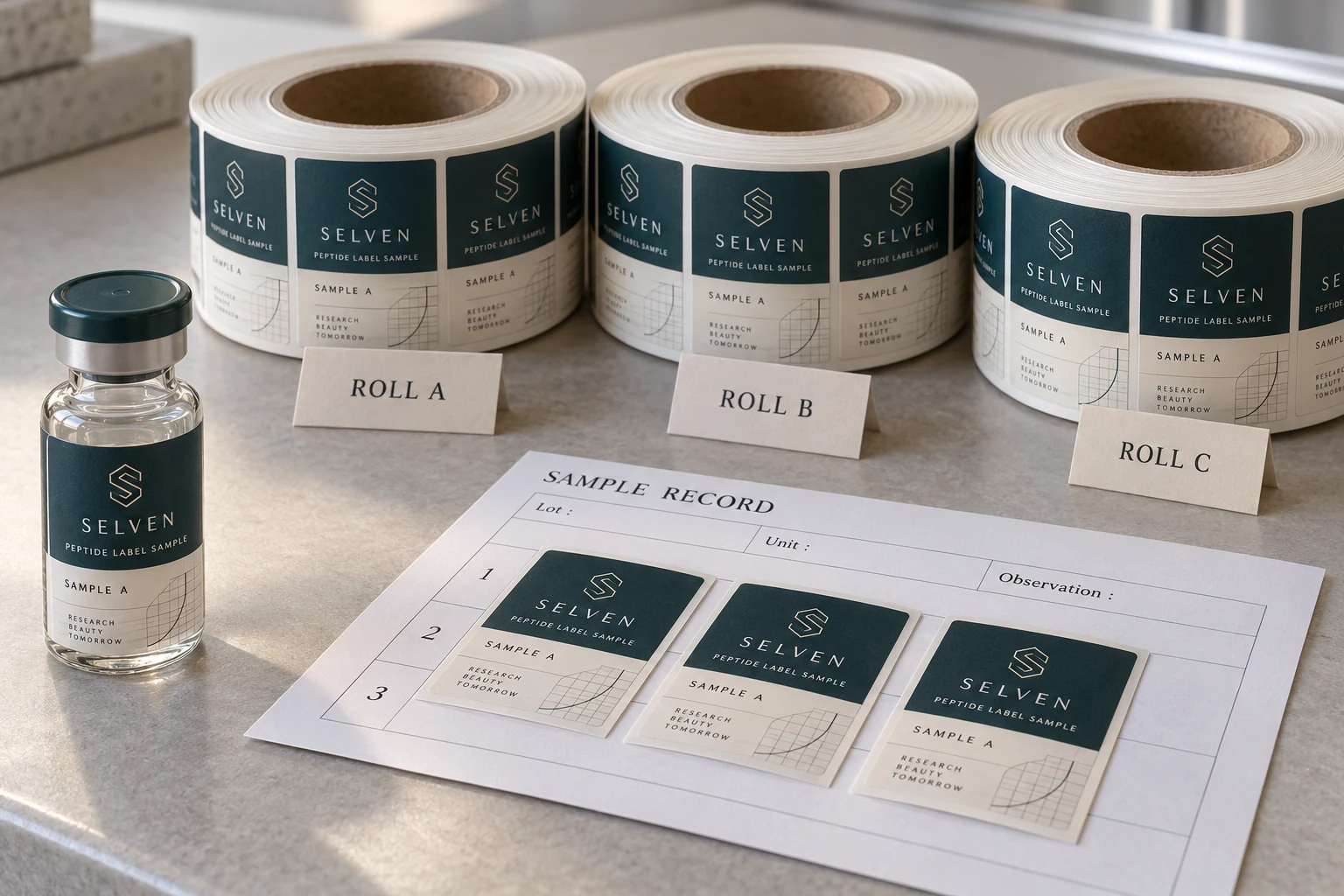
The separately identified rolls and specimens illustrate why a release record needs a defined lot and specimen origin. They do not show a completed inspection or establish how many pieces should be examined.
| Field | What the buyer and responsible team should define | What remains unresolved without it |
|---|---|---|
| Lot identity | Which production or delivery group the decision covers | Whether a result can be applied to other stock |
| Inspection unit | One finished label, a roll, a sheet or another stated unit | What a counted nonconformity actually refers to |
| Characteristic | The approved wording, dimension or observable condition | Whether different inspectors are judging the same thing |
| Selection | How specimens will represent the defined population | Whether convenient outer labels are being favored |
| Decision and authority | Agreed method, disposition and person responsible | Whether an observation authorizes use |
Keep each design identifiable. Combining several SKUs into one order total does not automatically justify treating them as one inspection lot. Equally, splitting every carton into a separate lot without a reason can create unnecessary work. The grouping needs an explanation tied to production information and the decision being made.
For custom peptide vial labels, make the proposed supply format and quantity per design available to the quality reviewer. A plan written for loose pieces may leave practical questions when the delivered stock is wound on rolls. Agree access to specimens without casually damaging or losing identification on usable stock.
Separate selection from the acceptance criterion
Write how a specimen will be located, removed where appropriate and linked to its roll or sheet. Selecting whatever is easiest to reach can conceal where the sample came from. Photographing the selected pieces afterward does not repair an undefined selection method.
Then agree what constitutes conformity for the characteristic. For artwork identity, the reference might be the released design and revision. For a dimension, it needs the actual specified dimension and accepted evaluation method. For appearance, a mutually understood reference or description is more useful than asking whether it looks premium.
Finally, document how the result changes stock status. A concern may call for holding the affected lot, further investigation or another agreed disposition. Do not quietly replace specimens until a clean group appears. Nor should purchasing invent a reject rule after seeing a result it dislikes. Record observations and let the agreed process govern the decision.
Two illustrative orders justify different arrangements
Imagine a small brand receiving one design for hand application. Its immediate task is an identity and visible-condition screen before a separate application review. If that limited purpose is explicit, a simple record may be appropriate. It should say what was examined and avoid presenting the check as statistical proof about every label.
Now imagine a packaging service provider receiving several repeat designs under an established quality agreement. It needs the correct lot boundaries, selection method, characteristic definitions and acceptance procedure, with the appropriate responsible person. Replacing that arrangement with a few photographs because the delivery looks familiar weakens the information needed for release.
These are illustrative purchasing situations, not RP Labels inspection results. The second example does not imply that every small order requires an elaborate system. The first does not justify ignoring a characteristic whose consequences require a more controlled approach. Risk and the intended inference determine what deserves review.
Keep screening, acceptance and performance evidence distinct
A visually clean sample does not establish cold durability, chemical resistance or suitability for a particular application line. Those questions require relevant construction and use evidence. If the open question is what a pre-order specimen represents, the printed-proof and material-trial guide helps separate those sample purposes.
Once the incoming arrangement is agreed, retain its version with the order. Record the actual lot references, inspected specimens, observations and disposition after delivery. The existing receiving-stock guide covers the practical handoff between arriving cartons and released stock. The sampling brief supplies the decision basis that a general receiving checklist cannot choose for you.
Questions to settle before the shipment
Can we choose a sample size from an online table?
Do not use an isolated number without the applicable plan and assumptions. Ask the responsible quality person to identify the method, lot basis, selection and decision criteria appropriate to the characteristic and order.
Does finding no problem mean there are no defective labels?
That conclusion exceeds a sample observation. Report what the agreed procedure permits you to conclude. Neither this article nor a photograph establishes a zero-defect guarantee for unexamined stock.
Should every SKU be a separate lot?
Not automatically. Keep identities traceable, then agree grouping using relevant production and supply information. A combined purchase order is not sufficient reasoning for combining the inspection decision.
What should go into the printing inquiry?
Use the project inquiry form to send the SKU list, quantity per design, roll or sheet format, required lot identification and any existing inspection procedure or characteristic definitions. Ask what information and representative specimens can be supplied. Agree the quality decision with the responsible team before turning an arrival check into permission to use the whole lot.