Vial Labels for a Contract Packer: Agree One Handoff
The brand approves the design. The printer prepares the labels. The contract packer is expected to make everything work on arrival. That arrangement leaves a gap if nobody has asked the packer what it actually needs before the print order is released.
I would bring the packer’s requirements into the buying brief before discussing a final production date. The purpose is not to add another approval meeting. It is to make the brand’s purchase instruction, the printer’s specification and the packer’s incoming job describe the same delivery.
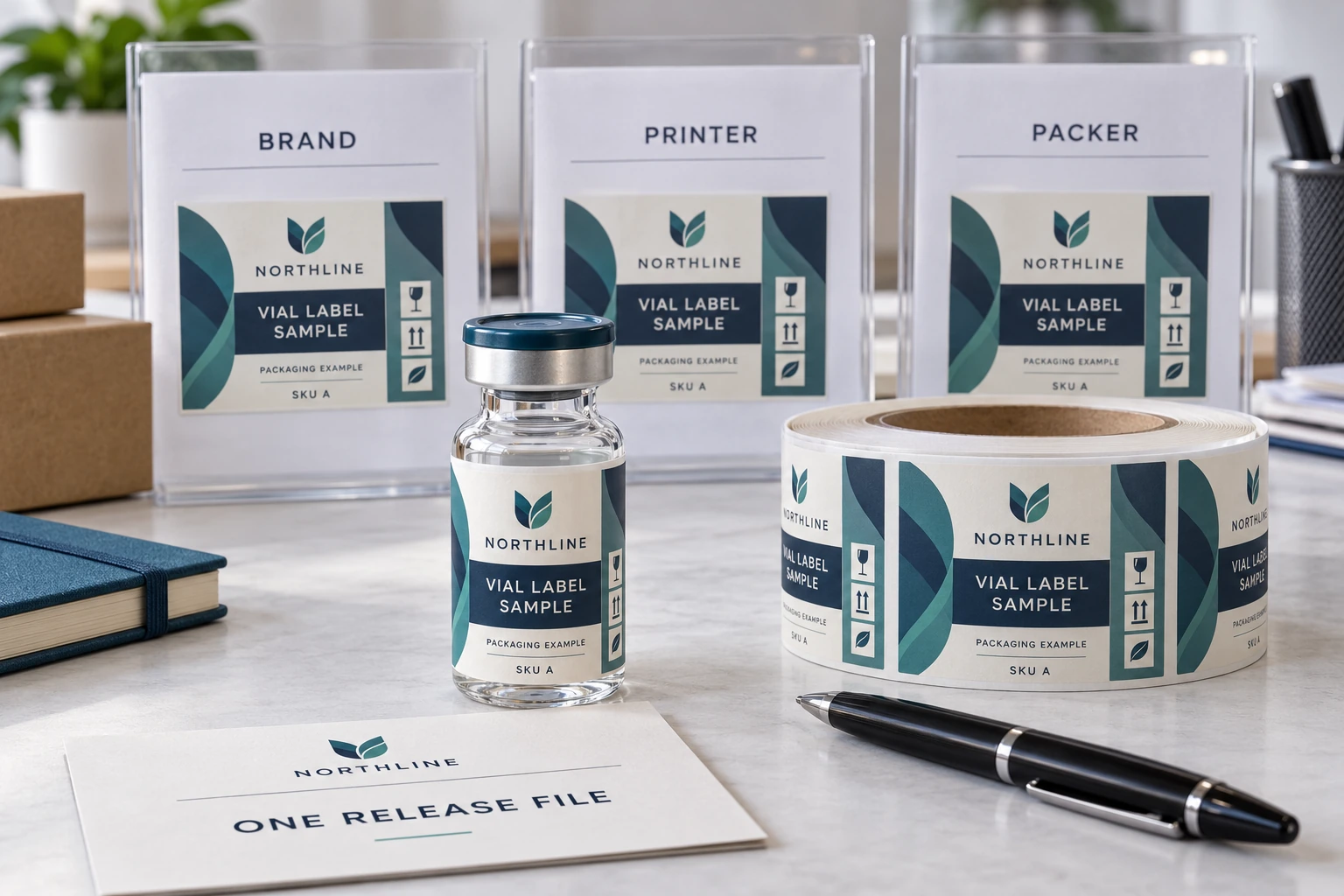
Give the three parties different responsibilities
The brand should identify who controls product wording, brand appearance and the commercial purchase decision. The printer should confirm the proposed label construction and supply specification. The packer should supply its receiving and application requirements and identify who can review compatibility. These are suggested handover roles, not a substitute for the parties’ agreement.
For custom peptide vial labels, this discussion concerns packaging printing and application. A print approval does not approve vial contents or replace the brand’s product responsibilities. Keep those decisions with the appropriately responsible people rather than allowing an artwork file to imply a broader authorization.
One person may hold several roles in a small business. The distinction still helps: signing off wording and confirming roll compatibility are separate tasks even when the same buyer coordinates both.
Obtain the packer’s brief before freezing the quote
Ask how the labels will be applied and which supplied format the packer can accept. If a machine is involved, obtain the relevant requirements directly from its operator or technical contact. Do not copy another packer’s setup because both facilities use roll labels.
Add the delivery address, receiving contact, booking requirements if applicable, job reference, identification needs and required arrival window. Ask how the packer wants different designs separated. Confirm who will receive the labels and who can authorize use; these may be different people.
The roll-label ordering guide deals with technical roll inputs. This handoff has a wider coordination job: deciding who supplies those inputs, who reviews the proposed response and which version becomes the order instruction. A list of machine dimensions without an owner can still be incomplete.
Compare a hand-applied trial with a scheduled packing slot
Consider an illustrative founder arranging a small hand-applied run with a local packing service. The packer may prefer a simple supply format and clear separation of designs. The founder benefits from confirming the actual handling method before ordering an unnecessarily complicated presentation.
Now consider an illustrative buyer with a reserved machine-labeling slot. The labels must arrive with the right job identification and an accepted supply specification. A familiar-looking roll that has not been reviewed can leave the booking exposed even if its printed artwork is correct.
These are coordination examples, not accounts of customer jobs. The second arrangement is not automatically better or more professional. It has different dependencies. The appropriate label purchase follows the real process and volume rather than the buyer’s preference for how a roll looks in a photograph.
Create one release pack everyone can identify
Give the release pack a job number and revision. Include the approved design list, quantity per design, container reference, confirmed construction and supply details. Identify who approved each area and what remains conditional. Keep superseded versions clearly separate from the release.
- Brand owner: approved wording and artwork references, with a named contact for corrections.
- Printer: confirmed proposed construction, finished format and packing identification.
- Packer: reviewed receiving and application inputs, plus any agreed trial requirement.
- Coordinator: delivery destination, dates, unresolved items and a consolidated release instruction.
Do not forward three unrelated message chains and expect the printer to decide which contradictory instruction wins. Consolidate the final requirements. If an unanswered point affects production, raise it before release rather than hiding it in an attachment the next reviewer may miss.
Treat arrival, trial and production start as separate milestones
Labels dispatched is not labels received. Labels received is not labels released for the packing job. A planned application trial may sit between arrival and production. Write these milestones separately when the schedule depends on them.
Ask the packer what happens if the shipment arrives late, contains a different presentation or requires clarification. Ask the printer how a changed specification affects the proposal. Agree who communicates the revised plan to each party. Do not promise the packer’s slot on the basis of an unconfirmed courier estimate.
For RP Labels, the existing business guidance describes typical production timing after final approval, with transport confirmed separately. A project involving another facility needs its own written schedule. The packer’s booking, customs handling and local receiving arrangements should not be silently included inside a printing lead time.
Make changes visible to every affected party
Suppose a buyer changes the container after artwork approval. Even when the visible wording stays the same, fit or application assumptions may need another review. A late change in roll presentation can also affect the packer without changing the label design. Route changes by their practical effect, not only by whether the PDF looks different.
Ask who must approve the revised item and whether earlier acceptance remains applicable. Save the new release reference with the order and delivery plan. A brief written update that names the difference is easier to act on than another attachment named final-new.
Questions before shipping labels to a packer
Can I send the printer the packer’s address and stop there?
An address does not identify application requirements, incoming job references or release responsibility. Obtain the relevant requirements and confirm how the shipment will be received and matched to the packing job.
Who approves the artwork?
Nominate the brand’s authorized approver for content and appearance. Separately identify who reviews the construction and application inputs. Agree how their approvals are consolidated into one production release.
Does a reviewed roll specification remove the need for a trial?
Not necessarily. Discuss any trial requirement with the responsible packer and supplier. A supplied specification and a physical application observation answer different questions.
Bring the packer into your next inquiry
Use the quote form to send the vial reference, artwork status, quantity per design, packer’s supplied requirements and required arrival window. Identify one coordinating contact. Ask RP Labels to review the printing specification alongside the handoff needs. The best handover is the one in which nobody on the receiving end has to guess which file, roll or date the other two parties meant.