Static During Label Dispensing: Bring the Packer into the Liner Decision
Describe the event before naming the fault
A label behaves unpredictably near the dispensing point, or particles seem to collect on the web. Someone calls it static and asks purchasing to change the liner. That may be a useful investigation, but the description is not yet a confirmed diagnosis or a complete replacement specification.
Start with the packer’s observation of where and when the event occurs. Record the actual stock and equipment context, then ask the material and equipment specialists what information would distinguish static-related behavior from detection, release or mechanical handling problems. Purchasing should coordinate that review without prescribing electrical adjustments.

Keep observable behavior in the first report
Useful descriptions include a separated label following an unintended path, the web attracting loose material or a repeatable handling interruption at a particular stage. State whether the event was directly observed, reported by an operator or inferred from a later result.
Identify the roll, liner proposal, label dimensions, finish and equipment arrangement. Record known environmental or process changes without inventing measurements. “The room felt dry” is different from a logged humidity record, and neither alone proves the cause.
Preserve an unused stock sample and the relevant operating record. Ask the packer whether a short video can safely show the sequence. A video is a communication aid, not a substitute for the equipment provider’s assessment or an authorization to operate outside the approved procedure.
Separate neighboring explanations
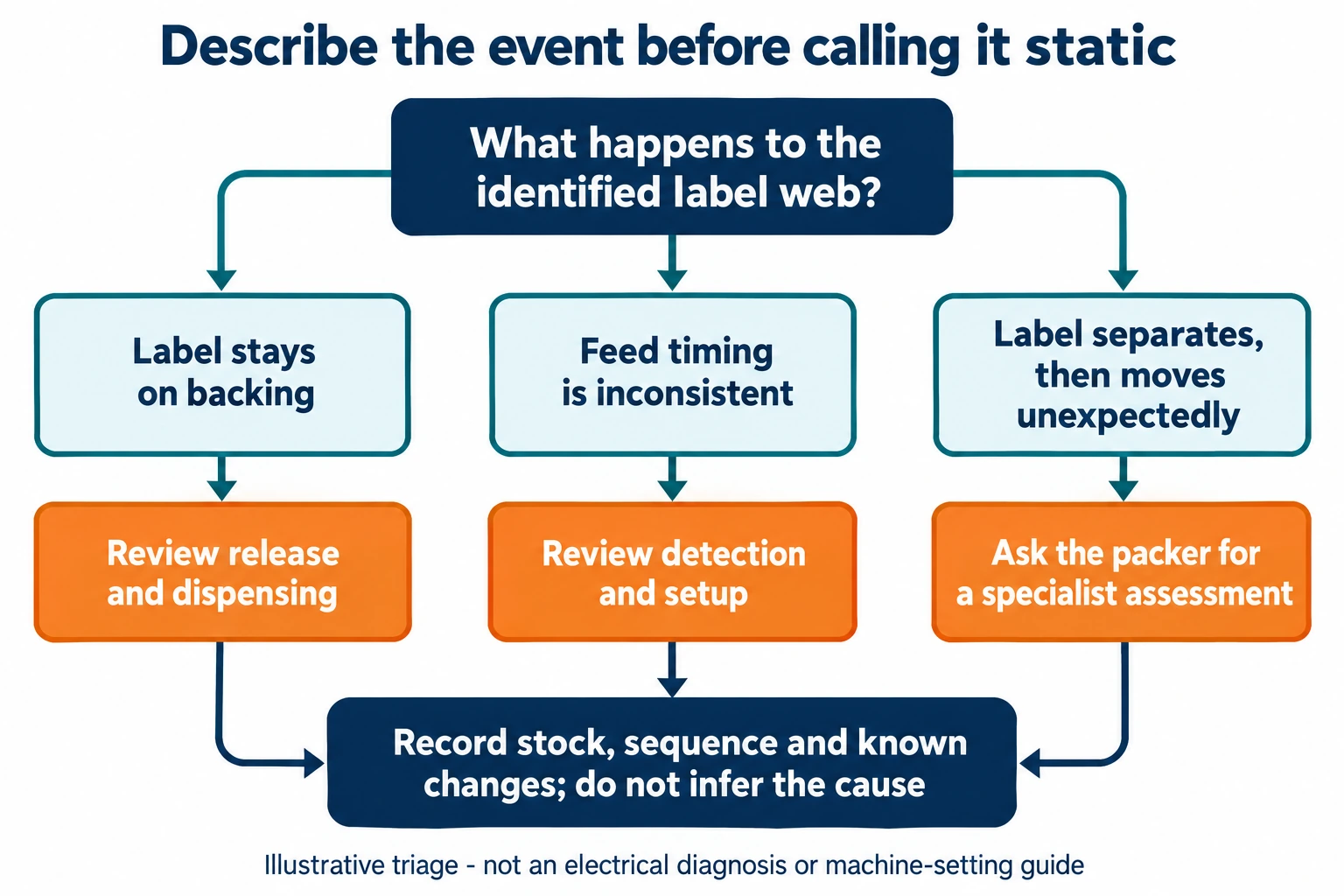
| Observed event | Question to investigate | Why an immediate liner change may be premature |
|---|---|---|
| Label remains on backing | Release and dispensing interaction | The event may occur before the suspected static effect |
| Label separates but timing is inconsistent | Detection and feed requirements | Clear or reflective construction can raise separate sensing questions |
| Web or label moves unexpectedly after separation | Packer’s handling and static assessment | Actual equipment and material conditions are needed |
| Loose particles appear on stock | Source and stage of the particles | Visible debris does not identify the attracting mechanism |
The same event can have more than one contributor. Ask the specialist what observation would change its recommendation. A proposal that names a new liner without explaining the relevant requirement leaves the buyer unable to judge whether the change addresses the problem.
Turn the description into a sequence record
For a fictional roll R7, “static problem” is an explanation to investigate. “The label stays on the liner” and “the label separates, then moves toward another surface” are different observations. Keep the sequence intact and state which stock and operating record it describes. Neither sentence, by itself, identifies the cause.
Meech’s bottle-labeling application note describes static associated with adhesive-label separation as a possible source of alignment problems. It is a manufacturer application example, not evidence that the event on R7 is electrical or that a particular device fits your line. Equipment changes belong to qualified personnel and the applicable instructions.
If the uncertainty is whether the machine sees the label transition at all, the detection review guide helps specify that separate task. If a different backing is actually proposed, use the liner comparison guide to retain the complete construction and packer’s requirements. Do not let an early nickname select the replacement material.
Treat the liner as part of the complete supplied system
A liner change can affect more than the suspected static behavior. The packer may need to reassess detection, release, web handling and finished roll dimensions. Confirm the actual proposed construction rather than asking for a broad family name and assuming all versions are equivalent.
For custom vial labels, send the packer’s requirements before material approval. The converter should explain the available proposal and any unresolved compatibility questions. This article does not establish that RP Labels supplies an antistatic construction or a particular equipment solution.
If the issue concerns equipment grounding, ionization or another electrical measure, the competent equipment personnel must handle it through the appropriate procedure. A purchasing article cannot supply a safe universal setting or installation instruction. Keep the buyer’s action focused on evidence, responsibility and approval.
Two illustrative investigations
In one hypothetical project, a clear label is intermittently missed by the detection system, while its physical release appears consistent. The operator initially describes the behavior as static. A sensing review may be the more relevant first step. Replacing the liner without documenting detection requirements could leave the same interruption unresolved.
In another project, the label separates as expected but behaves differently after a documented change in material and operating conditions. The packer requests a specialist assessment of the material-equipment interaction. Here, a proposed construction comparison may be useful, provided the samples and conditions are identified and other changes are recorded.
Neither example diagnoses an actual machine. They demonstrate why a familiar word should not replace the sequence of events. The buyer can help by making the sequence clear and ensuring the correct parties receive the same information.
Make a proposed trial interpretable
Agree the purpose of the trial before ordering samples. Identify the candidate construction, the original reference and the packer’s relevant process. State which observation the comparison should address and who will decide whether it is acceptable.
If equipment settings or conditions change during the comparison, record them. A successful result with both new stock and a changed setup may support that combined arrangement, but it does not show that the liner alone solved the issue. That limitation matters for future orders and other packing locations.
A fair alternative may be retaining the existing construction if an independently identified process issue is resolved and the relevant review supports it. Another may be changing the construction after specialist assessment. Do not automatically choose the more expensive stock or treat the cheapest change as sufficient.
Keep the approved scope with the reorder
Record the accepted material reference, finished roll arrangement and the equipment context of the approval. Note any conditions that the packer says require renewed review. The same artwork on another liner or another line is not automatically the same approved combination.
Keep actual interruptions, tested observations and unconfirmed explanations separate in the record. That avoids turning an early operator description into a permanent claim about the supplier’s material. It also gives a later reviewer a useful starting point if the behavior changes.
Frequently asked questions
Does changing to a different liner family solve static?
No universal result is established. The actual material and equipment interaction needs assessment, and a liner change may introduce other compatibility questions. Ask for a defined proposal and representative review.
Should purchasing request an antistatic device?
The equipment specialist should determine whether a device or another measure is appropriate. Purchasing can request a supported proposal, scope and responsibility, but should not prescribe electrical modifications from a label symptom.
Can a video prove the cause?
It can show the sequence and help the specialist ask better questions. It cannot independently establish the electrical, material or mechanical cause without the relevant assessment.
Send the sequence and system identity
For a label project review, provide the stock reference, construction, dimensions, packer requirements, observed event and known changes. Include the quantity per design and an identified sample. Ask which material comparison is appropriate after the packer’s assessment, rather than requesting an unsupported universal fix.