From Test Data to Printed Vial Labels: Approve the Production Source
A good test preview can leave the wrong source connected
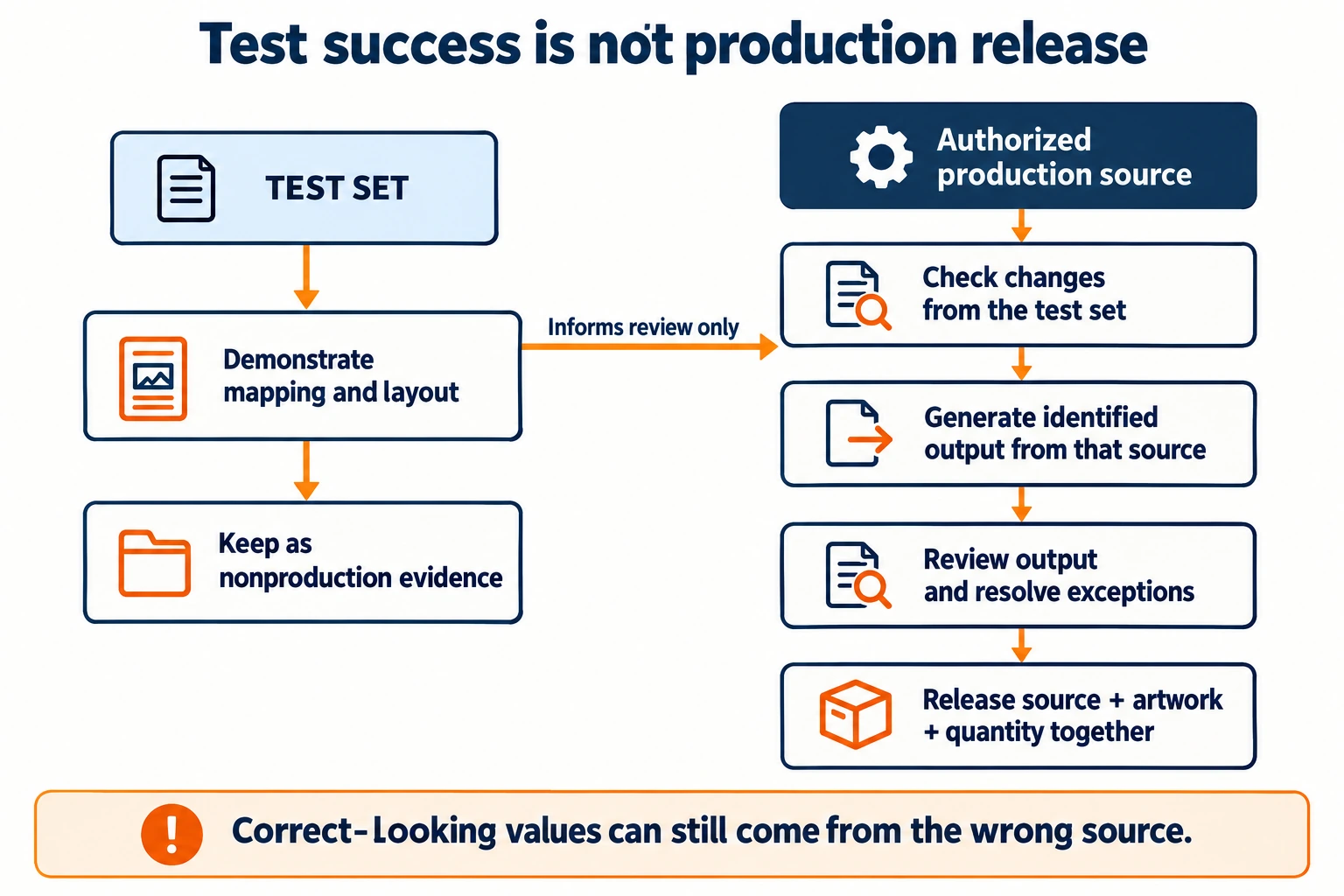
The test merge looks correct: the identifier fits, the wording is readable and each example lands on its intended design. The real dataset arrives afterward. Before printing, the buyer still needs to confirm which source generated the actual production output. Reopening the accepted test preview cannot answer that question.
I would make production release a separate gate tied to an identified source, template and output. The decision is whether that combination is authorized for this job. It is possible for every visible character to be plausible while the output still contains demonstration values.
This guide concerns packaging-data handover. It neither assigns product identifiers nor establishes an RP Labels variable-data validation, database or automated reconciliation service. Confirm what preparation and checking the proposed supplier can actually support.

Give the demonstration an explicit nonproduction status
Use safe representative values to answer defined questions: field mapping, longest permitted text, leading zeros, blank-field behavior or layout. Mark the file and accompanying instructions as test material. State the purpose so a successful demonstration does not become evidence for checks it never performed.
Keep test records distinct from the production release path. Different names help, but names alone are insufficient: a file called production can still contain copied examples. The responsible owner must identify the actual source and the authorization attached to it.
Avoid sending confidential records just because they are convenient. Legitimate non-sensitive examples can often answer an initial transfer or layout question. Confirm the recipient and relevant information-handling arrangements separately before supplying authorized production data.
Create a manifest for the combination being released
A manifest can be a short acknowledged table. Its purpose is to connect things that are otherwise approved in separate messages. The entries below describe fields to fill, not a real dataset or a validated printing system.
| Release field | Record the actual reference | Who resolves uncertainty |
|---|---|---|
| Demonstration | Test set and the limited questions reviewed | Buyer and workflow reviewer |
| Production source | Fixed data version and authorized owner | Data owner |
| Template | Artwork revision and field-to-design mapping | Artwork/output preparer |
| Generated output | Output reference and source version used | Output preparer, acknowledged by reviewer |
| Exceptions | Outstanding mismatches and their agreed status | Responsible owner for each issue |
| Release | Approved combination and quantity per design | Named production approver |
Ask the output preparer to identify the active source used for the delivered production output. Compare that statement with the output and authorized data under the agreed review method. A screenshot of a selected source path can support a record, but it does not prove every generated label is correct.
The leading-zero handover guide explains exact-character preservation through export and import. This release manifest asks another question: even if those characters survive, are they from the production source that the owner authorized?
Compare the real data with the tested field envelope
Production values may introduce longer strings, different characters, permitted blanks or a new combination of fields. Compare those characteristics with the demonstration. Do not assume a template tested on short values has already shown how the longest authorized value will appear.
Keep data content and layout suitability separate. A correct long identifier may need a layout revision; shortening the identifier without authority would create another problem. The data owner approves values and permitted transformations. The artwork team assesses a feasible arrangement for those approved values.
Record any changed input format or mapping. If the demonstration used one field as the visible identifier and the real file supplies another, resolve that difference before output release. Do not ask the printer to infer a business relationship from similar column names.
Review output from the production source
Request the agreed production review output, identified with the source and template references. Include representative cases that expose the actual differences from the test set. Agree who performs complete-file reconciliation, what it covers and how unresolved exceptions block or limit release.
Representative checks are useful demonstrations; they are not a statement that every record passed. Likewise, equal source and output counts do not establish correct content or mapping. A duplicated record can replace an omitted one while leaving the total unchanged.
Where symbols are used, the payload and printed-text comparison guide addresses their relationship on the same specimen. That relationship can be correct for a test value and still be the wrong production record. Keep source authorization and field consistency as separate checks.
This article prescribes no sample size, universal software control or automatic quality guarantee. The responsible team should agree review scope appropriate to the actual job. If a provider cannot support the required path, resolve that gap before releasing the merge.
Two illustrative errors need different corrections
Imagine a demonstration containing short identifiers. The production source is correctly selected, but its longest valid value overflows the allocated panel. The useful correction concerns the layout and affected output. Replacing the production source with shorter test values would hide the requirement instead of meeting it.
Now imagine suitable production values in the same structure, but the output process still points to the test set. The template can look perfect. The correction is to generate and review output from the authorized production source, rather than approve another screenshot of the demonstration.
These are fictional situations, not actual incidents or measured losses. A third, simpler case deserves a fair alternative: if every label genuinely needs the same fixed approved string, ordinary fixed artwork may be sufficient. A merge adds no value merely because variable printing sounds more capable.
Keep late changes outside the released combination
If another dataset arrives after sign-off, identify its changes and ask for actual work status. A new attachment does not stop printing already released under an earlier source. Obtain acknowledgement of any feasible hold, revised output and renewed release before treating the change as implemented.
Preserve the approved source and output. Corrections should have an identifiable revision, reason and authorization. Quietly editing a received file until it fits can leave the buyer unable to explain which values were actually approved.
Keep the test evidence as test evidence for later troubleshooting. Preserve the production manifest separately with the artwork release checks. The next reorder needs its own source identity; a previous successful handover does not approve future data automatically.
Questions about the production-data gate
Does approving the test merge approve the real dataset?
It supports only the demonstrated path and examples within their stated scope. The actual production source, generated output and unresolved exceptions need the agreed release review.
Is a file checksum enough?
It can help distinguish exact file versions when the parties use it correctly. It does not approve the values, prove that the output used that source or establish correct row-to-design mapping.
Should the provider repair a missing identifier?
Report the exception to the authorized data owner. A plausible value inferred from nearby rows is not an approved correction. Record any authorized transformation and reissue the affected output as needed.
Ask how the actual source reaches production
For custom vial labels, submit a data-printing inquiry with a clearly marked safe test set, field definitions, design mapping, dimensions and quantity per design. Name the production-data owner and ask how the supplier distinguishes test, received, reviewed and released sources. Agree that scope before sending the final authorized dataset.