One Wrap or Front-and-Back Vial Labels? Compare the Whole Application Job
The front of a small vial is valuable space. A buyer wants a recognizable brand, a clear identifier and room for approved secondary information. One wrap label keeps those elements on a single piece. Separate front and back labels create two panels, but also create two pieces that must be ordered, matched and applied as a system.
I would choose between them by reviewing the complete labeled vial and the application task together. Neither architecture is automatically more professional or economical. The useful choice is the one that carries the approved information clearly and can be supplied and applied through the actual packing arrangement.
Start with information, not a preferred rectangle
List what the buyer has approved for the main panel and what belongs in secondary areas. Keep product wording and any market-specific review with the responsible buyer. This article addresses packaging architecture; it does not determine which statements a product must carry or approve claims about vial contents.
For custom peptide vial labels, decide which identifier should be visible from the main viewing angle. Then assess how the rest of the information will be found when the vial is turned. A flat wrap proof shows the whole composition at once; the wrapped container presents only part of it.
With two labels, establish what connects the front and back. A consistent product code and revision relationship can help the packing team identify the intended pair. Do not rely on similar colors alone where several designs are handled together. A beautiful front label does not compensate for an uncertain back-label identity.
Compare the labeled vial and the loose pieces together
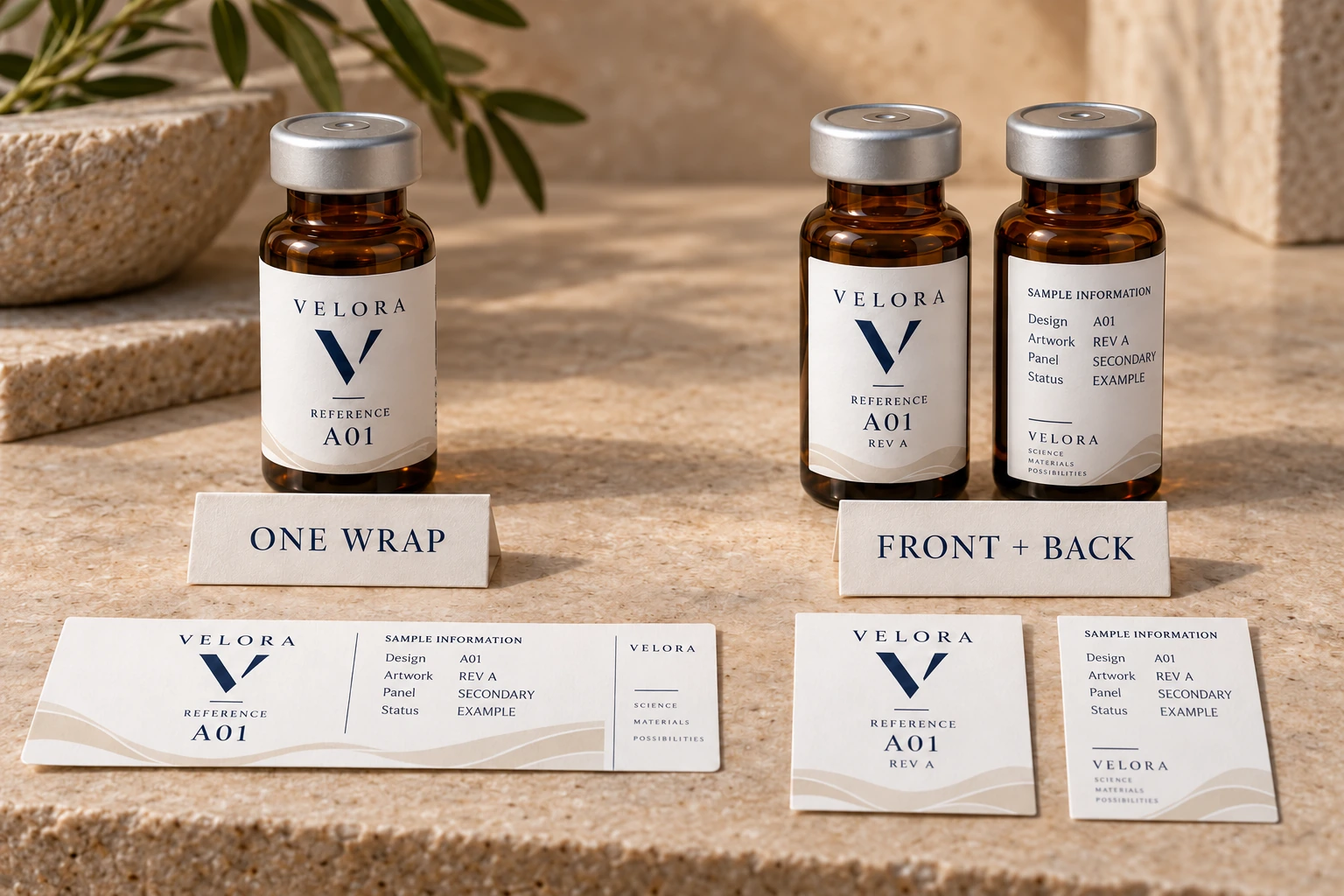
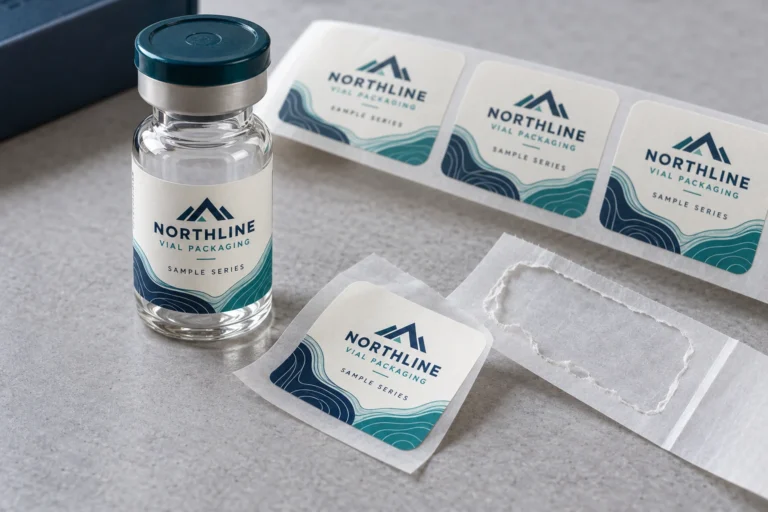
Review a one-piece wrap and a two-piece alternative at actual size on the intended container. Beside each vial, lay out the loose pieces that would be supplied. This simple comparison makes the quantity and handling difference visible instead of letting a rendered front view decide the order.
| Purchasing question | One wrap | Separate front and back |
|---|---|---|
| Pieces per vial | One identified artwork piece | Two identified pieces forming a pair |
| Information placement | Shared continuous layout around the body | Distinct panels with a relationship to maintain |
| Application review | Wrap position and seam | Both positions and their relationship |
| Quantity record | Labels required for the vial count | Front pieces, back pieces and complete usable pairs |
Confirm the dimensions and fit of each option. The vial measurement guide explains how to establish a starting area from the actual container. It does not choose the number of pieces for you, and a nominal vial capacity cannot settle either option’s dimensions.
Ask who can apply the proposed system
A two-piece layout needs a workable method of placing both labels. Tell the printer and packer whether application is by hand or by a specified machine arrangement. Ask the application team to review the proposal before treating two separate artwork files as a finished solution.
Keep equipment capability conditional. A line that handles an accepted wrap arrangement is not automatically approved for a second label or a particular relationship between panels. Obtain the operator’s requirements instead of assuming a design change can be accommodated without another review.
For hand application, assess how the person will identify the pair, hold the vial and place the pieces. A positioning aid or another approach may be worth discussing with the responsible team, but this guide does not establish that any particular fixture or service is supplied. Review the real process rather than adding an imaginary step to the packing plan.
Count complete sets before comparing piece prices
Two separate labels make two order lines or otherwise clearly identified requirements. State the quantity of each design and the number of complete pairs needed. A combined piece total can hide a shortage on one side. Confirm how the supplier defines minimum quantities and any agreed usable-count requirement for each component.
For illustration, if a packing plan needs one front and one back on each vial, surplus fronts do not replace missing backs. This is a counting relationship, not an RP Labels order example or a waste prediction. Agree how spare stock, approved quantity allowances and later replenishment will be handled for the actual job.
Compare the confirmed printing and application scope, rather than dividing the invoice by the largest piece total. Do not assume that a smaller front label makes the whole system cheaper. Equally, do not reject two pieces solely because there are two artwork items; the arrangement may meet a genuine presentation or packing need.
Two illustrative buyers can reasonably choose differently
Consider a small brand with one vial format, stable wording and a hand-application process already suited to a wrap. Keeping one piece may simplify the release and stock relationship. The buyer still needs to review the seam and the reading area instead of making the logo larger until the secondary text becomes difficult to find.
Now consider a buyer whose approved presentation calls for a distinct front panel and a separate information panel. Two coordinated pieces may suit that layout if the intended application method can position them appropriately. The buyer should make the extra matching and quantity requirements explicit before asking for price comparisons.
These situations are illustrative. They do not establish a measured labor saving, an error rate or a universal recommendation. The better option is the one whose information and application requirements can actually be accepted, with the quotation describing the whole system.
Release the pair as a pair
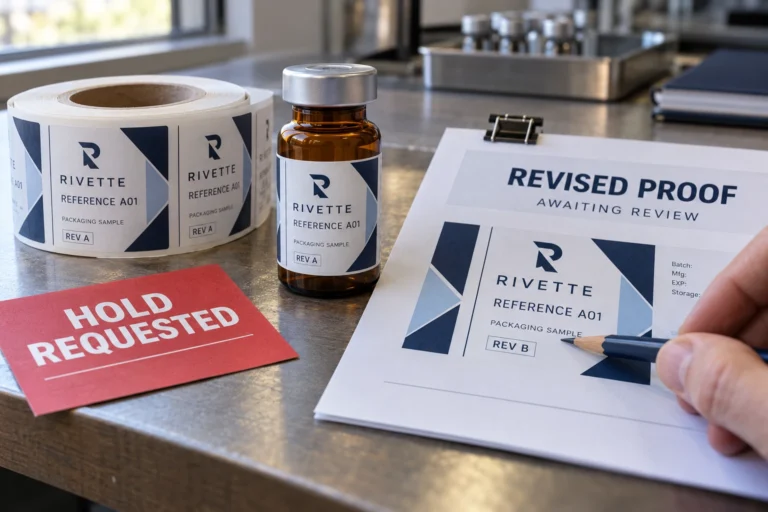
For a two-piece system, keep a release record naming both artwork files and revisions. If only the front changes, state whether the existing back remains the approved partner. Do not let two independently valid files become an unintended combination at the packing table.
Review physical stock as well as files. Identify whether earlier pieces will remain available and how they will be distinguished from a revised version. The goal is not an elaborate system; it is a clear answer when someone asks which back belongs with this front.
Questions about one-piece and two-piece vial labels
Is a wrap always easier to apply?
Do not assume it. Review the actual container, construction and application method. One piece reduces the number of components, but that alone does not prove a better application result.
Can I reuse one back label across several fronts?
Only if the responsible buyer approves the information relationship. Identify compatible pairs explicitly and review whether the shared back remains correct for each design.
Does a two-piece system qualify as one design for minimum quantity?
Ask for confirmation. RP Labels’ 100-piece starting quantity is subject to each design and specification. Do not assume two separate pieces share a minimum or may be mixed arbitrarily.
What evidence is useful before ordering?
An actual-size layout helps assess information and position. Where material and application behavior matter, request representative evidence for those questions separately. A packaging illustration does not prove either.
Ask for the complete arrangement
Send vial dimensions or a sample reference, approved information hierarchy, application method, artwork status and required vial count through the quote form. Request quantities for each piece and complete usable pairs where relevant. Ask the supplier to confirm which arrangement it can offer before releasing the final artwork.