Vial Labels and Tray Clearance: Check the Finished Package
The bare vial is not the finished outside envelope
The empty vial fits its tray pocket. Later, the buyer approves a label with a different construction or a local overlap. Before releasing the printing job, check whether the finished labeled package still works with that same tray or sleeve. A bare-container fit leaves the added layers and their location unexamined.
I would review the actual labeled vial in the intended holder, locate contact at label and seam height, and identify which component can reasonably change. Do not assume that a small label change has no effect, or that every contact automatically requires a thinner label.
This is a packaging fit check, not a universal clearance calculation. The appropriate dimensions, permitted contact and acceptance method must come from the actual component design and responsible packaging team. It is not advice to alter a vial, closure or product storage requirement.
Separate vial fit from tray fit
The vial measurement guide helps establish the usable labeling area, circumference and intended seam treatment. That determines whether the proposed label fits the container. It does not establish whether the finished container fits a separate, close-fitting holder.
For the holder question, identify where the pocket or sleeve contacts the vial. Contact may occur below the label, across its body or near a local seam. The same general description tight fit can conceal different geometries. An upper retaining feature and a straight-sided pocket are not necessarily controlled by the same part of the package.
Label construction adds material outside the bare container where it is applied. A local overlap can add a different buildup from a single-layer region. That basic geometric observation does not supply a clearance value or predict the actual fit. Flexible components, container variation and the packing arrangement still need physical assessment.
Review the components as one identified set

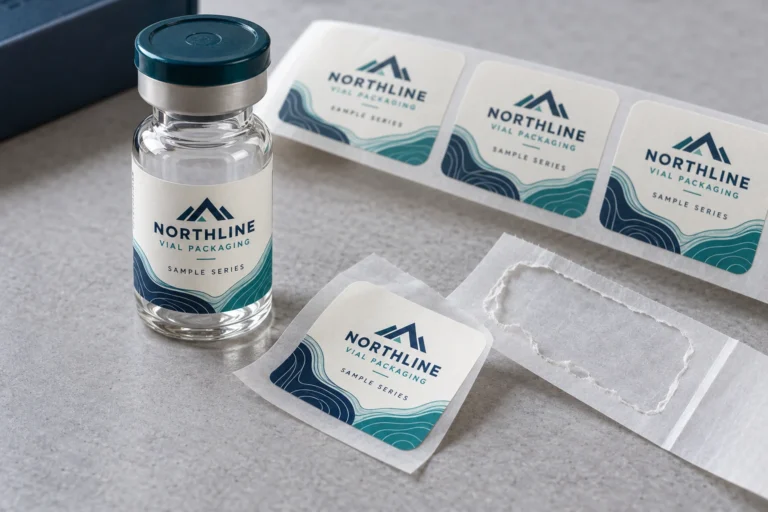
The scene identifies the bare vial, labeled vial and holder as separate components. It does not show a measured clearance or prove an acceptable fit. The actual contact and local seam still need examination in the intended package.
| Component or condition | What to identify | Observation needed before changing it |
|---|---|---|
| Vial | Actual container reference and relevant variation | Where the holder contacts the container |
| Label | Finished construction, size and applied position | Whether contact falls within the labeled area |
| Seam | Agreed gap or overlap and orientation | Whether a local buildup meets a contact feature |
| Holder | Intended tray, insert or sleeve reference | What fit and removal behavior its owner permits |
| Packing sequence | How the finished vial enters and leaves | Whether the intended movement creates an issue |
| Change authority | Owner of each component | Which alternative can actually be approved |
Use representative actual components where the decision depends on physical interaction. A drawing can identify intended dimensions and contact locations, while a paper label mock-up can help explore position. Neither automatically represents the final adhesive construction or the holder’s behavior.
Retain the label construction reference with the trial set. Two equally attractive printed samples may have different layers or local finishing. If the proposal changes after the review, ask whether the earlier fit observation still represents the offered package. The artwork file alone cannot answer that.
Locate the interference before selecting a remedy
With the responsible packaging team, observe the package under the intended safe packing and removal procedure. Do not force a sample to demonstrate that it fits. Record where contact or resistance is observed, which specimen is involved and whether the label or holder shows a visible change.
Compare the bare and labeled specimens only to isolate the added-package question. They should represent the same relevant container and holder references. A random bare vial that happens to slide easily does not establish that every container in the order has the same geometry.
If contact occurs outside the label area, changing label thickness may not address it. If it is localized at the seam, review that location and its permitted alternatives. If it extends across the whole labeled region, the complete construction and holder dimensions deserve attention. These are investigation branches, not diagnoses supplied by a photograph.
Give more than one component a chance to change
An available alternative label construction may be appropriate if it still meets the approved appearance, handling and application needs. Ask the printer what is available and what must be reviewed again. Do not remove a protective layer simply to reduce buildup without checking the job that layer was intended to do.
A holder or packing-layout revision may be the better route if the label is an accepted stable component and the holder can reasonably accommodate it. That requires the holder owner’s approval. It is not evidence that RP Labels supplies trays or redesigns third-party packaging.
Placement or seam orientation may also deserve review where the product and process permit it. Keep the approved brand panel and operational information usable. Moving a seam out of one contact area should not create a new reading, fit or application problem elsewhere. Ask the relevant people to review the complete change.
Two illustrative packages show why location matters
Imagine a brand changing to a locally built-up finish on a vial that enters a closely fitted insert. The contact is at the decorated body area. The buyer needs a representative finished construction with the insert before treating a bare-vial fit as sufficient. Both a suitable label alternative and an approved insert change may deserve comparison.
Now imagine a holder locating the vial only in a region below a smaller front label. The proposed label does not occupy that contact area. The buyer should still review the real combination, but a label-thickness change may not address the concern being reported. Container or holder variation could be the more relevant question.
These are illustrative geometric situations, not measured pack-out trials. If the existing labeled package already has relevant accepted evidence and no component or packing change, confirm those references rather than restarting an unnecessary redesign. Evidence of a changed combination is what calls the earlier assumption into question.
Keep clearance and surface scuffing distinct
A package may fit the holder while rubbing a decorative area. Conversely, a surface may remain attractive while insertion is unsuitable for the intended operation. The pack-out scuff review addresses the surface-contact consequence. It does not set the holder’s permitted mechanical fit.
Record the combined approval with the container, label and holder references, applied position, seam arrangement and packing sequence. State what was observed and which questions remain open. Keep a change to one component visible to the parties responsible for the others.
Questions about labeled-package clearance
Can the nominal vial capacity determine tray fit?
No. Use actual component references and relevant dimensions. Capacity does not identify the bare outside geometry, let alone the completed labeled package and its local seam.
Is there a standard extra allowance for every label?
This guide establishes none. The actual construction, holder design, component variation and permitted behavior determine the review. Obtain the appropriate dimensional and acceptance requirements from the responsible team.
Should the label always become thinner?
No. First locate the concern. A different construction, approved holder change or permissible placement revision may address different causes. Any change must preserve the label’s other accepted requirements.
What should the printing inquiry include?
For custom peptide vial labels, submit the actual vial and holder references, relevant drawings or samples, label construction, intended seam and position, packing sequence and quantity per design through the project inquiry form. Explain the observed contact location and ask which available label proposal can be reviewed with the complete package.