Bottle Labels or Direct Container Printing? Decide Where Each SKU Commits Stock
Choose bottle labels or direct container printing by comparing when the order commits physical bottles to each SKU, and who completes the remaining work. A separately printed label can let an approved neutral bottle remain unassigned until application. A directly decorated bottle may already carry one design when it arrives. Neither arrangement is automatically cheaper: compare usable, decorated containers at the same packing destination, with the stock and responsibilities visible.
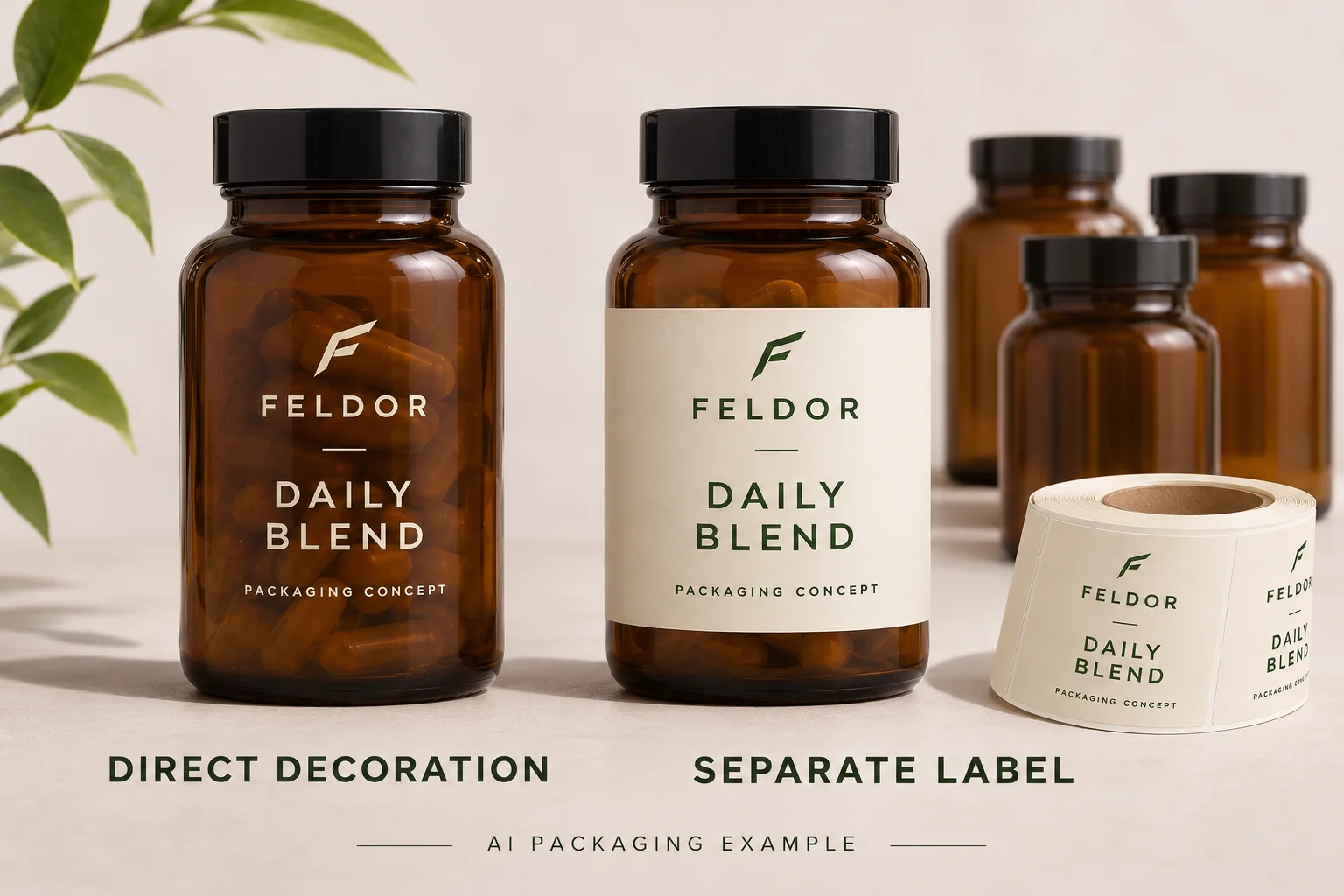
The important difference is where stock becomes specific
For a brand testing several supplement products, the expensive uncertainty may sit in the container order rather than the label unit price. A bottle carrying one product’s printed wording is no longer neutral stock for the whole range. Separately printed labels also commit money to individual designs, but they do not necessarily commit the bottles at the same moment.
A shared brand mark printed directly on every bottle may leave SKU assignment open if approved product-specific information is added later. Conversely, applying separate labels early can commit the bottles early. Compare the actual wording and operation sequence, rather than treating either decoration method as inherently flexible.
That distinction reflects a real adjacent-industry question. In an October 2024 Reddit discussion, a self-described small skincare business wanted direct bottle printing while questioning the container commitment across its products. This is one person’s reported situation, not an RP Labels customer, verified business record or measure of market demand.
Use the question to examine your own order. Do not copy the poster’s quantities or another supplier’s minimum as an industry rule. Obtain actual terms for the container, decoration and label specifications you are comparing.
Put both proposals at the same delivery stage
Ask what each quote delivers. One offer might supply decorated empty bottles ready for the next agreed operation. Another might supply neutral bottles and separate printed labels, leaving transport, storage and application to the buyer. A label-printing quotation is not a quotation for a finished, labeled bottle.
Berlin Packaging’s decorating and labeling page lists screen printing and pressure-sensitive label application as separate services, alongside a route that ships printed labels for customers to apply. These are useful examples of different delivery scopes. They do not establish RP Labels’ services, another supplier’s minimums or a general cost advantage.
| Comparison field | Directly decorated bottle proposal | Neutral bottle plus separate label proposal | Evidence to request |
|---|---|---|---|
| Delivered unit | Identify the exact decorated container and whether other work remains | Identify bottle supply, printed-label supply and application separately | Written scope and receiving destination |
| SKU commitment | State quantity already carrying each approved design | State design-specific labels and bottles assigned at application | Per-SKU quantities and allocation record |
| Remaining work | Identify receiving, inspection and any further packing tasks | Add label receiving, version picking and application | Named party for each operation |
| Physical acceptance | Review the decorated bottle against its actual use | Review the complete applied label on the intended bottle | Representative specimen and agreed observations |
| Revision route | Confirm whether affected decorated stock has any accepted alternative use | Separate unused labels, neutral bottles and already-labeled bottles | Written change and stock-status decision |
Do not add a fictional labor rate to make one route win. Use your own records, a packer’s actual proposal and supplier quotations. Leave missing costs or responsibilities open rather than disguising them as zero.
Build a stock-commitment worksheet for each SKU
Start with the next defined purchasing period, not an imagined future sales volume. Enter the quantity each SKU is currently authorized to require, the artwork revision and the intended bottle reference. Mark forecasts as forecasts. Then collect the following inputs for both routes.
First, record how many containers must be purchased and how many must be decorated for each design now. Identify any neutral remainder separately. Ask whether a later decoration release is actually available rather than assuming that an order can be staged after it has been accepted.
Second, record the design-specific label purchase and the planned application quantity. Identify where application occurs and who controls the release. The bottles may remain neutral in your warehouse while becoming SKU-specific before shipment from a packer. Use the real point of commitment, not the point that makes the purchasing sheet look most flexible.
Third, record the stock that would remain if a named SKU needed less packaging than forecast, or its wording changed before use. Keep decorated bottles, unused labels, neutral bottles and already-labeled bottles in separate fields. Do not assume that existing print can be removed or covered acceptably. Any such proposal needs authorization and a physical review.
Fourth, name the owner of each stock balance and its storage location. If several designs can share one neutral bottle reference, count that pool once. Showing the entire available pool against every SKU would invent capacity that does not exist.
The shared-pool branch is available only when the buyer has approved the same container and closure for the relevant products, and the physical stock remains suitable and unassigned. Different geometry, material, closure or accepted product requirements may prevent sharing. A similar bottle photograph does not establish interchangeability.
If the container cannot be shared, compare the routes as separate SKU-specific supplies. If application responsibility is missing, pause the label-route total. If a direct-print proposal does not identify the decorated quantities or accepted specimen, pause that comparison too. Neither incomplete proposal is ready to be selected on price alone.
Allow either route to win
A stable SKU with a confirmed container, approved wording, acceptable decorated sample and workable replenishment terms can justify direct printing. The buyer may prefer the resulting appearance and a delivery that removes a separately managed application step. Confirm what is included; no particular printing method guarantees durability merely because ink is placed directly on the bottle.
Separate labels deserve consideration when a genuinely shared container pool has value, several designs are still being tested, and application can be completed reliably at a known cost. That flexibility stops at the actual application and allocation decision. Printed labels can still become obsolete, and keeping bottles neutral does not make storage or handling free.
Before comparing larger label quantities, the small-batch cost-per-design guide helps examine the label portion of this decision. Here, retain the additional container commitment and application work alongside it. RP Labels’ starting quantity is 100 pieces, subject to each design and specification being confirmed; it says nothing about another supplier’s decorated-bottle minimum.
Request the part of the comparison that is actually supplied
Keep container suitability and approved product wording with the responsible buyer. This purchasing comparison does not approve product information or supply medical or regulatory advice. RP Labels’ scope here is custom printed labels; direct container printing, bottle supply and application services must not be assumed to be included.
For the label route, review the supplement bottle and jar label options, then request a scoped label quotation with a bottle sample or clear reference, measured labeling area, quantity per SKU, approved artwork status, who will apply the labels and the destination. Ask for the proposed construction and supply format against that application plan. Keep the separate bottle and decoration proposals beside it so your final decision covers the same usable result.