A Video of Vial Label Samples: What Can You Approve Remotely?
Decide what the video is supposed to answer
A supplier sends a video rotating a labeled vial under a light. The buyer can see the general layout and changing reflections, but is now asked to approve the complete order. Before replying, separate the decisions the recording can support from those that still require another form of evidence.
A useful video can communicate an identified sample’s appearance and sequence of handling. It cannot deliver the physical specimen to the buyer, reproduce every viewing condition or prove adhesion and durability. Remote review works best when its scope is explicit.

Identify the specimen before reviewing the image
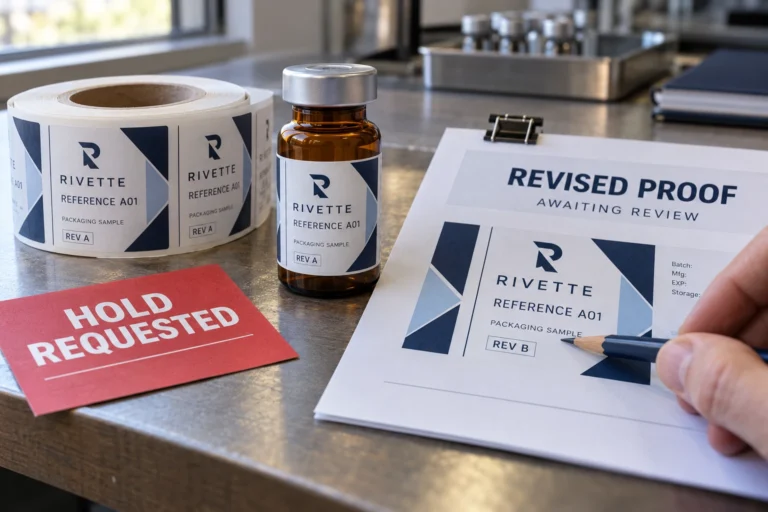
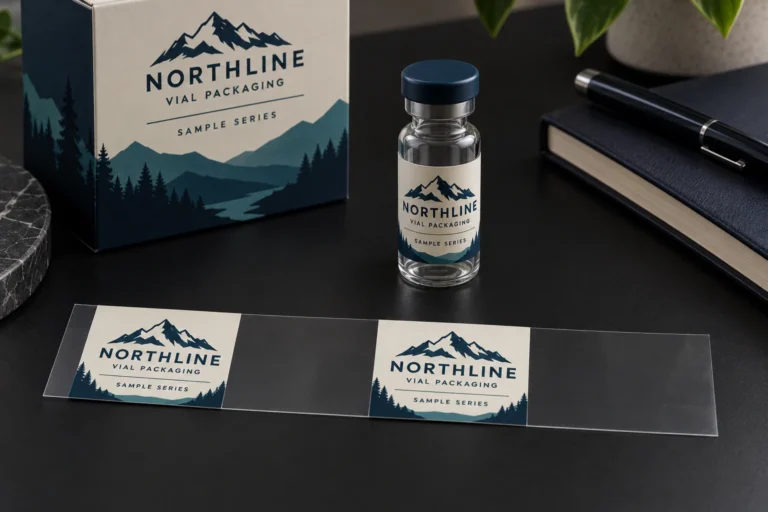
Ask which artwork revision, construction and vial the recording shows. Is it a finished project sample, a generic material example or a digital mockup? State which is being reviewed. A generic sample can explain a finish direction without approving the buyer’s actual layout.
Request an overall view and relevant close views, with a reasonably steady sequence. If the decision concerns reading around a curve, the recording should show that part of the package. If it concerns a specific field, a dramatic moving reflection may obscure the very feature that needs review.
Do not ask the supplier to create an improvised destructive test merely because it looks persuasive on camera. Any performance assessment needs an appropriate method, identified conditions and competent interpretation.
Use a decision-by-evidence record
| Decision | What a clear identified video may support | What remains limited |
|---|---|---|
| General layout | Relative placement and visible hierarchy | Exact finished dimensions without suitable references |
| Reflective appearance | How the shown sample changes with angle | Calibrated color or every real viewing condition |
| Visible construction feature | Presence of a layer or delivered presentation | Full material identity or performance |
| Handling sequence | What is visibly done to the shown specimen | Repeatability or suitability under another process |
| Final project acceptance | Only the explicitly reviewed scope | Requirements not represented in the recording |
The table does not mean video is weak evidence for every task. It means the buyer should match the evidence to the question. A well-framed recording may answer a simple orientation question more efficiently than shipping an unrelated material swatch.
Separate display appearance from physical approval
Screens, camera processing, lighting and movement affect how a sample is represented. A video should not become the sole calibrated color reference. If color matching is central, agree an appropriate physical reference and viewing basis with the responsible reviewer.
For custom vial labels, digital proof support is useful for artwork review. A filmed physical example adds information about that example; it does not convert a digital approval into a universal material qualification.
Where texture, stiffness, peel handling or actual packer compatibility determines the purchase, a relevant physical sample may still be needed. Ask what must be sent and what it represents rather than treating sample delivery as an automatic ritual for every minor question.
Two illustrative remote approvals
In one hypothetical project, the buyer needs to confirm which edge of an identified design leads on a finished roll. A clear video showing the roll, print face and unwinding direction, together with the agreed diagram, can communicate that relationship well. It still does not prove compatibility with every packer setting.
In another project, the buyer wants to know whether a small reverse-text field remains readable under ordinary handling. A compressed moving video with glare may not answer the task. An actual-size proof and appropriate physical specimen may be the better next evidence.
These examples illustrate evidence selection, not actual RP Labels sample services or test results. The right next step depends on what the buyer needs to decide, not on whether a recording looks polished.

Give a bounded approval response
State the sample identity and the exact feature accepted. List any requirements still open. For example, a buyer may accept the visible placement of a decorative panel while retaining physical appearance or application approval. Avoid a single “looks good” message when it could be interpreted as a complete release.
Ask the supplier to acknowledge the scope. If the recording does represent the final proposed sample, keep its reference with the approved artwork and construction. If it is only illustrative, mark it accordingly so it does not later become a misleading reorder standard.
When the project changes, decide whether the earlier recording remains relevant. A video of another vial size or finish may still explain the concept, but it should not silently carry forward as proof of the revised package.
Write a response someone else can interpret
For a fictional sample S-07 and artwork R3, a useful record might say: “The video identifies S-07/R3. Accepted: the visible panel placement. Open: physical color reference and application review. Production release: not yet authorized.” These are example references, not an RP order or a required numbering system.
Send that scope to the supplier and ask for acknowledgment. If production is genuinely ready to release, the authorized buyer must separately state the approved job and close or deliberately resolve its open requirements. A partial visual acceptance should not quietly become a complete release when the message is forwarded to another person.
The sample-selection guide helps choose the physical evidence for an unresolved question. If the remaining issue is glare in a product image, the photography review guide separates camera conditions from a package-level reading problem.
Consider the cost of unresolved decisions
Physical samples and remote reviews both consume time and resources. Choose proportionately. If a simple remote view resolves the actual open question, additional samples may add little. If the decision depends on touch, fit or the real application route, avoiding a relevant sample can leave a larger uncertainty.
Do not invent savings from skipping sample delivery or assume a video guarantees faster approval. Ask for the actual available sample route, timing and scope. RP Labels’ typical sample guidance remains subject to the project and confirmation; shipping is a separate matter.
Frequently asked questions
Can I approve color from a video?
A video communicates appearance but is not a universal calibrated color reference. Agree suitable references and viewing conditions where color matching matters to the purchase.
Does a successful filmed peel prove machine compatibility?
No. It shows the action performed on that specimen. The packer’s actual requirements and representative review are needed for the intended dispensing process.
Must every order wait for a mailed sample?
Not automatically. Identify the open decision and the evidence needed. A stable repeat and an unqualified new construction can reasonably require different review scopes.
Ask for the evidence that resolves the question
For a sample inquiry, send the artwork, dimensions, quantity per design and intended vial, then state what you need to inspect remotely and what may require a physical specimen. Ask the supplier to identify the sample and the limits of the proposed review before treating it as final approval.