Which Datasheet Applies to This Label? Match the Revision to the Offered Construction
A familiar document title can hide a different proposal
The supplier sends a material datasheet, and the buyer files it under the label project. Later, the quotation changes a component or uses another reference. The document still looks authoritative, but its relationship to the current offer may no longer be clear.
Before using a datasheet to support a purchase, connect its exact product reference and revision to the construction being offered. This article concerns document identity and change control. It does not turn a component datasheet into a test report for the complete printed label.
Start with the quoted construction
Ask the supplier to identify the proposed face material, adhesive, liner and top finish at the level relevant to the project. Some information may be proprietary or supplied through a finished-construction reference. The buyer needs a clear relationship, not necessarily every formulation detail.
Then record the datasheet issuer, title, product reference, revision or publication date and the source from which it was obtained. Keep the actual file or authoritative link rather than only a screenshot of one attractive property.
If the reference does not match literally, ask the supplier to explain the relationship. A local trade name, converted product or bundled construction may require a cross-reference. Do not infer equivalence from similar codes or a shared face-material family.
Make a document-to-proposal map
| Check | What to connect | If the relationship is unclear |
|---|---|---|
| Product identity | Datasheet reference to quoted component or construction | Request a supplier-confirmed cross-reference |
| Revision | Document version to the current proposal | Ask whether a newer applicable version exists |
| Component scope | What the document actually describes | Keep unrepresented layers as open questions |
| Property basis | Stated conditions and definitions | Do not copy a number without its context |
| Change history | Any relevant alteration since approval | Reassess affected purchasing decisions |
| Availability | Actual offer for this project | Do not treat a published sheet as a stock commitment |
This map is not a scoring system. Several matching fields do not compensate for a critical mismatch in the actual material. The responsible technical reviewer should decide which differences matter to the intended requirement.
A worked mismatch: the liner changed
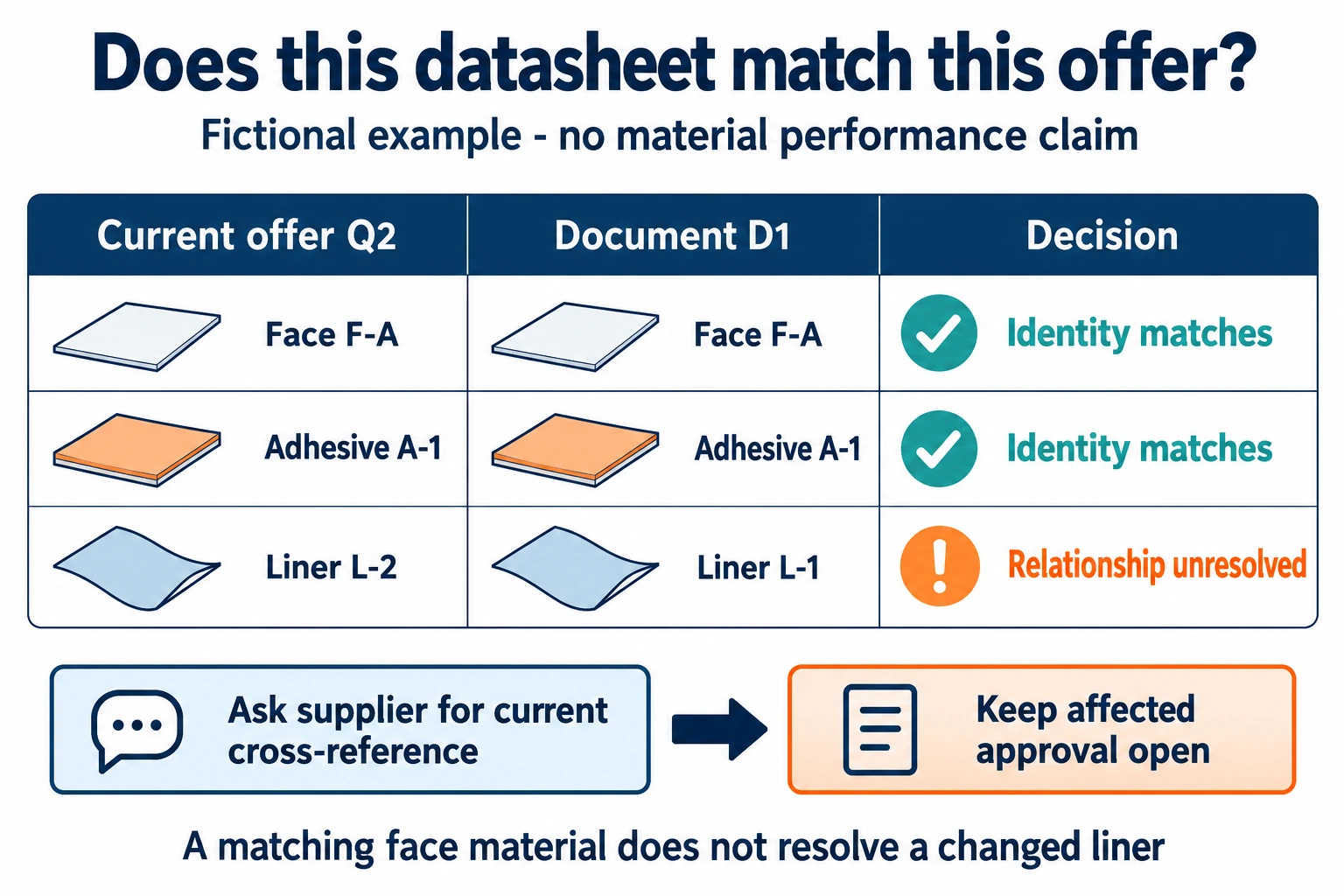
Consider fictional offer Q2: face F-A, adhesive A-1 and liner L-2. The attached document D1 names F-A, A-1 and L-1. Matching the first two codes does not explain the third. These invented codes demonstrate comparison only; they name no real material or RP construction.
Record the result as “liner relationship unresolved,” rather than “document rejected” or “complete construction approved.” Ask the supplier to connect Q2 to the applicable document and identify what changed. If L-2 is only a trade-name alias, obtain that explanation. If it is a different carrier, the responsible reviewer decides which dispensing or handling questions need reopening. Do not assume either equivalence or failure.
An updated cross-reference closes the identity question only. Where the purchase also relies on a resistance claim, the report-scope guide explains how to compare the actual specimen, method and claimed outcome. A well-matched document does not establish an unrepresented performance claim.
Keep specification, guidance and evidence distinct
A datasheet may describe a component and give conditions or typical properties. Application guidance may explain how that material is intended to be used. A test report may document a particular evaluation. These documents can support one another without being interchangeable.
For custom vial labels, ask what the finished sample represents in relation to the cited document. Printing, protective finish and later marking may introduce questions outside a base-material description.
Do not turn a typical value into a guaranteed acceptance limit unless the actual agreement supports that interpretation. Likewise, do not discard useful component information merely because it is not a complete finished-label qualification. Its scope should be understood and used appropriately.
Two illustrative document checks
In one hypothetical quotation, the supplier proposes a different liner while sending the datasheet used for the previous construction. The face-material information may still be relevant, but the carrier and dispensing questions need an updated relationship. Filing the old sheet as complete support would conceal the changed component.
In another project, the datasheet’s date is older than the quotation, but the supplier confirms that its identified revision remains applicable to the unchanged offered reference. Age alone does not make it false or irrelevant. The buyer should retain that confirmation and any remaining scope limits rather than demanding a newly dated document for appearances.
These examples illustrate document applicability, not actual supplier documents or proof of performance. The important question is what the file describes and how that relates to the current proposal.
Ask focused questions when versions differ
If a newer document exists, compare the relevant changed sections and ask whether they affect the offered construction or approved use. A formatting update may have a different consequence from a changed material reference or stated condition.
If the supplier cannot establish the relationship, keep the affected claim open. Ask whether another authoritative document, an identified sample or an appropriate evaluation can resolve it. Do not fill the gap with another manufacturer’s unrelated brochure.
Availability and quotation remain separate. A valid datasheet does not reserve material or confirm the project’s price and timing. Ask the supplier to acknowledge the actual proposed supply and any conditions before the buyer relies on it.
Retain the evidence snapshot with the release
Keep the accepted construction, document revision and relevant explanation with the artwork release. If links are used, record the accessed version and date because a web page may later change. Avoid overwriting the historical record when a new revision arrives.
For a reorder, check whether the construction or relevant requirement changed. A full repeated review may be unnecessary when everything remains confirmed, but an old document should not silently support a new substitute. Reopen the questions affected by the actual difference.
The practical outcome is a traceable evidence basis. It does not require the buyer to build a technical library for unrelated materials or claim that a well-organized folder establishes suitability on its own.
Frequently asked questions
Is the newest datasheet always the correct one?
Not automatically. It must describe the actual offered reference and relevant revision. A newer file for another product is less useful than an applicable identified document.
Does a component datasheet approve my printed label?
It supports its stated scope. The finished print, finish, container and process may need additional evidence. Ask which requirements remain outside the document.
Should I reject an offer with a different internal code?
First request a clear cross-reference. Different naming systems can be legitimate, but the relationship should be confirmed rather than guessed from similar wording.
Submit the document and proposal together
For a construction inquiry, send the quoted reference, actual datasheet and revision, artwork, vial details and quantity per design. Mark the property or requirement you need supported. Ask the supplier to confirm the relationship and identify any finished-label questions that remain open.