Roll vs Sheet Supplement Labels: A Buyer’s Checklist
Choose roll or sheet supplement labels around the person and process that will apply them. For hand application, compare how labels are picked, peeled and kept with the right bottle. For a roll-fed machine, obtain the packer’s receiving specification before approving a roll order. A familiar bottle size and a good-looking PDF do not settle the supply format.
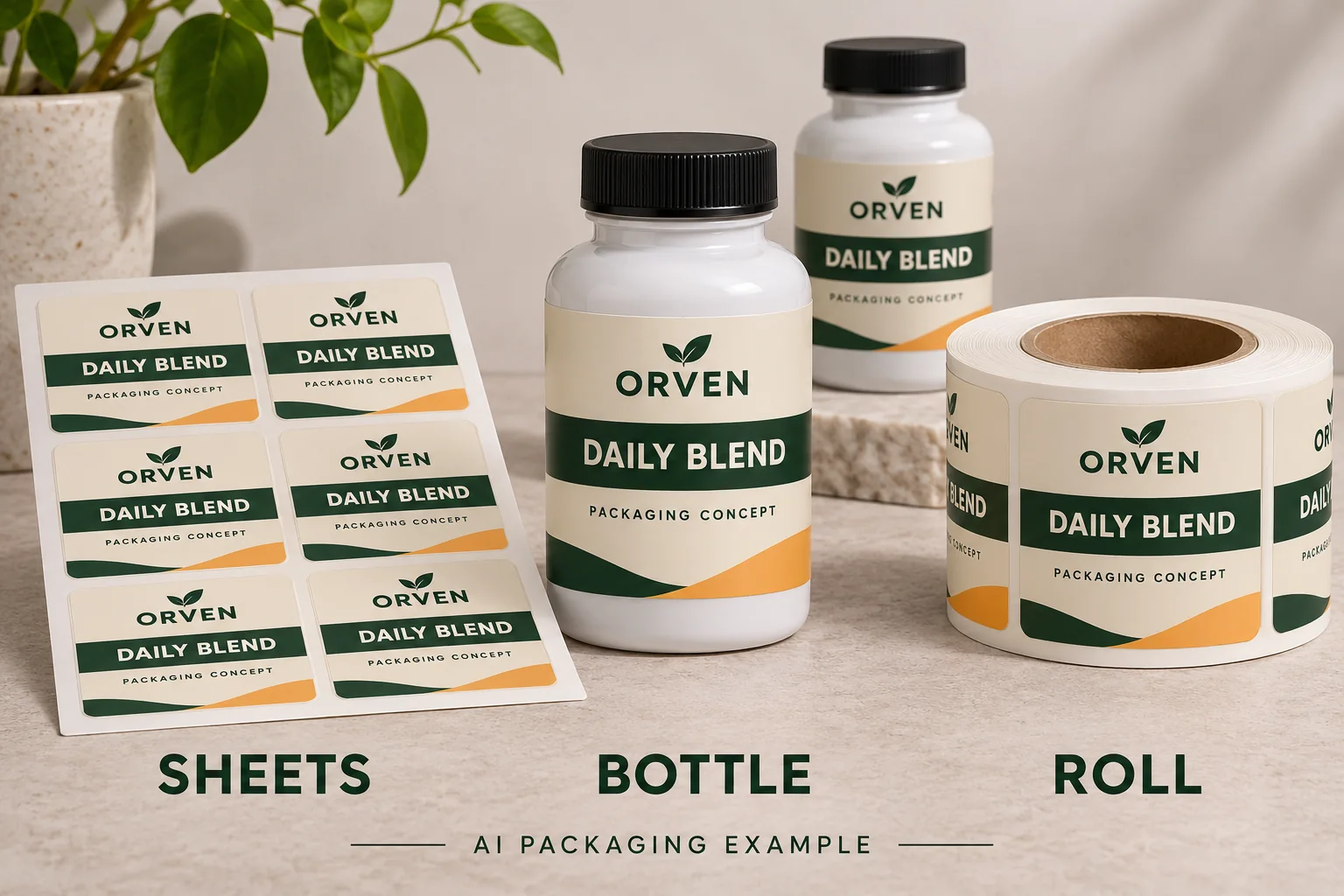
Sheets can be a sensible starting point for a small manual run with several designs. Rolls can also suit manual work, especially with a suitable dispenser, and are required by some application equipment. Neither format automatically reduces your total cost. The useful comparison includes usable labels, handling, version control and any preparation needed at the packing station.
Start with the packing station, then compare the formats
Ask who will apply the labels, where the work will happen and what will be on the table or machine at that moment. A brand owner’s manual trial and a contract packer’s routine line may need different delivery specifications, even when the printed design stays the same. Record the intended process for this order rather than choosing around a possible future machine.
Use the table to identify the next fact you need. It is a purchasing worksheet, not a claim that every sheet or roll will suit the process shown.
| Your application task | A sheet option may fit when | A roll option may fit when | Confirm before release |
|---|---|---|---|
| Apply labels by hand at one station | The operator can hold the carrier, identify the design and peel it without damage | A suitable dispenser or controlled roll position makes repeated peeling practical | Try the proposed carrier and record handling problems |
| Switch between several SKUs | Separate sheets or a clearly mapped layout support picking | Separate, identified rolls support the planned changeovers | Keep artwork revision and usable quantity visible for each SKU |
| Use an existing roll-fed applicator | Sheets would require a different application plan | The actual roll specification is accepted by the packer | Obtain the equipment brief and any required representative trial |
| Send labels to another packing site | The receiver agrees the sheet layout and inner-pack identification | The receiver agrees the winding and roll limits | Obtain written receiving instructions from the application site |
If the application owner is unknown, pause format approval. You can still review artwork or request a provisional comparison, but mark the format as open. Buying a roll that needs unplanned conversion is a different proposal from buying stock the packer can use as delivered.
Run a small handling comparison with the proposed carrier
For manual work, have the intended operator try the proposed sheet layout or roll arrangement on the actual bottle. Keep the design and construction comparable where possible. Record which differences belong to the carrier and which belong to the label itself; a film label on a roll and an unrelated paper label on a sheet do not isolate the format decision.
Observe the sequence from selecting a design to setting the labeled bottle aside. Can the operator see the SKU before peeling? Does the carrier remain stable? Can the label be lifted without touching or damaging the printed area? How will part-used stock be identified when the station closes? Record observations rather than promising a production rate from a short demonstration.
If both arrangements work, compare handling preference, storage space and the quoted delivered scope. If one arrangement creates picking ambiguity or damaged labels, change the layout or presentation and review it again. A simpler separate-SKU sheet can be a better choice than a mixed sheet that needs constant checking. The mixed versus separate SKU sheet guide covers that subsequent layout decision.
For machine application, get one accepted receiving brief
Ask the operator or equipment supplier for the required drawing and dimensions. Capture the print face, leading edge of the artwork, core inside diameter, maximum outside roll diameter, liner requirements and any specified spacing or sensing arrangement. Use the actual diagram agreed by both parties; a winding-option number without its picture is incomplete.
Avery’s unwind explanation distinguishes ordinary hand application from a machine or dispenser that needs the correct feed arrangement. It supports checking the delivery orientation; it does not establish a universal core, winding number or machine setting. The detailed roll direction and core specification guide explains the next approval step once rolls have been selected.
Ask whether a trial is needed and what the trial roll must represent. Loose labels may help check artwork or bottle fit while leaving feeding, sensing and roll handling unresolved. Keep those approvals separate. If a packer needs a representative roll and it is not yet available, leave machine compatibility open instead of treating a visual proof as acceptance.
Keep the format decision connected to each SKU
Prepare a line for every design: SKU identifier, approved artwork filename and revision, finished dimensions, required usable quantity, proposed carrier and destination packing site. State whether quantities refer to individual labels, sheets, rolls or complete front-and-back sets. A total piece count can otherwise hide a shortage of one component or design.
Review material, bottle surface and exposure conditions alongside the carrier choice. A sheet does not prove adhesion, and a roll does not prove scuff or moisture resistance. Where codes are needed, supply approved data and review printed examples in the intended scanning workflow. Buyer-approved product information must remain readable on the actual package.
Obtain comparable quotes for the options you can actually use. Ask what is included in preparing, identifying and packing each version. RP Labels starts at 100 pieces, with the minimum confirmed for each design and specification. That statement does not mean any collection of small quantities can be combined into one unrestricted minimum.
Close the open fields before placing the order
Record the chosen format and the reason, attach the accepted layout or winding drawing, and list unresolved checks with an owner. If handling fails, revisit the carrier presentation. If machine requirements are missing, obtain them from the packer. If both formats pass, select on the agreed delivered scope and your real operating preference.
For custom supplement bottle and jar labels, send RP Labels a format-comparison enquiry with the application method, dimensions, artwork revision and quantity per SKU. Include the proposed sheet layout or the packer’s roll drawing when available, and identify the packing destination. Ask for any open format requirements to be confirmed before production approval; production timing and transport remain separate parts of the order.