Paper or Film Vial Labels? Choose Around Handling, Appearance and Cost
Choose around the handling, not the material nickname
Two white labels can look similar on a screen and lead to different purchasing discussions. One proposal describes paper. Another describes film. The buyer asks which is better, but has not yet explained whether the vials remain dry, encounter occasional moisture or travel through repeated handling.
I would define that exposure before comparing appearances or prices. Paper and film identify broad face-material families, not the whole finished-label specification. A useful choice connects the face, printed surface, adhesive and actual container to the job they must perform. Buying the most elaborate construction is not automatically the careful choice.
Describe the label’s real working day
For custom vial labels, describe what happens during application, packing, storage and ordinary handling. Keep application conditions separate from later exposure. A label applied to dry glass and later encountering a splash presents different questions from one applied while the container is already damp.
Be specific about contact without inventing test limits. Is water occasional or prolonged? Will fingers, trays or neighboring packages repeatedly touch the print? Does another process need to add information afterward? If the answer is unknown, identify who can establish it before a final material is approved.
Avoid turning an uncertain brief into a list of maximum requirements. Asking for every possible resistance can make proposals harder to compare without resolving the actual use. Start with the conditions that can reasonably occur, then discuss the evidence needed for the important ones.
Separate four parts of the proposal
The face material carries the design. The printed surface and any protective treatment affect what the buyer sees and touches. The adhesive connects that construction to the vial. The supply format determines how the labels reach the application process. A face-material name does not settle all four questions.
Avery’s material comparison describes paper and plastic-film options for different handling needs. It is a supplier’s general explanation, not evidence that every film has the same resistance or that RP Labels uses a particular Avery construction. Use it to frame questions, then confirm the actual proposal.
Ask for the proposed material reference and included finish. If the supplier changes one part between options, have it identified. A paper proposal with one surface treatment and a film proposal with another are complete alternatives; their difference cannot be attributed solely to paper versus film.
Compare options on one fixed brief
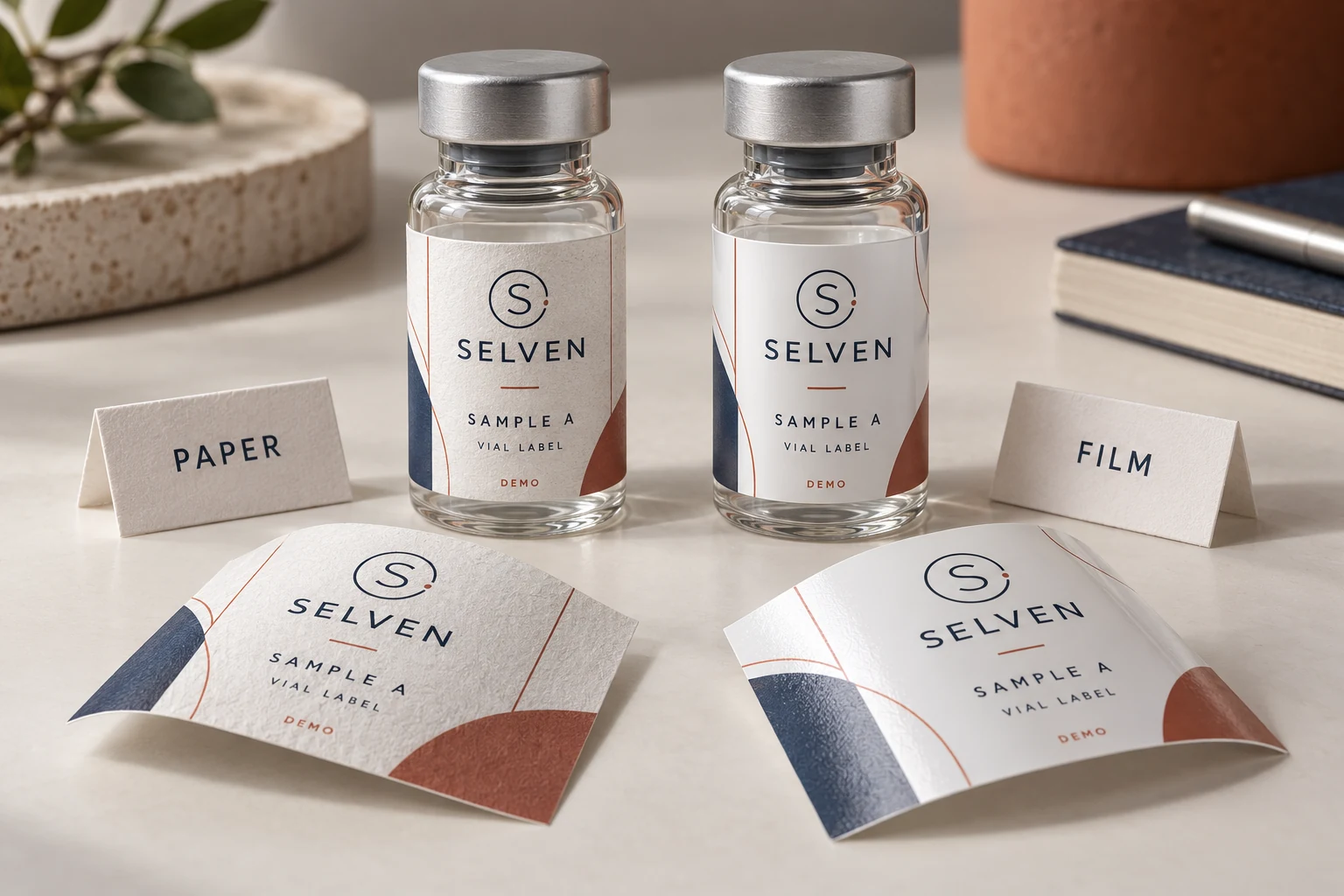
Keep the vial, size, artwork and quantity per design constant for an initial comparison. Otherwise a larger font, different background or more expensive finish can make one specimen look preferable while the buyer believes only the face material changed.
| Requirement | What to describe | What should support approval |
|---|---|---|
| Surface appearance | Desired texture, opacity and visual character | Representative finished appearance on the intended vial |
| Handling | Relevant contact and movement | An agreed review using the proposed construction |
| Moisture | Actual type and duration of contact, where known | Evidence limited to those conditions |
| Adhesion | Container and application circumstances | Appropriate guidance and a representative application check |
| Later marking | The real writing or overprinting method | A check on the offered finished surface |
The AI image shows example surface differences, not moisture, adhesion or durability results. A photograph can help discuss appearance; it cannot supply the evidence in the right-hand column.
Give a dry-use paper option a fair review
Consider an illustrative brand preparing vials for a dry presentation setting. The team wants a particular paper texture and has no established wet-use requirement. A suitable paper proposal deserves consideration rather than automatic rejection because a film sample sounds more durable.
The buyer should still confirm adhesion, printing and handling suitability. Dry does not mean never touched, and a pleasing texture does not establish that the finished label meets the order. The sensible outcome may be a straightforward construction that satisfies the actual brief without an appearance upgrade nobody needs.
Now consider an illustrative buyer whose labeled vials encounter recurring moisture during its documented workflow. The discussion needs a defined construction and relevant finished-label evidence. A film option may be worth reviewing, but the word film alone does not approve the adhesive, print or complete result.
These situations illustrate different requirements. They are not customer trials, and they do not establish a general performance ranking for every material offered under either family name.
Keep the price difference attached to the difference in scope
Ask for both acceptable options against the same quantity split and delivery basis. Record whether appearance, finishing, preparation or supply format changes. If an option solves no relevant requirement, its extra complexity may be unnecessary. If it addresses an important exposure, the buyer needs evidence rather than a broad premium label.
For water-related requirements, the splash-and-soak specification guide explains the next question in more detail. Keep that separate from this initial family selection. Choosing a candidate is not the same as proving it suitable for every wet condition.
Retain the accepted construction and representative reference with the artwork revision. A later substitution should identify what changes and whether a renewed review is necessary. Reusing the same design does not establish that the underlying material stayed unchanged.
Questions about paper and film vial labels
Is film automatically waterproof?
No universal conclusion follows from the family name. Confirm the offered finished construction and evidence for the actual contact conditions, including the printed surface and adhesive where relevant.
Is paper always the lower-cost choice?
Ask for comparable quotations. Quantity, construction, preparation and finishing affect the actual proposal. Do not present an assumed material price relationship as a quote for your job.
Can I choose from an unprinted swatch?
A swatch can narrow surface preferences. It may not represent the final print, protection or appearance. Agree what additional review is needed for the purchasing decision still open.
What should I submit for material advice?
Send the vial reference, dimensions, quantity per design, artwork and known handling or moisture conditions through the project enquiry form. State the appearance you prefer and the conditions you have not established. Ask for a defined proposal and the evidence needed before release.