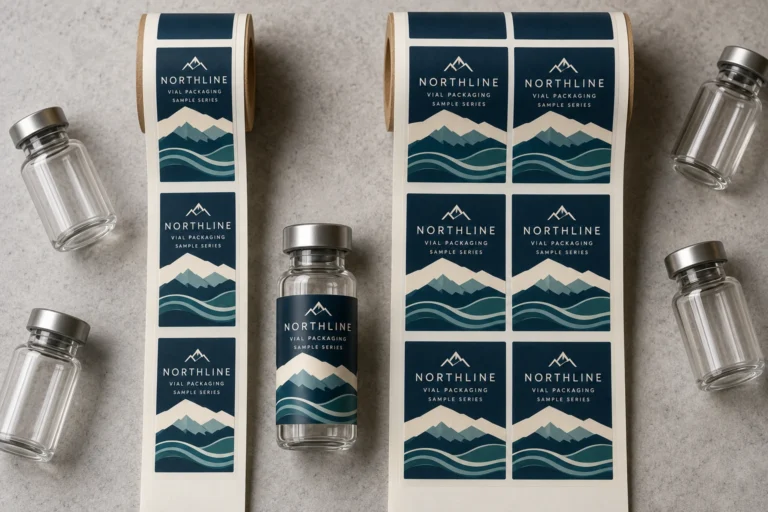
Vial Label Roll Splices: Agree the Join Policy Before Ordering
A roll can have the right artwork, core and winding direction and still arrive with a delivery detail the packer never agreed to: a join in the web. The buyer sees an order for printed pieces. The operator needs to know what will pass through the equipment, where an interruption may occur, and which stock is available to use.
For machine-applied vial labels, put the splice policy in the enquiry before choosing the offer. Ask whether joins are permitted, how they must be identified and how the affected section will be treated. A request for rolls does not answer those questions. Nor does this guide establish a splice construction that suits every labeler.
Start with permission, then discuss presentation
A splice joins sections of web. Its acceptability is a separate purchasing question from whether the labels have been wound correctly. Obtain the packer’s actual restriction or equipment guidance rather than copying another buyer’s allowance. If its requirement is no joins, state that plainly and ask the printer to confirm whether the proposed supply can meet it.
For custom peptide vial labels, keep the requirement attached to the design, construction and roll specification. A supplier’s answer about one job should not silently become permission for every material or order. Identify any requirement that remains unconfirmed before releasing production.
If joins are allowed, ask the packer which details it needs. These might include advance identification, the location of an indicator and instructions for the affected section. The operator should determine the relevant handling requirements. A general article cannot prescribe tape, overlap, thickness, sensor settings or an acceptable machine speed for an unidentified line.
Make the join visible in the supply agreement

A flag on a photographed roll can explain the idea. It does not prove that the delivered roll will be marked in the way your packer requires. Ask for the actual marking and declaration arrangement to be acknowledged in the order confirmation.
| Agreement item | Question to resolve |
|---|---|
| Permission | Are joins excluded, conditionally allowed or awaiting review? |
| Identification | How will a joined roll and the affected position be indicated? |
| Declaration | What join information will accompany each identified roll? |
| Usable quantity | How will affected labels or removed sections be accounted for? |
| Handling owner | Who decides whether the section can proceed on the packing line? |
An unmarked join and an accurately declared join are different delivery situations, even if the physical construction is similar. Keep that distinction in any comparison of offers. Do not turn the table into a universal industry specification; it is a list of decisions for this particular purchase.
Do not let a gross count settle a usable-count question
Suppose an illustrative packer must remove a section surrounding a join under its agreed procedure. The buyer needs to know whether the quoted quantity describes printed positions, delivered labels or usable labels after that agreed treatment. These are different counting bases. No assumed waste allowance should fill the gap.
Ask for the required usable minimum per design and the counting basis to be reconciled before ordering. If additional stock is proposed, identify its purpose and whether it is included or separately charged. A percentage used on a previous job is not automatically suitable here, especially where different designs have unequal requirements.
The existing roll delivery specification guide covers orientation, core and outer diameter. Preserve those requirements while adding the join policy. Splitting a delivery into additional rolls may be worth discussing, but confirm availability, quantities and cost rather than assuming a different roll arrangement removes every concern.
Two packing situations justify different purchases
Consider an illustrative brand using a contract packer with a written restriction against web joins for the proposed run. The attractive price is useful only if the offer satisfies that restriction or the packer formally accepts another proposal. The buyer should resolve the mismatch before printing, not ask the operator to improvise when the cartons arrive.
Now consider an illustrative short run applied by hand from a roll. The person peeling labels may be able to identify and set aside a declared section without the same equipment dependency. That can make a different supply arrangement workable. The buyer still needs the identification and count to make sense; hand application is not permission for unexplained shortages.
Neither example establishes that a join will cause failure or that an alternative supply will always run successfully. They show why a blanket rule can waste money in one workflow and leave a serious unresolved requirement in another. Buy against the actual application arrangement.
Define a response before the roll reaches the line
Agree who receives the roll declaration and who can authorize use. If the delivery differs from the acknowledged policy, keep the affected roll identifiable while asking for clarification. Photograph its reference and the observed condition before removing packaging or separating pieces that could lose their source identity.
Describe the observation without guessing the production cause. A reported join at a particular position is more useful than saying the roll is bad. Record whether the stock has entered the machine, which material remains available, and whether the rest of the delivery can be reviewed independently.
Where a trial is appropriate, ask what it must represent and what the packer wants to observe. A loose printed label cannot demonstrate how a joined web will be handled. Equally, a satisfactory check on one identified sample does not approve every future join or replace an agreed no-join requirement.
Questions about ordering joined label rolls
Are splices always unacceptable?
The answer depends on the application requirements and the agreed supply. Obtain the relevant packer or equipment restriction. This article does not establish an allowance or certify any splice method.
Does a splice change the number of usable labels?
It may affect the counting discussion if the agreed handling removes labels or web sections. Confirm the counting basis and required usable quantity instead of assuming every printed position is available to apply.
Can a roll flag replace a written declaration?
Ask what the receiving and operating teams require. A visible indicator and a roll-level record can serve different purposes. Agree the actual presentation rather than relying on a generic example photograph.
Should I ask RP Labels for splice-free rolls?
State the requirement and ask whether it can be met for the proposed job. Availability and quotation must be confirmed. Do not infer a supply guarantee from an explanatory article.
Send the restriction with the printing brief
Use the project quote form to send the packer’s join restriction, vial and label dimensions, roll requirements, artwork revision and usable quantity per design. Ask for permission, identification and counting treatment to be answered explicitly. That gives the operator a delivery it can assess before the packing slot is committed.