Editable Vial Label Artwork: Agree the Handover Before Design Starts
The first vial-label order can be printed from a good PDF. The difficulty appears later, when a buyer needs to change one identifier and discovers that the delivered file is not the editable layout it expected. The design looks right, but the next task was never part of the handover agreement.
Agree the deliverables before design work begins. An approved print output, an editable source package and permission to use every included asset are related questions, not the same question. Ask what will be delivered and what the recipient can actually do with it. Free artwork support should not be stretched into an unwritten promise about source files or rights.
Describe the edit you expect to make later
Will the buyer only repeat the same print order, add another SKU, change a line of approved wording or adapt the layout to a new container? These tasks can require different files and skills. Tell the designer the expected task instead of asking for everything in the vague hope that one file will cover it.
For custom peptide vial labels, distinguish product wording supplied by the buyer from the artwork that organizes it. The recipient still needs an approved information source when making a revision. Editable text is not permission to invent a product statement or bypass the release review.
List the program and version the receiving designer can use, where relevant. If nobody on the buyer’s side can open or maintain the proposed source format, source delivery alone may not solve the problem. An agreed future-editing service or another suitable format could be a better purchase, subject to the actual proposal.
Separate the handover into useful parts
| Deliverable | What it helps with | What to confirm |
|---|---|---|
| Print output | Reproducing the approved released artwork | Revision, dimensions and supplier requirements |
| Editable layout | Making agreed future design changes | Format, editable elements and software needs |
| Linked artwork | Keeping images and brand elements connected | Included files, versions and permitted uses |
| Font information | Identifying typography and future access needs | Font names and applicable permissions |
| Release preview | Comparing the opened source with the intended result | Matching revision and visible appearance |
This is a proposed deliverables list, not an automatic entitlement or a statement of RP Labels’ source-file policy. Confirm the included items, any separate work and permitted uses with the parties responsible before proceeding.
Ask what editable means in that file
A file can contain movable artwork while its text has been converted to shapes. It can also contain a flattened image placed inside an otherwise editable document. The filename or extension alone does not establish which elements can be changed in the way the buyer expects.
Ask specifically about the product-name field, variable information areas, logo, images and technical layers relevant to the job. Some elements may properly remain fixed or require specialist editing. The goal is not to demand that every production setting becomes a casual text box; it is to understand the actual maintenance task.
The source-artwork quality guide addresses another problem: whether a logo or image has appropriate source detail. Here, the file may look perfectly sharp and still be unsuitable for the intended future edit. Keep source quality and practical editability separate in the handover check.
Do not confuse asset delivery with asset permission
Ask who supplied the logo, photographs, illustration and fonts, and whether the intended recipient can use them for the proposed work. If an asset needs separate permission or access, record that dependency. A folder full of files is not enough information about what each recipient may do with them.
Adobe’s font-packaging guidance explains that font-file sharing depends on the applicable terms and that a collaborator may need its own licensed access. Do not assume a designer can simply copy every font into the handover folder. Check the particular asset terms with the responsible provider.
This is a procurement check, not a legal conclusion about a specific design agreement. If ownership or usage is disputed, resolve that with the relevant parties before passing the material onward. Do not ask another printer to recreate protected material merely because the original file was not included.
A repeat buyer and a growing range need different packages
Consider an illustrative buyer ordering a stable label with no planned design changes. A properly identified print output and an agreed repeat-print route may be enough for its immediate task. Paying for a broader editable package is not automatically necessary if the buyer understands and accepts the future dependency.
Now consider an illustrative brand adding several variants over time through another designer. It needs to know which source elements can be updated, how linked images are supplied and what typography access the receiving designer requires. A flat preview may look complete while leaving that future workflow undefined.
The second buyer should discuss those deliverables before treating a print-only offer as equivalent to a source-file handover. The first buyer should not purchase complexity solely because it sounds more professional. In both cases, choose the deliverable that fits a real next task, with its conditions visible.
Test the handover on the receiving side
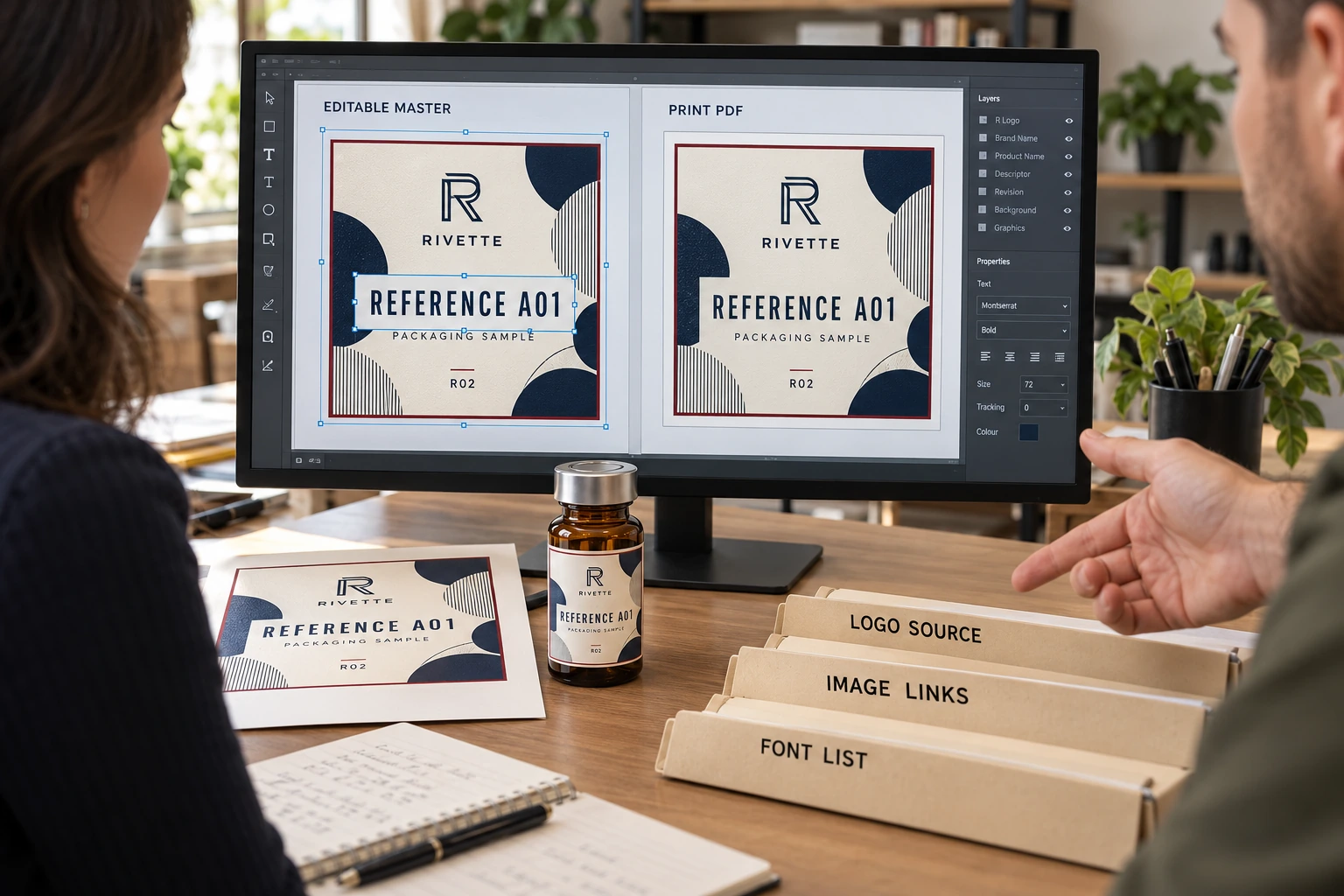
Ask the intended recipient to open the delivered package in its own authorized environment. Compare it with the matching preview. Note missing links, substituted typography, unexpected changes or elements that cannot be edited as agreed. Identify the file and revision in the response rather than saying the artwork does not work.
If appropriate under the arrangement, have the recipient make one representative edit in a duplicate working file and return a preview. This can reveal a practical maintenance problem without altering the released master. Keep the original delivery intact so that a test edit does not quietly become the next production instruction.
After any actual revision, obtain a new release review and print output. Successfully opening the source does not approve a changed label. Nor does an accepted original proof automatically authorize future edits made by another person. Keep source maintenance and production release as separate decisions.
Questions about editable label files
Is a PDF necessarily non-editable?
No. PDFs can contain different kinds of objects and may permit some editing. What matters is whether the file supports the specific maintenance task safely and as agreed; its extension alone cannot answer that.
Does free artwork assistance include every source file?
Do not assume it. Ask what deliverables, formats and permitted uses the service includes for the project. RP Labels’ confirmed free artwork and digital proof support does not by itself establish an unrestricted source-file handover.
Should the designer include all fonts in a ZIP file?
Only where the applicable permissions allow that arrangement. Request a font list and clarify the receiving party’s access requirements rather than copying files indiscriminately.
What should I do if I only have a preview image?
Explain that limitation. Discuss obtaining the authorized source or rebuilding legitimate artwork from your own materials, with the resulting design reviewed as a new revision. Do not call a recreated layout the original master.
Agree the files while discussing the design
The free label designer can help explore a starting concept. For the actual printing project, use the quote form to send the available logo or source material, label dimensions, quantity per design, intended future edits and required delivery formats. Ask which files and permitted assets can be included. A useful handover is one the next person can open, understand and use for the agreed task.