Mixed or Separate SKU Sheets? Plan How Vial Labels Will Be Picked
Mixed-design sheets can look wonderfully organized in a proof. At the packing table, the fastest-moving SKU disappears first and leaves a stack of partly used sheets. Separate sheets avoid that particular imbalance, but may require more changes between stacks when each small order needs several variants. The layout decision belongs to the picking workflow, not just the print preview.
Once hand-applied sheets are the agreed format, I would choose mixed or single-design sheets by how labels will actually be taken and replenished. Ask which layouts the supplier can provide, then approve a physical sheet map. This is a delivery-layout decision; it does not replace artwork approval or confirm an arbitrary mixed-design minimum quantity.
Describe the packing sequence before drawing a grid
Does one person complete a batch of one vial design before starting another? Does a packing station need small quantities from several designs throughout the day? Are several people taking labels from the same stack? These details matter more than whether the sheet looks balanced on a monitor.
For custom peptide vial labels, identify each design and its actual quantity separately. Add the anticipated use pattern without pretending that a forecast is a firm order. An equal number of positions per sheet can be inconvenient when the designs are consumed at different rates.
Keep the earlier format decision separate. The rolls versus sheets guide explains when each supply format may suit an application. Here the buyer has already selected sheets and needs a useful arrangement within them. If the proposed job moves to a roll-fed machine, revisit the format rather than forcing the sheet plan onto another process.
Approve a sheet map that the packing table can use
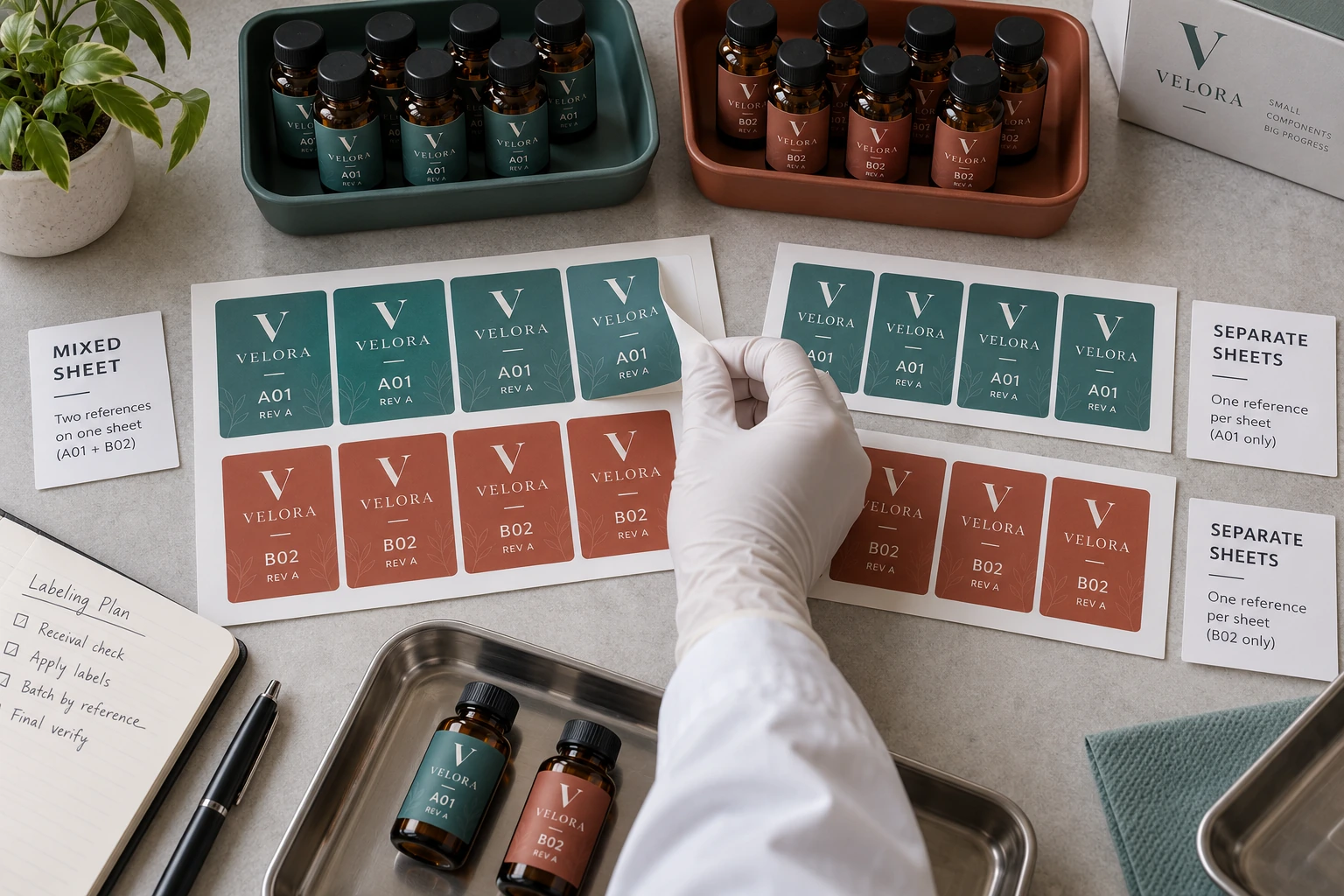
Ask for the sheet dimensions, number of label positions, design locations and orientation to be stated. Where the supplier proposes a layout, request a clear map showing which positions belong to which design. Separate the finished label shape from the overall sheet size.
The map should help a person identify a row or group without studying the entire artwork again. If the labels must be removed in a particular sequence, show it in the review. Ask how any proposed edge spacing, backing or waste removal affects picking; do not prescribe a universal layout or imply every construction can be supplied identically.
| Layout question | Mixed-design sheets | Single-design sheets |
|---|---|---|
| Picking sequence | Several designs available on one sheet | One design available in each stack |
| Unequal consumption | Partial sheets need a clear handling plan | Remaining stock stays grouped by design |
| Replenishment | Confirm what replaces a depleted design | Confirm the order requirement per design |
| Identification | Rows and positions need clear identities | Each stack still needs its design reference |
These are planning differences, not measured productivity results. A sheet photograph cannot prove faster work, lower error rates or a particular cost saving.
Plan the remaining sheet as carefully as the new one
The first sheet is usually easy to recognize. The more revealing question is what happens after some positions have been removed. Does a partially used mixed sheet still make the remaining designs obvious? Can it be returned to a clearly identified place without mixing it with another revision?
Discuss the handling of unused sheets and partial sheets with the team doing the application. Keep the original design reference connected to the stock. Avoid cutting up or repacking sheets informally if doing so would remove the information needed to identify them; confirm a suitable approach for the actual material and workflow.
Do not assume that adding a large printed sheet header is always available or appropriate. Ask how the supplied sheet or its packaging can be identified. A practical identifier that the supplier can actually provide is better than an elaborate instruction that never appears in the order confirmation.
A coordinated kit and an uneven range are different cases
Consider an illustrative packing service preparing the same small selection of vial variants repeatedly. A mixed sheet might keep the needed designs together, provided the picking sequence is clear and the quantities match the job. The benefit would need to be checked at the actual station, rather than announced as an efficiency claim.
Now consider an illustrative brand whose A01 label is used frequently while B02 is needed only occasionally. An equal mixed layout can leave B02 on partly empty sheets. Separate sheets may make replenishment and remaining-stock identification easier. They may also mean more stack changes when the less common design is needed.
Neither buyer should choose the arrangement solely because it uses fewer sheet types. The first should confirm that the set remains useful after partial picking. The second should compare its uneven demand with the proposed order quantities and minimums. A convenient sample grid is not automatically the right production layout.
Check picking without treating it as a performance certificate
Where feasible, request a representative sheet to examine removal and handling. Identify which aspects it represents: label construction, cut shape, spacing and layout. An ordinary paper layout can explain position and sequence, but it does not establish how the finished adhesive labels will peel from their backing.
Have the intended user review the sheet at the real packing table. Note where the person reaches, how the remaining designs are identified and what happens when a sheet is partly consumed. Record useful observations without assigning an invented error rate or claiming an ergonomic test that was never conducted.
Feed any agreed change back into the identified sheet-map revision. Keep artwork revision and delivery-layout revision understandable. A printer may reproduce the right designs in a different arrangement unless both are part of the accepted instruction.
Questions about multi-design label sheets
Can I combine several designs into the 100-piece starting quantity?
Do not assume that. RP Labels’ starting quantity is subject to each design and specification being confirmed. Supply the split per design and ask which layout and quotation are available.
Are mixed sheets always cheaper?
No saving is established here. Ask for an actual quotation covering the proposed arrangement and quantities. Compare it with handling and replenishment needs rather than predicting a lower price from the grid alone.
Can a designer’s sheet preview prove easy peeling?
It can communicate positions and orientation. Review a representative finished construction where removal behavior matters. A visual layout and an adhesive-label sample answer different questions.
What changes when only one SKU needs a reorder?
Identify its remaining requirement and ask how it can be supplied. Do not assume the original mixed layout can be repeated without surplus designs or that a different layout has the same quotation conditions.
Put the sheet plan in the enquiry
Send the vial and label dimensions, quantity per design, expected picking sequence and proposed sheet map through the printing enquiry form. Ask which mixed or separate layouts are available and what sample would represent the actual delivery. Choose a sheet the next person can use after half its labels have gone.