Cold Vial Labels: Application Temperature Is Not Storage Temperature
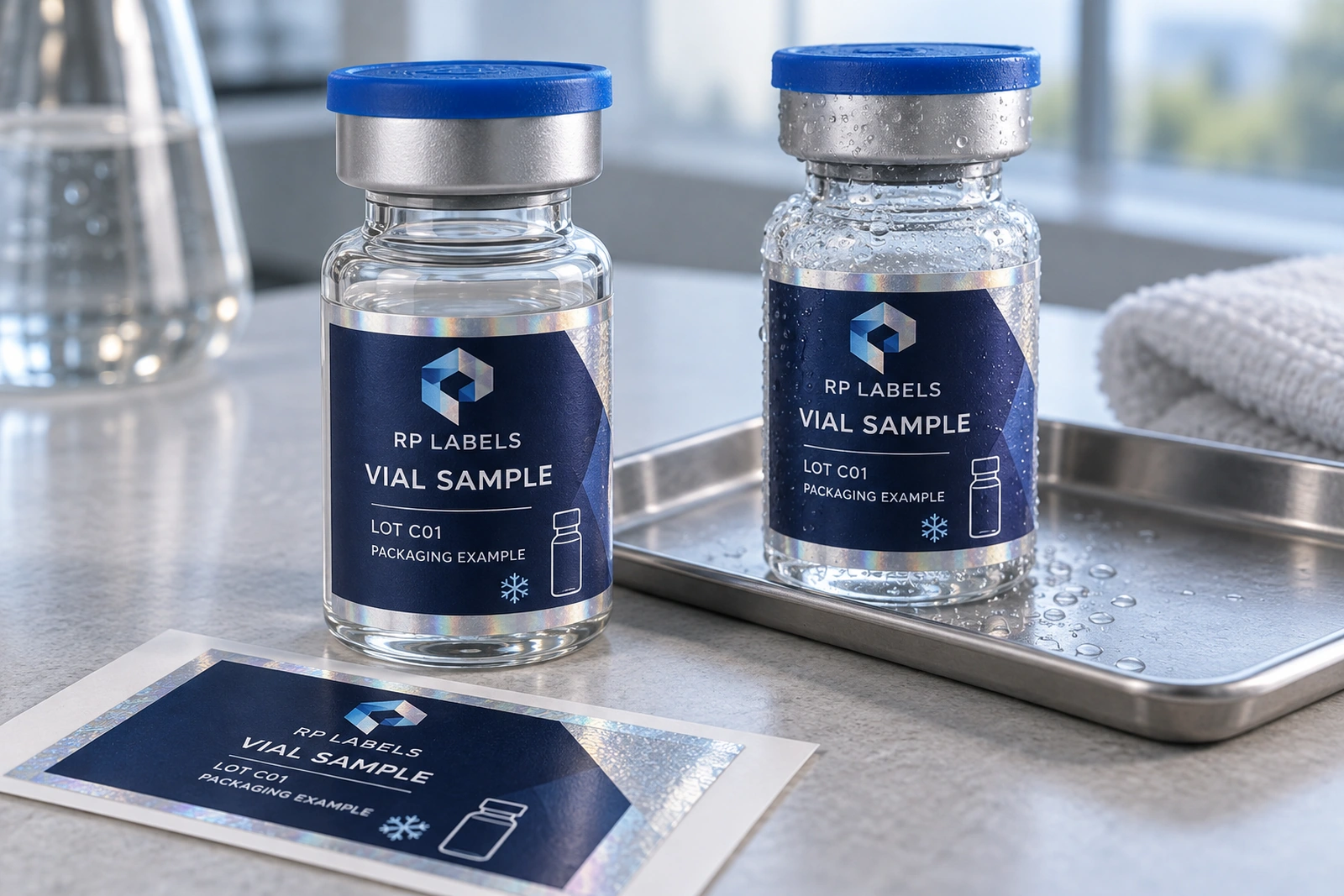
A quote that says “suitable for cold storage” leaves an expensive question unanswered: will you apply the label before the vial is chilled, or after it comes out of storage? Those are different jobs. My first purchasing question would be about the surface at the moment of application, before discussing a stronger adhesive or a more attractive finish.
The label, glass, contents and handling process need separate consideration. A waterproof-looking face film does not establish that the adhesive will bond to damp glass. Equally, an adhesive that performs after a bond has developed may have different requirements when that bond is first formed. Ask for the relevant construction data and a sample trial, rather than treating “cold resistant” as a complete specification.
Separate the two temperature questions
Application temperature describes conditions when the label is attached. Service temperature describes the conditions an applied construction is intended to encounter. A manufacturer's values belong to a particular material, adhesive and test context; they are not interchangeable numbers for every label carrying the same appearance.
For example, an Avery Dennison film product data sheet lists minimum application temperature separately from service temperature and describes water exposure after application to a dry surface. This illustrates why both questions matter. It does not identify the construction RP Labels will supply for your order or prove suitability for your container.
Write down the actual sequence: empty glass arrives, containers are filled or handled, labels are applied, and the finished packaging enters storage. Include any waiting period available between these steps. Your supplier can then discuss a sample against a real process instead of guessing which temperature you meant.
Turn the cold-label request into a process brief
Use one row for each actual handling stage. The fields below ask for observations and supplier confirmation; they prescribe no temperature, waiting time or standardized test. Keep product-handling constraints set by the responsible technical team fixed while the proposed label is reviewed.
| Process stage | Buyer input | Evidence to request for the offered construction |
|---|---|---|
| Before application | Actual outside surface, coating or residue, and visible moisture | Whether the identified application conditions are represented |
| During labeling | Container and environment conditions; hand or machine process | Supplier instructions for this candidate, not a generic freezer claim |
| Before storage | Available interval and any fixed handling restriction | Construction-specific conditioning requirements and unresolved differences |
| Storage and return | Actual sequence, duration and relevant environmental changes | A representative review of the agreed sequence |
| Reading or scanning | Information task, lighting and ordinary handling | Separate observations for attachment, print and usable information |
If an application condition is missing from the supplied evidence, keep that part of the decision open. Ask whether an available alternative or a permitted process change can be assessed; do not silently substitute dry room-condition application for the real cold or damp surface. If the process is fixed, the candidate must be reviewed against that constraint.
Record each candidate reference and which stages the specimen actually represents. A sample that remains attached after one storage observation does not by itself establish repeated-cycle, freezer, chemical or lifetime performance. Preserve any untested stages in the inquiry instead of removing them from the brief. Use the cold-label inquiry with this sequence, container dimensions and quantity per design to request the next relevant evidence.
Two buyers can need different constructions
Consider a hypothetical packaging operation that labels dry vials at room conditions before placing them in refrigerated storage. Its priority is a reliable bond through the later storage and handling cycle. There is time to review the supplier's recommended application conditions and conditioning period before chilling. A cold-storage requirement alone should not force it into the most specialized adhesive available.
Now consider a second hypothetical buyer adding identification to already chilled vials. Moisture may form when those containers meet warmer air. That buyer needs to describe surface temperature and condensation at application, plus any permitted drying or process changes. Simply ordering the same attractive foil film as the first buyer would leave the hardest part unresolved.
Neither example is a product-storage recommendation. Follow the requirements for your actual contents and operating procedure. Do not warm or otherwise change a controlled product merely to make a label easier to apply. If the packaging process cannot change, say so at the start of the material discussion.
Build a sample comparison around your process
Keep the container geometry, application method and artwork consistent when comparing candidate constructions. A supplier cannot learn much from a trial where one label is hand-smoothed onto clean dry glass and another is hurried onto a different damp bottle. Record what happened rather than naming a winner from memory.
- Identify the actual container, including its surface finish and usable straight-sided area.
- Record the application environment and whether visible moisture is present.
- Follow the candidate construction's recommended application and conditioning procedure.
- Inspect after the real storage and handling sequence, including return to the conditions in which staff read the label.
- Note lifting, movement, clouding, print damage and readability separately; photograph the same areas for each candidate.
This is a purchasing comparison, not a standardized validation protocol. Agree on any formal testing your product or organization requires with the appropriate technical team. Do not turn a short tabletop trial into a lifetime, freezer or medical-use claim.
Face film and adhesive solve different problems
A face material can affect moisture exposure, flexibility and appearance. The adhesive determines another part of the relationship with the glass. Printing, protective layers and any variable-data area add further decisions. A label can remain attached while its information becomes hard to read, or remain readable while an edge lifts.
Separate those failure descriptions in your notes. “The label failed” invites an unfocused replacement. “The lower edge lifted after the specified handling cycle, while the text remained clear” gives the supplier something useful to investigate. If a curved surface or seam is also involved, use the existing edge-lift purchasing guide alongside the temperature discussion.
For reflective designs, check the wording under the light used by staff. Condensation and reflections can make an already crowded information panel harder to inspect. Choosing a quiet, opaque text area may be more useful than increasing the amount of holographic coverage.
What to send with the inquiry
Include container photographs, measured dimensions, the label size, the application sequence, relevant temperatures, moisture exposure, intended storage duration and quantity per design. Explain which process details are fixed and which could be reviewed. Attach your artwork and describe how staff will read or scan the finished vial.
Use the material and finish guide to frame the discussion, then request a sample-led cold-vial label quote. RP Labels can discuss orders from 100 pieces per design, subject to specification. Ask the team to confirm the construction and sample plan before you commit to the printed run. A useful quote starts with the right application description, not the word “freezer” in a message.
Frequently asked questions
Does cold-storage suitability mean I can apply labels to wet glass?
No. Ask about application conditions independently. A construction intended for later cold storage is not automatically intended to form its initial bond through condensation or surface water.
Should I choose a film label instead of paper?
Discuss the complete construction and exposure. Face material alone cannot settle adhesive suitability, print durability or the performance of a protective layer. Compare actual candidate samples on the intended vial.
How long should labels sit before chilling?
Request the recommended conditioning time for the proposed construction and application process. There is no universal waiting period that this guide can apply to every adhesive, container and environment.
What if the vials must remain cold during labelling?
State that constraint clearly. Provide the real application conditions and involve your technical team. Review suitable materials or permitted process changes without altering the required handling of the contents.