Custom Vial Label Lead Times: What Starts the Production Clock?
Ask what starts the clock
The packaging plan has a target date, but the label file still has two unresolved lines. Someone writes ten to twelve days into the schedule. From which event: the first enquiry, payment, material confirmation, final artwork approval or dispatch? Until that is clear, the number cannot tell the buyer when usable labels will arrive.
I would turn a custom vial-label lead time into named milestones before promising a packing date. Confirm the starting event, the work covered and the unresolved conditions. A short written sequence is more useful than an optimistic delivery date that quietly includes several different businesses’ responsibilities.
Separate five events that are often compressed into one
For custom peptide vial labels, the enquiry may begin with an incomplete specification. Dimensions, quantity per design, material proposal and artwork can each need confirmation. Discussion at that stage is useful, but it is different from an instruction ready for production.
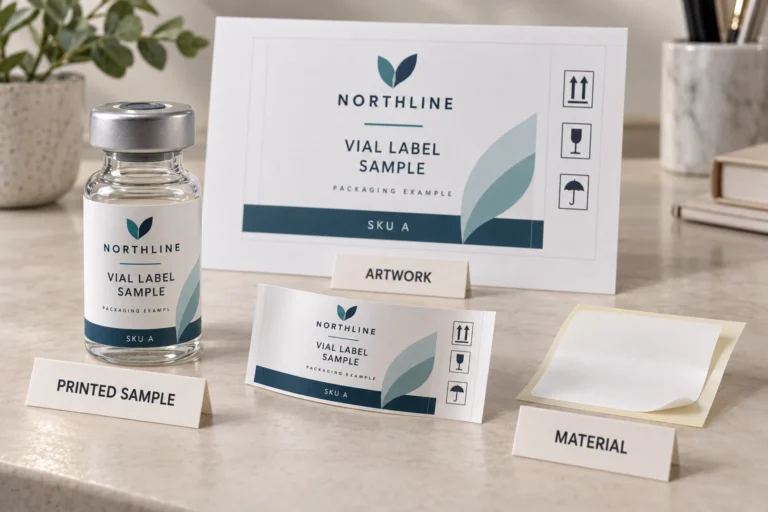
A digital proof review is another event. It identifies the proposed wording and layout for approval. If a physical sample is needed, define what it represents and whether that review must occur before the production release. Do not assume that approving a generic sample approves an artwork-specific printed result.
Production and transport then need their own entries. Finished labels are not necessarily dispatched labels, and dispatch does not establish arrival at the destination. If a packer has a receiving or application review, usable stock may require another step after delivery.
Build a milestone record with unknowns still visible
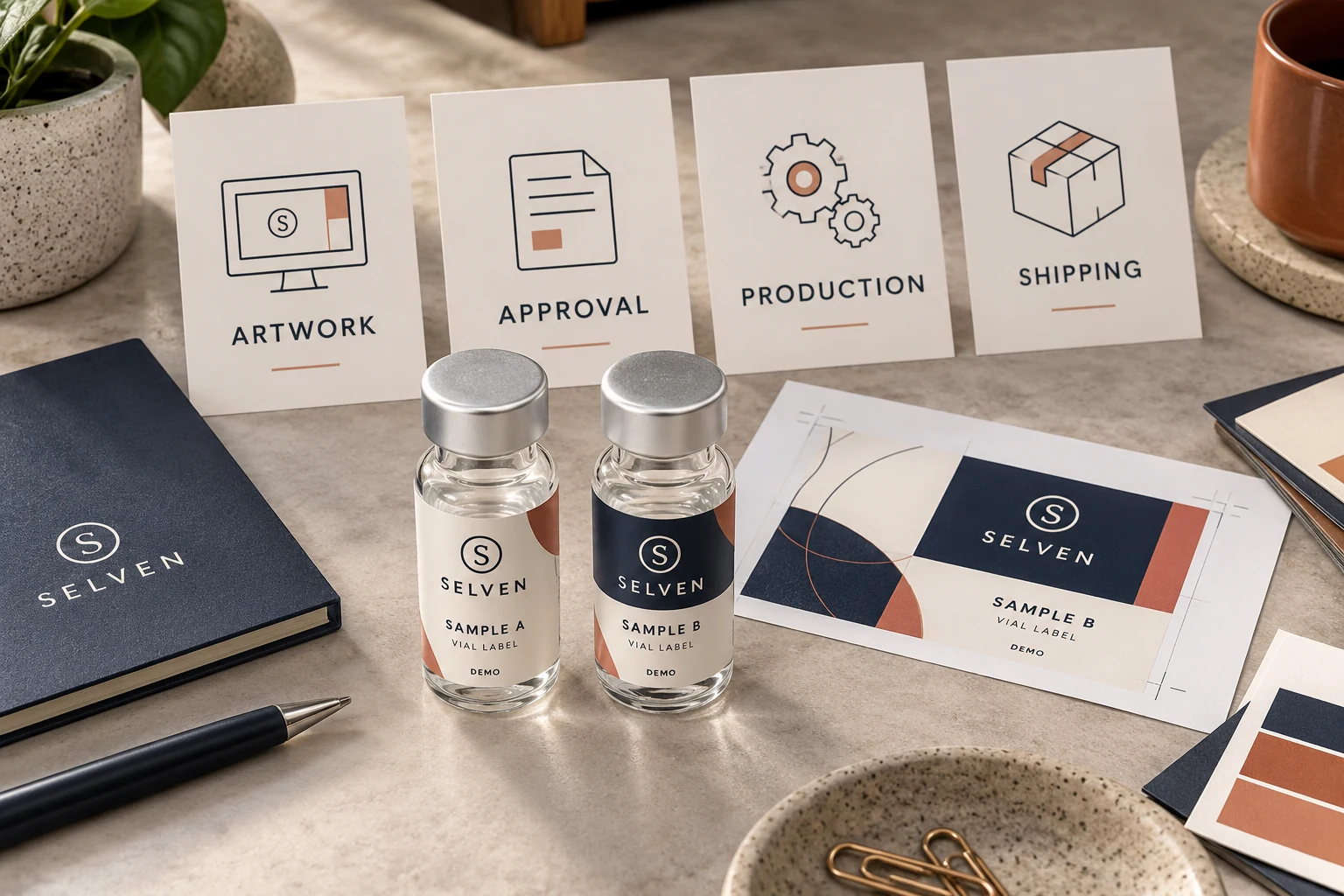
Use a table that identifies the event and the evidence needed to close it. Enter actual dates only when confirmed. There is no benefit in filling every blank with an estimate and later treating the estimate as an agreed commitment.
| Milestone | What needs confirmation | Useful record |
|---|---|---|
| Purchase brief ready | Vial, construction proposal and quantity per design | Identified specification with open questions listed |
| Artwork released | Exact revision and authorized approval | Supplier-accepted final release reference |
| Sample review, if required | What the sample represents and the decision it supports | Recorded acceptance or remaining changes |
| Production complete | Agreed work scope and completion basis | Confirmed status against the released job |
| Transport and receiving | Destination, dispatch arrangement and receiving requirements | Confirmed shipment plan and actual arrival status |
The table is a coordination aid, not an RP Labels order-tracking service. Ask which milestones apply to your job, which can overlap and which depend on an earlier decision. Do not invent parallel processing merely to make the timeline fit.
Use the published timing with its conditions attached
RP Labels’ current guidance describes typical samples in one to two days after confirmation and typical production in ten to twelve days after final approval. Shipping is confirmed separately. Those are conditional planning references, not a promise that every order reaches every destination within the production period.
Ask what confirmation means for the requested sample and what final approval must include for the proposed order. If material, dimensions or artwork remain unsettled, identify who needs to resolve them. A buyer should not infer that an initial email starts all production work.
Also ask how the supplier states days for the particular quotation rather than converting the guidance into an unsupported calendar calculation. The agreed job schedule should make its basis explicit. No general article can confirm a supplier’s current availability for your exact specification.
A draft launch and an unchanged repeat need different conversations
Consider an illustrative first-launch buyer whose vial dimensions are settled but whose product wording remains under review. The useful early action is to discuss a conditional specification and establish what information is still needed. It is premature to promise the final arrival date as though the artwork had already been released.
Now consider an illustrative repeat buyer with an accepted construction and an unchanged approved file. The conversation can concentrate on confirming that those references remain valid, the required quantity, supplier availability and transport. Even this buyer should check whether anything has changed rather than assuming the previous schedule repeats automatically.
The first buyer does not need to stay silent until every detail is ready. Early discussion can uncover dependencies. The distinction is between exploring feasibility and receiving a confirmed production arrangement. These examples describe planning choices, not actual customer delivery results.
Work backward from the date you need usable labels
State the date and place where labels must be available for the intended task. Then identify transport, receiving and any review that sits before that task. Ask the relevant parties to confirm their own portion. Avoid making a courier estimate stand in for a printer’s production commitment or a packer’s release decision.
The contract-packer handoff guide explains the wider coordination roles. Use it when another facility receives or applies the labels. The timing question here is narrower: which event starts each period, and which unresolved item currently controls the next step?
If the dates cannot fit, discuss genuine alternatives. Keeping an already accepted design, postponing an optional finish change or moving the packing plan may be more workable than demanding an unsupported rush promise. Any alternative service, quantity or split delivery still requires explicit agreement; it is not automatically available.
Test the required date against named owners and open gates
Start at the task that needs usable stock, then ask the responsible party to supply each preceding milestone. Leave dates blank until there is a stated basis. Requested, proposed and confirmed dates should remain visibly different; a planning table does not reserve capacity.
| Work backward from | Input from the responsible party | Stop or reopen the plan when |
|---|---|---|
| Usable stock at the packer | Required task, location and stock-release owner | Receiving or application review has no agreed time |
| Arrival and receiving | Actual receiving conditions and transport proposal | An arrival estimate is copied as a guarantee |
| Dispatch-ready order | Confirmed packing and handover basis | Production complete is assumed to mean dispatched |
| Production release | Supplier-confirmed start condition and work scope | Material, artwork or quantity remains unresolved |
| Evidence and approval | Required sample purpose, released revision and approver | A generic sample or working file is treated as final approval |
If one approval is still open, name its owner and the next decision rather than subtracting the typical production period from the event date. Discuss a simpler already-approved specification, a later packing date or another explicitly confirmed route. Do not omit a necessary sample review solely to make the dates fit. A reduced quantity or staged delivery is an option to ask about, not an offered rush service.
For the timing inquiry, send the target usable date and destination, quantity per design, current artwork status and the unresolved gate. Ask for a milestone-based feasibility response before telling another team that the order will arrive. Retain the confirmed response with the released job reference.
Treat a changed file as a changed schedule question
When the approved revision changes, ask which work has already happened and whether the replacement affects the confirmed sequence. A small visual edit can have a different consequence before release than after printing. Do not calculate a new arrival date until the actual job status is known.
Keep one current schedule reference with the specification and approved artwork. Record who confirmed it and which conditions remain open. This makes a later status question specific enough to answer without reconstructing several email chains.
Questions about custom vial-label timing
Does sending artwork start the production lead time?
Not necessarily. Submission, review and final approval are different events. Ask the supplier to identify the required release and starting condition for the actual quotation.
Are sample time and production time interchangeable?
No. They describe different deliverables. Confirm the sample’s purpose, whether it is required before production, and what review remains afterward.
Does the production period include international shipping?
RP Labels confirms shipping separately. Provide the destination and distinguish production completion, dispatch, arrival and any local receiving step.
What information makes a timing enquiry useful?
Send the vial dimensions, SKU list, quantity per design, artwork status, delivery destination and target usable date through the project enquiry form. Identify the decisions still open. Request a milestone-based response so the next action addresses the actual dependency.