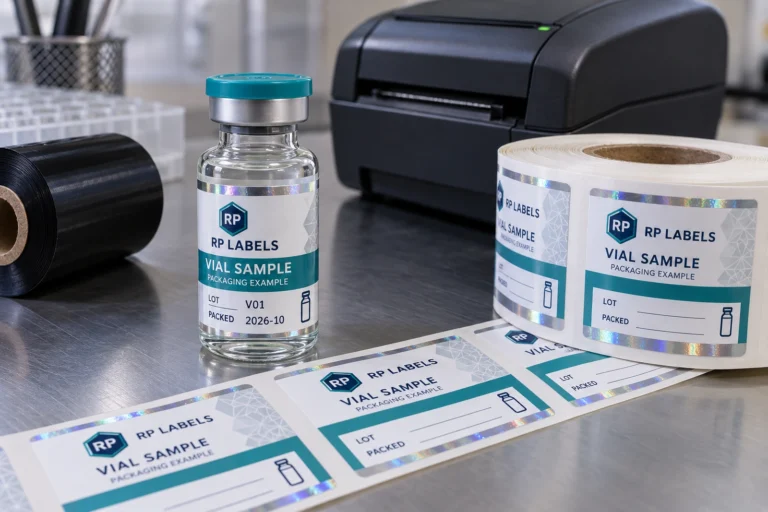
One Lane or Several Across? Confirm the Finished Vial Label Roll Layout
A production layout is not the roll your packer receives
A quotation or proof may show several labels across a wide web because that arrangement suits printing. The packer may need a finished roll containing only one label across. Confusing the converter’s production layout with the delivered layout can leave both sides believing they approved the same job.
Before final approval, ask how many lanes of labels will remain on each finished roll. Show the intended feed direction and liner width. Do not infer the answer from the number of labels shown on a proof sheet or from the total quantity ordered.
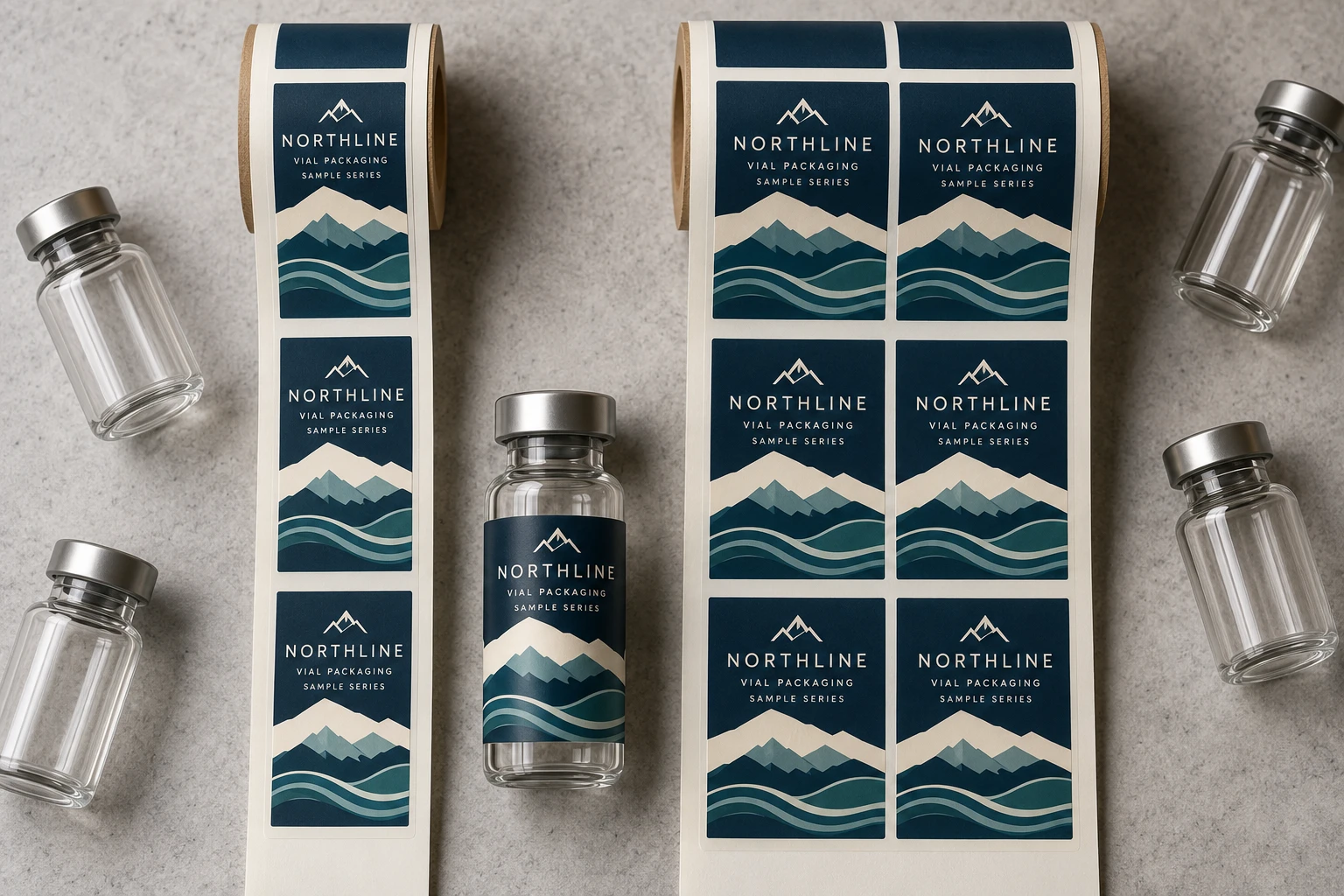
Define a lane in the delivery drawing
For this review, a lane is a line of labels running along the web in its feed direction. Two labels beside each other across the liner form two lanes. Two labels one after another along the same narrow strip do not.
Use a drawing that marks the web edges, direction of travel, label orientation and number of lanes across. Include units for the finished liner width and any spacing requirements supplied by the packer. The converter should confirm what it will deliver, not only how it proposes to arrange the print run internally.
A single design can appear in multiple lanes, and different designs can also be arranged across a web. Neither arrangement should be assumed suitable. If more than one SKU is involved, identify which design belongs in each delivered lane and how rolls will be labeled.
Keep three layouts separate
The artwork layout controls the design within the finished label. The production layout controls how the converter organizes its work. The delivery layout controls what the buyer or packer receives. A change in one may require another approval, but the three are not automatically identical.
| Layout | What the buyer needs to establish | What should not be inferred |
|---|---|---|
| Individual label artwork | Correct design, orientation and cut relationship | Finished roll lane count |
| Converter production arrangement | Any relevant constraints that affect the quoted result | That a wide production web will be delivered unchanged |
| Finished roll presentation | Lane count, liner width, direction and SKU identity | Compatibility with an unnamed machine |
| Packing and roll labels | Which finished rolls contain which design and quantity | Quantity per lane from a total order number |
The packer’s written requirement is the useful starting point. Ask the converter to acknowledge it and identify any changes needed. Avoid selecting dimensions or gaps from an unrelated online example; the actual equipment and construction determine what needs confirmation.
Clarify quantity before comparing prices
A statement such as “one thousand repeats” can be ambiguous when several labels occur across the web. Ask whether the quoted unit is individual usable labels, repeats, rolls or length. Record quantity per design and, where relevant, per lane or roll.
Do not assume that a multi-lane arrangement automatically saves money for the buyer. Any production benefit must be considered alongside finishing, roll division, packer compatibility and identification. A lower unit price for a presentation that requires unplanned handling may not answer the original purchasing task.
For custom vial label purchasing, submit the intended finished format with the artwork and quantities. Each design and specification needs confirmation; a total starting quantity is not a promise that arbitrary lane and SKU combinations are available.
Two illustrative approvals
In one example, a proof shows the same vial label several times across a page. The packer’s brief requires a narrow single-lane roll. The buyer asks the supplier to confirm the final lane count and width rather than rejecting the production proof merely because it shows multiple copies. The production arrangement may be entirely compatible with the requested finished delivery after the supplier’s confirmed finishing process.
In a second example, the buyer actually requests two different SKUs side by side for a particular handling task. A single-lane sample cannot demonstrate that delivered arrangement. The buyer needs a sample or documented review showing both lane identities, orientation and the packer’s requirements. Here, reducing everything to a generic “roll labels” description would omit the central decision.
These examples are hypothetical and do not establish an RP Labels finishing capability. The supplier must confirm the requested presentation, and the packer must confirm whether it suits the actual application process.
Review the sample at the point of delivery
Ask whether the sample represents the finished supplied roll or an intermediate production web. If it is intermediate, identify which remaining operations determine the final lane count and liner width. Do not approve a machine-delivery requirement from an unfinished sample without recording that limitation.
Check the supplied orientation against the actual artwork reading direction. A correct lane count can still carry the wrong leading edge. Confirm the relationship between the physical web, the artwork and the agreed unwind arrangement rather than treating them as independent pictures.
Retain the accepted finished-roll drawing with the order. If the converter later proposes a different production arrangement, ask whether it changes the delivered specification. The buyer need not control every internal production choice, but any change that affects the agreed output should be visible.
When the simpler arrangement wins
For a project whose packer requires one lane, a confirmed single-lane delivery is usually the relevant comparison. A more elaborate arrangement deserves consideration only if it serves an identified task and is supported by the packer. More labels across a web are not an improvement by themselves.
Conversely, a special handling process may genuinely require multiple lanes. Do not reject that need because single-lane rolls are familiar. The right question is which finished presentation performs the agreed task with clear SKU and quantity control.
Frequently asked questions
Does a multi-up digital proof mean a multi-lane delivery?
No. It may describe a production or page arrangement. Request a separate confirmation of the finished roll lane count, liner width and feed direction.
Can I convert a multi-lane roll myself?
Do not assume an improvised conversion preserves the required edges, dimensions or handling performance. Ask the supplier for a confirmed finished presentation and clarify any necessary service or recovery option.
Is lane count enough to approve a roll?
No. Orientation, liner width, spacing, core and diameter limits may also matter. Use the actual packer’s requirements and keep them together in the delivery brief.
If the job actually needs manual picking from sheets, the mixed-SKU sheet guide answers the different arrangement question within that format instead of forcing a roll-lane requirement onto it.
Submit a finished-roll requirement
When you request a quotation, provide the label dimensions, quantity per SKU, artwork and a drawing of the required finished lanes. Add the packer’s liner-width, orientation and roll requirements. Ask the supplier to distinguish the production arrangement from the output you will receive.