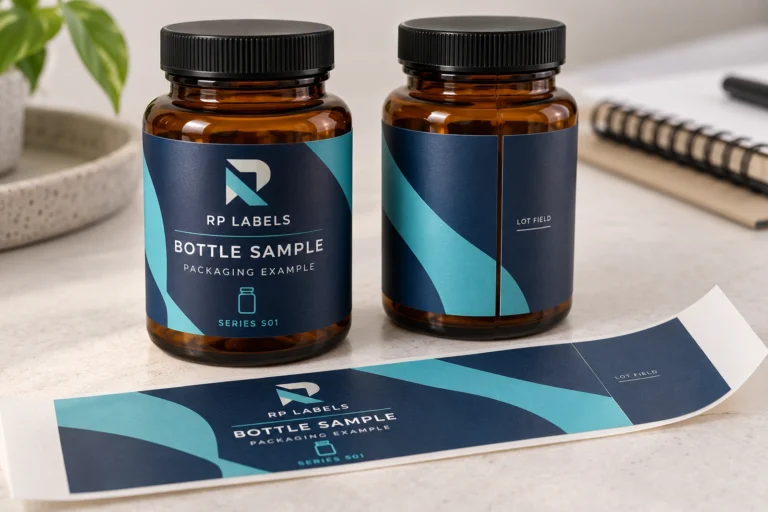
A Scratch Repeats in the Same Place: Separate Print Pattern from Handling
Map the mark before choosing a tougher finish
A pale line appears across several vial labels. If it repeats at the same position relative to the artwork, it deserves a different investigation from random marks introduced while loose vials rub together. Before ordering a thicker protective layer, map the repeated feature on identified specimens.
The first decision is whether the observation belongs to the supplied printed pattern, a repeated contact point or irregular later handling. A repeat alone does not identify a press component or prove a manufacturing fault. It does give the supplier a more useful question than “the labels scratch easily.”

Compare the same reference frame
Lay unused labels in the same orientation and identify their position in the available strip or stack. Mark the location of the line relative to a stable artwork feature and the physical cut. Keep enough of each label visible that the relationship can be checked.
Then compare applied labels and, where relevant, their position in trays or other packaging. A mark repeating at the same artwork coordinate is not necessarily the same as a mark repeating where each vial contacts a divider. Both patterns can be informative, but they point to different records.
Do not scratch an intact reference to make it resemble the complaint. Preserve unused and affected specimens separately. If the only available examples have already been handled extensively, state that limitation rather than describing their condition as received.
Use a pattern record
| Pattern | Evidence to retain | Next useful review |
|---|---|---|
| Same mark on consecutive unused labels | Continuous strip, roll identity and artwork position | Supplier’s file and output assessment |
| Same contact area after packing | Applied specimens and packaging relationship | Pack-out and surface-contact review |
| Irregular marks after loose handling | Handling stage and affected surfaces | Actual abrasion exposure and finish suitability |
| Mark visible only in an image | Same specimen viewed directly | Lighting, reflection or image representation |
The pattern record should include how many specimens were examined and which portion of the stock they represent. Avoid extrapolating a defect rate from a handful of selected examples. An observed repeated mark can justify a hold or further inspection without supporting a whole-order conclusion.
Compare the artwork before diagnosing abrasion
Check whether the apparent line is present in the approved file or intended graphic. A deliberately distressed texture or fine pale rule may resemble a scratch when seen on a small curved label. If the feature is part of the accepted artwork, a new finish will not remove it.
If the file does not contain the mark, give the supplier the identified unused specimens and approved revision. Ask it to assess the output. Do not name a damaged roller, plate or other machine part from the photograph. The converter has production information the buyer does not.
For custom vial label orders, retain the approved artwork and physical reference together. Their different roles matter: one states the intended design; the other shows what was accepted in the actual construction.
Two illustrative review paths
In one hypothetical order, a fine pale line appears through the same letter on a sequence of unused labels. The buyer retains the strip and checks the approved file. If the line is absent from the file, the supplier has a focused output question to investigate. Adding a protective laminate without reviewing the repeated mark would not explain its origin.
In another order, labels are clean before packing but develop marks at the point where each vial touches a rigid divider. The packaging relationship deserves attention alongside the surface finish. A revised divider or handling arrangement may be a fair alternative to changing the entire label construction.
These examples are not actual production findings. They show why a spatial pattern and a timeline can help separate the next investigations without claiming a root cause prematurely.
Ask the correction to address the observed mechanism
If the issue is in the supplied output, request an identified corrected sample and an explanation of what will be checked. If it arises during a known contact route, define that route and the relevant appearance requirement before comparing protective finishes.
A more elaborate finish may be appropriate when supported by the actual exposure and sample evidence. It may be unnecessary if a preventable packaging contact is the main problem. Conversely, a handling change should not be used to excuse output that already differs from the approved reference before packing.
Keep the comparison practical. Identify the printed information that must remain readable and the decorative areas whose appearance matters. Do not demand an absolute scratchproof guarantee in place of a defined review. A single attractive photograph cannot establish resistance to every contact condition.
Record the accepted result and its limits
Retain the old observation, corrected or alternative sample and the conditions reviewed. If the change involves artwork, finish or pack-out, identify each revision separately. This allows a repeat order to preserve the accepted combination rather than copying only the new material name.
If only a limited sample was assessed, keep that scope visible. The result may support the next purchasing decision without proving every future shipment or handling route. Unknowns should remain open questions rather than become confident marketing claims.
Frequently asked questions
Does a repeated line prove a printing-machine defect?
No. It establishes a pattern to investigate. Check the approved artwork, supplied specimens and relevant handling relationship before assigning a production cause.
Should every scratched label receive laminate?
No automatic choice is justified. Identify whether the mark predates handling and what actual contact occurs. Compare a proposed finish with other relevant corrections on the same defined task.
Can I count only the visibly damaged labels?
For an acceptance decision, agree the inspection and counting scope with the responsible parties. Selected examples document a concern but do not necessarily establish the full affected quantity.
If the marks arise through an identified later contact route, the scuff and pack-out guide helps define that exposure before selecting a protective finish.
Submit a pattern, not just a close-up
For a focused label review, send the approved artwork, roll or stack identity, consecutive specimens where available, photographs showing mark position and the handling stage. Include the quantity inspected and the actual appearance requirement. Ask which correction and sample would address that observed pattern.