Trial Rolls for Supplement Labels: What to Order Before Production
Order a separate label trial roll when the packer needs to establish machine compatibility before the main purchase or when setup will consume material that should not count toward delivery of usable labels. First ask what the line trial must prove. Then specify the smallest roll that can answer that question, with a separate count and acceptance record for the production order.
A loose printed sample can help with artwork and fit. It cannot reveal how the roll feeds through the intended applicator. A short roll can show threading and initial application, but it may leave full-roll handling unanswered. Give each purchase a clear purpose before asking the printer to combine them into one price.
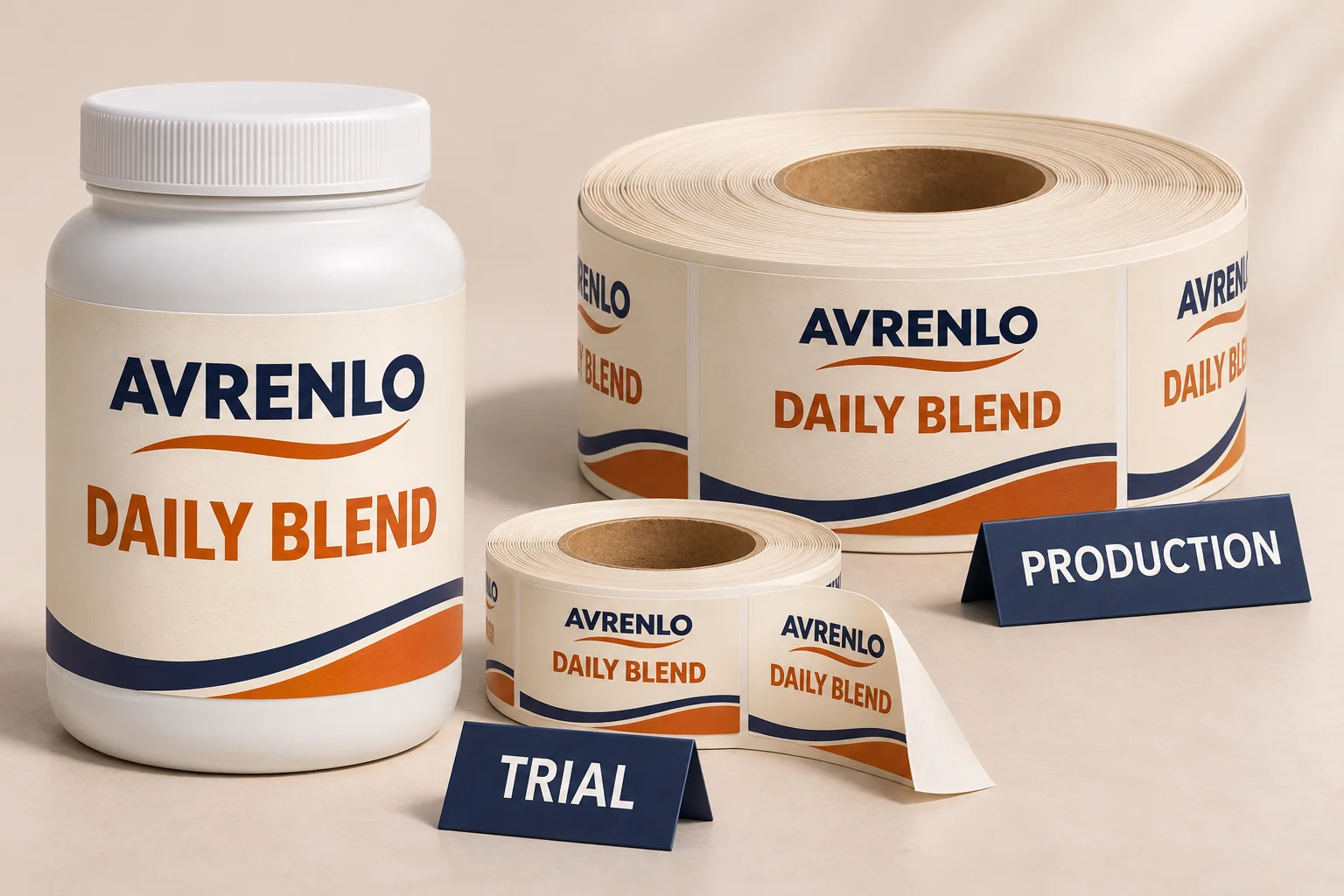
Ask the packer to name the trial decision
Decide whether you need to check basic feed and placement, qualify a changed liner or construction, or confirm the planned production roll under the conditions the line expects to run. These are different tests. A short demonstration can answer the first question without answering the last. Ask the person running the line to define the required observation and record what the trial will leave open.
For a short feed check, ask which roll and container features must match the next job. For a check of the full roll, include the outside diameter and the roll condition the packer needs to assess. Discuss any proposed deviation with the printer and packer before buying the trial. A smaller trial roll should not be treated as evidence about the first section of a larger roll that nobody loaded.
The LabelMill applicator specification identifies roll size, core and feed gap for one particular model. Use the machine documentation and the packer’s instructions for your equipment. Do not copy that model’s dimensions or assume a universal core. The roll specification guide explains which dimensions and orientation to exchange once you know what the trial needs to represent.
Make one short order brief for the trial
Have the printer acknowledge the trial specification and any differences from the proposed production order. Use the actual bottle or jar and closure where they affect presentation and handling. A substitute container can be useful when the packer wants to examine only feed, but it leaves placement and handling on the final jar open.
| Information to agree | Buyer action |
|---|---|
| What the trial must prove | Name the line, container, construction and specific observation that will allow the next step. |
| What must match | Record the accepted winding diagram, label and web dimensions, liner, spacing, materials and any printed sensing feature that matters to the trial. |
| What may differ | List any permitted change in artwork, roll diameter, finish or device setup. State which conclusions will remain out of scope. |
| Roll and jar quantity | Ask the packer for setup consumption, the planned check and any restart allowance. Confirm usable labels and the number of representative containers. |
| Disposition | Separate unused trial material, inspection specimens and rejected applications. Count none as released stock unless the buyer has explicitly approved that use. |
If blank trial labels carry the same construction and geometry, they may help answer an agreed handling question. If the process depends on a printed feature, a particular finish or accurate placement of an important artwork element, blank stock may fail to represent that part of the work. Do not pay for full production artwork solely out of habit. Equally, do not economize on a feature that the trial needs to test.
Count the trial and production quantities separately
Ask the packer to estimate material consumed in loading and adjusting, the number of packages it needs to observe and any repeat the protocol calls for. Also ask what remains as an accepted sample record. Convert those needs into labeled quantities with the printer. Do not assume that the roll can be made at any requested count, or that the number of labels is the only requirement for a usable test roll.
Consider an illustrative request for 500 usable production labels and a trial that the packer expects to consume 40 during setup and 60 during the check. Put 100 trial pieces and 500 production pieces on separate lines in the inquiry. If the printer proposes a different trial quantity, ask which trial requirement it would satisfy. The arithmetic does not prescribe a standard test size or confirm the available minimum for either line.
If trial material comes from the first production roll, agree how that consumption affects the remaining usable quantity and the status of the balance. This can be sensible when the specification and approvals are already clear and stock exposure is acceptable. When the whole construction has yet to prove that it can run, buying the full order first can leave the brand holding material it cannot use.
Close the trial with a specific decision
Ask the packer to capture the roll reference, bottle reference, where observations were made, the result and any unresolved difference. If the web feeds but the label position is unacceptable, do not record a general pass. Identify what changed and let the packer and printer decide whether another sample, construction or setup is needed. If a short roll passes but the planned full roll was outside the trial, obtain the evidence the packer requires before ordering that format.
An unchanged repeat on an accepted line may not need a dedicated trial when the buyer and packer can point to the approved specification and prior experience. Likewise, a manual launch can compare a sheet or hand-application route if it serves the actual packing plan. The trial should reduce a named uncertainty, not become an automatic purchase for all projects.
Start with custom supplement bottle and jar labels, then request a trial-roll and production quote. Send the packer’s roll drawing, jar reference, trial objective, estimated test consumption and usable production quantity per design. Ask the printer to confirm what the trial can represent, separate its price and quantities, and identify any open condition before you authorize the main order.