Small-Batch Custom Labels: Compare Cost per Design, Not Just per Piece
The cheapest label quote can still be the expensive decision. A buyer orders a large quantity to reach a lower unit price, then changes the product wording before using half the stock. The saving existed on the quotation. It did not survive the next artwork revision.
For small-batch custom labels, I would start with the number of usable labels each design needs. Then compare the complete specification and delivered cost. That sounds less exciting than a headline discount, but it gives a new brand a better way to protect cash while its range is still taking shape.
Put the quantity beside each design
An enquiry for 1,000 labels is incomplete when it covers several artworks. Is it one design repeated 1,000 times, four designs at 250 each, or a mixed order with one popular item and three experiments? Those briefs can involve different preparation, production and finishing arrangements. Do not assume a total order quantity produces the same price for every split.
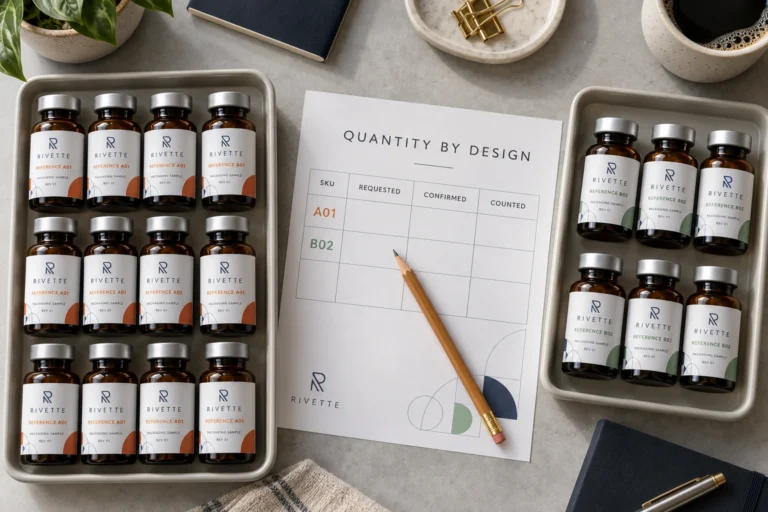
Write a simple allocation before requesting prices. Include a design reference, finished size, material, finish, supply format and quantity for each artwork. If two versions differ only in product name, still identify them separately. Let the supplier explain whether any efficiencies are possible rather than silently treating them as one design.
RP Labels accepts enquiries from 100 pieces per design, subject to the specification. That is a starting point for a discussion, not a promise that every construction or finishing combination has the same minimum. Confirm the proposed order split when requesting a written quote.
Compare like specifications before comparing prices
One quote may describe a basic paper label. Another may include film, an opaque information panel and a protective finish. A third may use a reflective construction. Putting their unit prices in one column does not tell you which offer fits the bottle or the intended use.
Ask each supplier to state the complete construction and finished dimensions. Identify the adhesive requirement through the container and application conditions. Record rolls or sheets, any artwork assistance, sample arrangements and shipping separately. A material nickname is not enough to establish that two offers cover the same job.
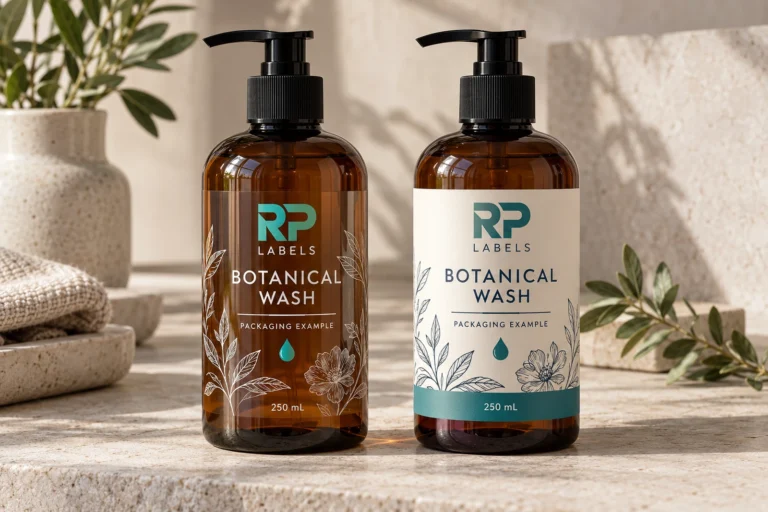
Our materials and finishes page can help you frame those choices. The economical option is the least complicated construction that meets your actual packaging brief. An appearance upgrade should have a clear purpose, such as a distinctive shelf presentation, rather than being added because another brand uses it.
Build one quote line per design before asking to combine the job
If several designs share a size, send the supplier the same line-by-line brief for two requested scenarios: the quantities you need separately, and any feasible combined arrangement it can offer. Common dimensions are useful input. They do not confirm that different materials, finishes or release dates can share preparation or pricing.
| Brief field | Buyer input | Decision before accepting a price |
|---|---|---|
| Artwork and revision | Identify every design, including a name-only variant | Do not collapse distinct designs into one unidentified total |
| Pieces required now | Quantity for each released artwork | Check the minimum for each offered specification |
| Construction and finish | Actual proposed material, adhesive and finishing | Same outside dimensions do not establish the same production job |
| Readiness | Released, awaiting buyer review, or a future forecast | Ask whether an unfinished design would hold the combined proposal |
| Supply and destination | Roll or sheet requirements and receiving point | Keep packing and delivery assumptions consistent |
| Supplier response | Confirmed grouping, itemized scope and open conditions | Record any actual efficiency; do not assume a fixed discount |
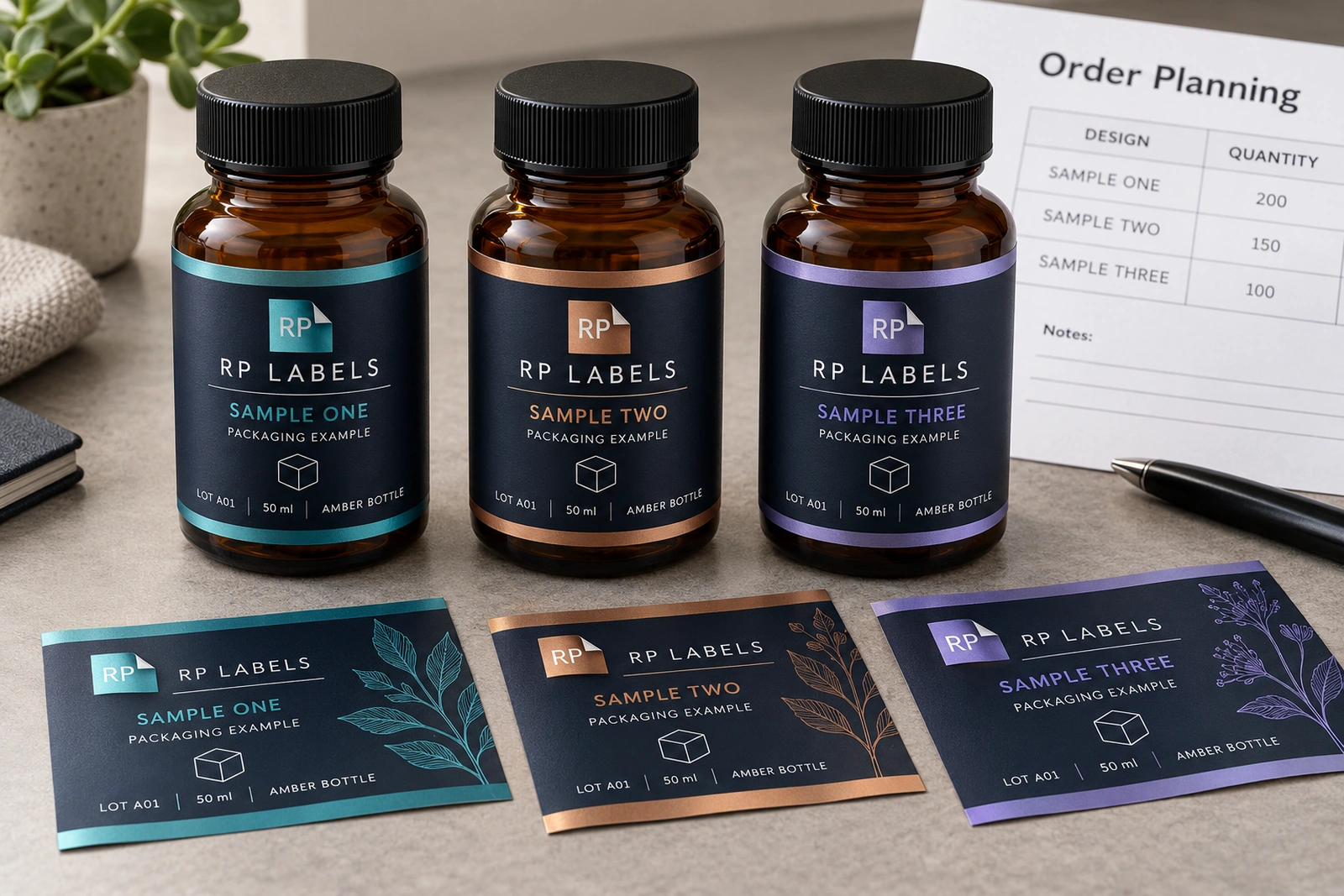
For an illustrative three-design project, two artworks may be released while the third still needs a content decision. Ask whether the supplier can quote the ready work separately and assess the third later, or whether a confirmed combined proposal requires all three releases together. Obtain the actual cost and timing consequences. Neither a split order nor waiting for the final design is automatically preferable.
Stop the comparison if one offer uses a different per-design quantity or leaves construction unresolved. Correct the brief first. If the supplier confirms no useful grouping, a transparent separate-design proposal can still be the appropriate purchase. Do not replace the response with an assumed percentage saving or treat a future forecast as a firm order.
Avery’s custom-order guidance likewise requests design count, quantity per design, material, finish and unwind information. This supports the usefulness of a complete brief; its prices and ordering services are not RP Labels terms. For custom vial labels, include the completed rows with your project inquiry and ask which grouping and per-design conditions can actually be confirmed.
Separate the first order from the likely repeat
A first order may involve resolving dimensions, arranging a sample and adjusting the design. A repeat order with an unchanged, approved specification has a different planning context. Ask for both scenarios if repeat demand is plausible, but do not invent a large future commitment simply to obtain a more attractive initial price.
Request a transparent explanation of what is included. Are there separate preparation or finishing charges? What changes if the artwork, material or size changes later? A clear answer helps you compare offers without assuming that every printer uses the same pricing method.
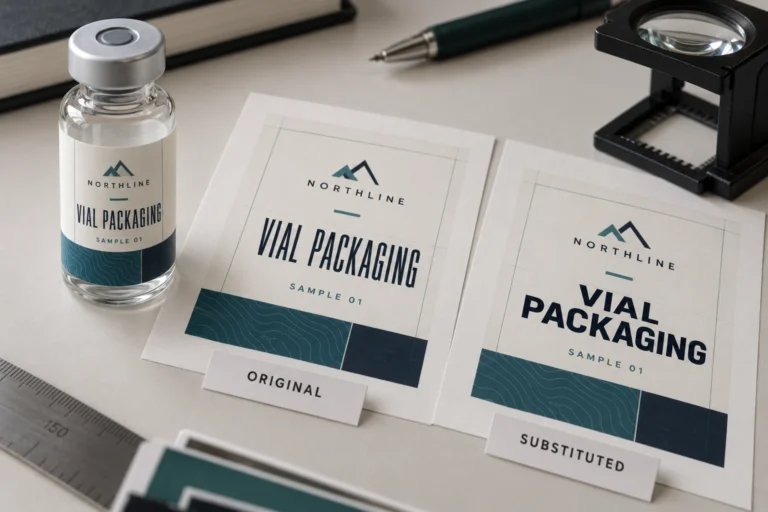
Keep the accepted specification and quote with the approved artwork. The relevant repeat reference is the complete job, not just an image of the front label. If a supplier substitutes a construction, ask for the change to be explained before accepting the repeat price.
Two illustrative budgets lead to different orders
Consider a hypothetical new brand with three designs. It expects to use 100 labels for design A, 100 for B and 300 for C during an initial launch. Ordering 1,000 of each would create 2,500 labels beyond that immediate plan. A lower price per piece does not erase the cash tied up in those extra labels.
Now consider a hypothetical established seller with one stable design and predictable replenishment. A larger quantity may make sense if storage, cash flow and expected use support it. The buyer should compare the extra purchasing commitment with the likely benefit, rather than importing the new brand’s short-run strategy unchanged.
These are planning examples, not RP Labels customer orders or quoted production rates. They show why quantity per design matters. A counterexample is an artwork version likely to change soon: even predictable sales may not justify a large stock commitment if the labels could become obsolete before they are used.
Calculate cost per usable label
Add the costs relevant to the order: labels, any separately quoted preparation or samples, shipping and other applicable landed-cost items. Divide that total by the quantity you realistically expect to use. Keep unconfirmed duties or charges identified as estimates and obtain the appropriate information for your destination.
For an illustrative comparison, imagine two otherwise comparable offers. One costs 180 currency units for 500 labels; another costs 240 for 1,000. If you expect to use only 400 before an artwork change, the planning cost is 0.45 versus 0.60 per usable label. These invented numbers explain the method; they are not RP Labels prices.
That calculation is not a forecast of waste. It makes your assumption visible. If you expect to use all 1,000, the comparison changes. The useful discussion is about expected consumption and revision risk, not a universal rule that smaller orders always save money.
Fix the uncertain details before buying more
Review dimensions on the actual container and settle the information hierarchy. A flat draft can help you choose a direction, but it is not a final physical proof. Use the free label designer for an initial concept, then ask RP Labels for free professional design assistance and a digital proof where more detailed work is needed.
Agree what the sample should represent: material, finish, print and fit. RP Labels’ usual sample preparation is 1–2 days after confirmation, while usual mass production is 10–12 days after final approval; both remain subject to the agreed job. Shipping time is separate. Build your launch plan around confirmed dates rather than treating those typical periods as guaranteed delivery dates.
Questions buyers ask about short runs
Can I combine different designs to meet the minimum?
Ask for confirmation against your exact split. RP Labels’ starting enquiry quantity is from 100 pieces per design, subject to specification. A total across several designs should not be assumed to meet every individual requirement.
Does a bigger order always reduce the real cost?
No. A lower unit price can be offset by unused inventory or a larger cash commitment. Compare the cost of labels likely to be used before the next artwork or packaging change.
Should I choose the cheapest material for a trial?
Use a construction representative of the intended order. A cheap trial on unrelated stock may help review layout but may not answer your questions about the final appearance, fit or handling.
What details make a quote easier to compare?
Provide quantities per design, finished dimensions, container material, desired finish, supply format and destination. Ask suppliers to identify what is included and what remains separately priced or unconfirmed.
Get a quote built around your launch
Send RP Labels your short-run label brief with the design allocation and the packaging you plan to use. Ask for a suitable first-order quantity and a comparable repeat scenario. The objective is a workable launch with usable labels, not an impressive discount on stock you may never need.