Outsource Vial Label Printing or Print In-House? Compare the Whole Workflow
Compare the finished job before comparing the label price
The blank stock looks inexpensive. The outsourced quote includes printing, preparation and a finished delivery. Put those two numbers beside each other and the decision appears obvious, until someone asks who will prepare every version, run the job and separate the usable labels from the rest.
For a brand buying custom vial labels, I would compare two complete workflows. What must the team do to obtain the same number of acceptable labels for each design? Keep the specification constant, then identify work that each route includes, transfers or leaves unresolved. Outsourcing can be sensible without being the cheapest route in every situation.
Write one common purchase brief
Start with the intended vial, finished label dimensions, quantity per design and approved artwork status. Add the appearance, application method and relevant handling requirements. If the in-house option uses a different construction from the outsourced proposal, record that as a difference rather than hiding it beneath the same description.
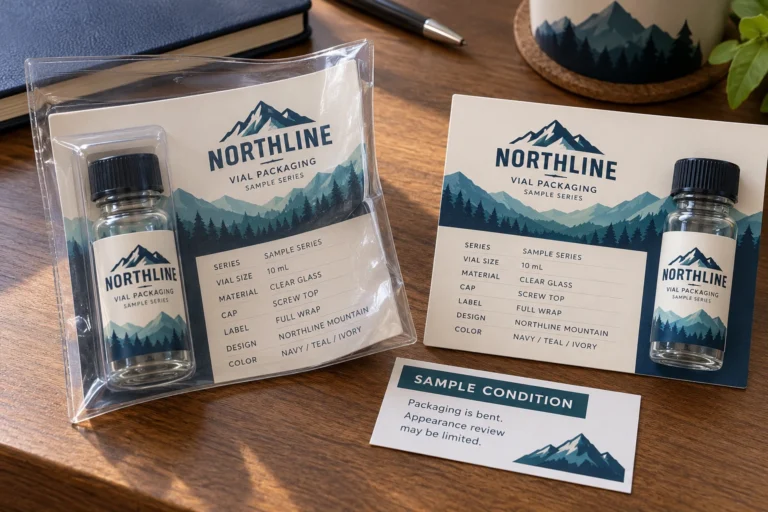
A sheet and a roll are supply formats, not proof of a printing route. Either photograph can omit important work. Ask what is actually delivered: printed and converted labels, unprinted stock, a prepared file, a sample or simply a proposed material. The example image illustrates these inputs; it does not identify which machine produced anything.
Do not add specialist equipment to the comparison unless the business really needs to acquire it. Equally, existing equipment does not make its future operation free. The useful question is which resources this particular job would consume, and whether those resources are available when required.
Count the work on both sides
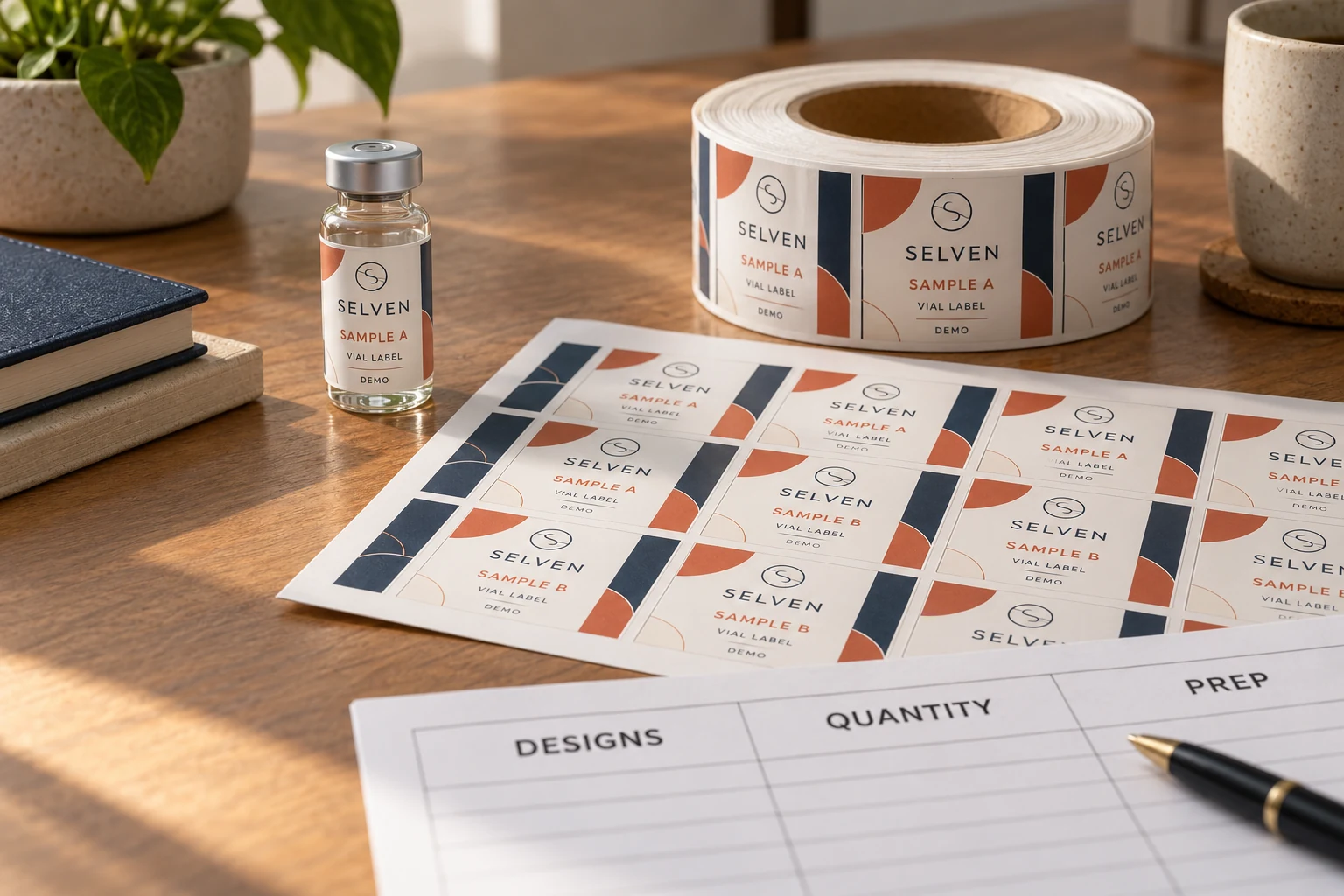
Use a small worksheet with the same rows for both options. Enter known figures from your records and actual quotations. Leave unknowns visible. A precise-looking total built from guessed labor time is less helpful than an honest list of unanswered questions.
| Input | In-house route | Outsourced finished-label route |
|---|---|---|
| Artwork preparation | Who checks and prepares each version? | What preparation is included or separately confirmed? |
| Production inputs | Compatible stock, consumables and available equipment | Confirmed construction and finished-label quantity |
| Staff work | Setup, running, separation and inspection | Briefing, proof review, receiving and inspection |
| Unusable material | Record actual spoilage rather than assuming none | Confirm the agreed quantity and acceptance arrangement |
| Delivery and availability | When can the team actually complete the work? | Production and transport confirmed separately |
Add internal purchasing rules where relevant, but keep them distinguishable from a supplier charge. Your staff’s approval time belongs in a workflow comparison. It should not be described as a hidden fee charged by the printer.
The existing small-run cost-per-design guide explains why the quantity beside each artwork matters. Here the extra decision is who performs the work, not simply how many labels to buy.
Separate the first job from the repeat job
An initial run may require finding usable source artwork, confirming dimensions and reviewing the proposed construction. An unchanged repeat may reuse some accepted inputs. Compare those situations separately rather than spreading first-job assumptions across every future order.
For an in-house route, ask who retains the working file and settings, and whether another colleague could repeat the job. For an outsourced route, identify the accepted artwork and construction references. Neither route becomes repeatable merely because a folder contains a file named final.
If the next run is likely to change, do not purchase a speculative quantity solely to lower an apparent unit cost. Record the demand assumption and the expected revision separately. Future orders remain possibilities until the business actually needs them.
Two illustrative brands can choose differently
Imagine a brand with one stable label, suitable existing equipment and a colleague who already manages a consistent small production routine. Its priority is local control and immediate access to the next modest quantity. Keeping that work in-house may be reasonable if the finished result meets the actual brief.
Now imagine a brand launching several versions while the same staff also handle purchasing and packing. Its old calculation includes stock and consumables but no preparation, checking or version separation. An outsourced finished-label proposal deserves serious consideration because it changes who performs those tasks. It still needs a comparable specification and a realistic delivery arrangement.
These are purchasing examples, not reported orders or measured savings. The second brand does not automatically save money, and the first does not automatically sacrifice quality. Their constraints are different. A sensible comparison allows either route to win when the evidence supports it.
Make the choice reversible where practical
Before changing an established workflow, identify the uncertainty that matters most. It might be appearance on the vial, a supply-format requirement or the effort needed to maintain versions. Request a proportionate sample or first-order review focused on that question, with availability confirmed by the supplier.
Keep ownership and authorization clear. The brand should retain artwork it is entitled to use and an identifiable approved output. Moving the work outside the business should not depend on copying another company’s design or assuming that every editable asset is included without agreement.
Review the first completed job against the original comparison. Record actual staff work, usable output and unresolved problems. Those observations provide a better basis for the next decision than a general belief that outsourcing or self-printing is always cheaper.
Questions before choosing a route
Is an existing printer a reason to keep every job in-house?
It is one relevant input. Check whether it fits the proposed construction, artwork, format and quantity, and whether staff time is available. Ownership alone does not answer those questions.
Should I include labor if nobody is being hired specifically for the job?
Record the work so the comparison shows its resource demand. Decide how your business values that time; do not invent an hourly rate and present it as an industry standard.
Does outsourcing remove my inspection responsibility?
No. The brand still needs to approve the purchase requirements and inspect the delivered work against the agreed reference. The tasks change; they do not all disappear.
What should I send for an outsourced comparison?
Use the printing enquiry form with the vial reference, dimensions, authorized artwork, quantity per design and intended workflow. Describe what the in-house alternative actually includes. Ask for the proposed construction, finished scope and timing so the next comparison concerns the same usable result.