Sticky Vial Label Roll Edges: Investigate Before Reordering
Locate the residue before changing the specification
A partly used vial-label roll has sticky-looking residue around an edge. The next purchase request is for less aggressive adhesive. That could be the wrong correction: attachment to the vial, movement of adhesive within the supplied stock and residue already present in a feed path are different questions.
I would first identify where the substance is observed, when it appeared and which stock was involved. Keep the affected roll traceable and separate the observation from a technical diagnosis. Do not send more uncertain stock through a machine simply to see whether the problem becomes obvious.
The purchasing decision is whether the current stock needs assessment and what must change, if anything, before an unchanged repeat. A photograph can open that investigation. It cannot prove a formulation, winding or storage cause by itself.
Distinguish roll-edge residue from bottle edge lift
A label lifting from an applied vial concerns attachment and the complete applied system. Material that appears to have moved beyond a supplied label edge is a different observation. Calling both problems weak glue can send the printer and packer toward incompatible corrections.
cab’s technical FAQ, updated in January 2026, discusses adhesive coat, flow and tight rewinding as possible contributors to ooze. It also warns about deposits in its print-and-apply context. That provides possible investigation paths, not a diagnosis of the stock on your bench or an instruction to adjust a machine.
If the actual concern is loss of adhesion after application, use the curved-bottle edge-lift guide. Here, preserve the supplied roll and residue evidence so the responsible supplier and operator can assess the stock before choosing a repeat construction.
Make an observation map that another person can use
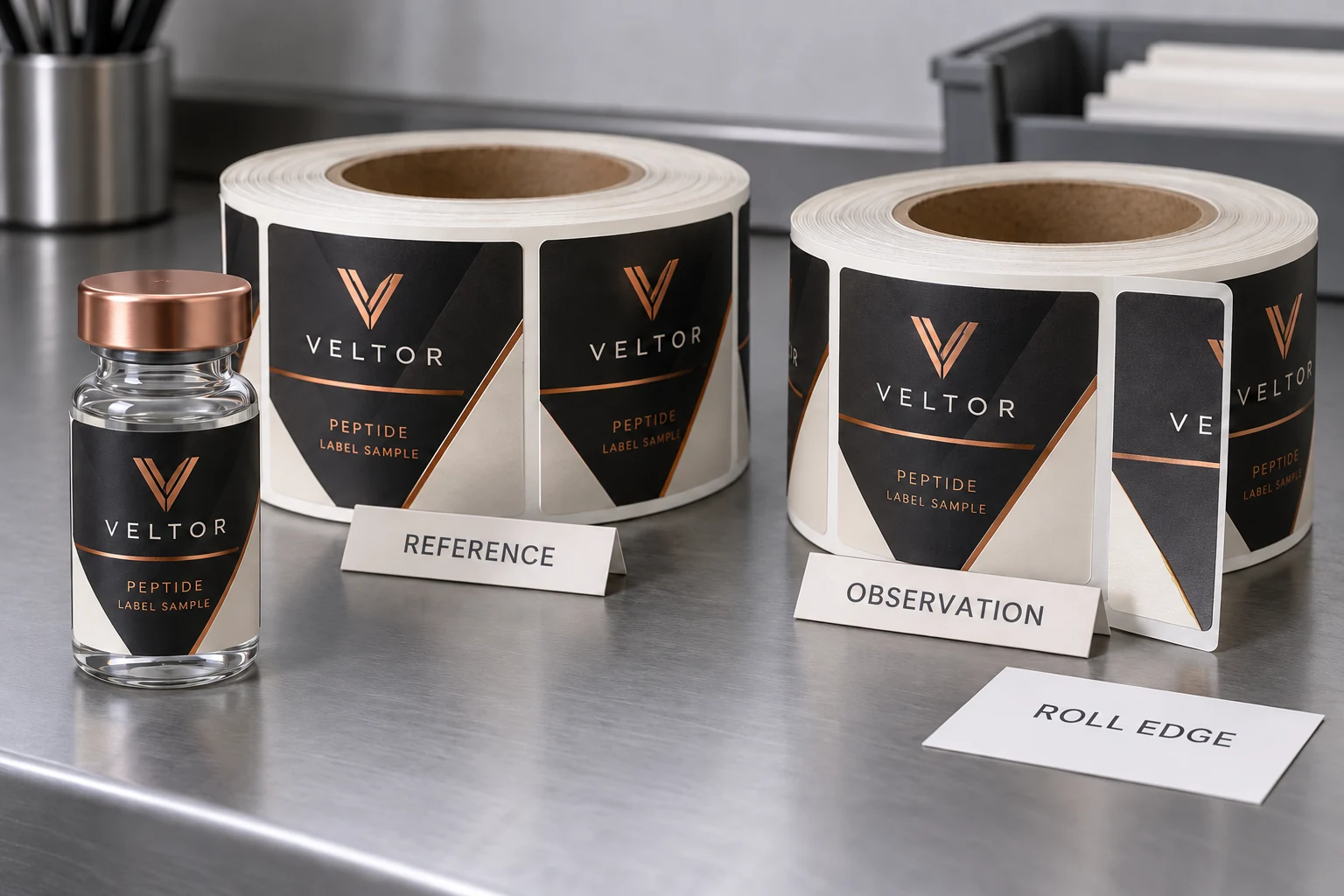
The image marks an illustrative edge observation beside an identified reference. It is not a photograph of defective RP stock, and the visible line cannot identify a substance or its cause.
| Observation | Record with it | What it does not establish alone |
|---|---|---|
| Sticky area on an unopened roll edge | Lot, package condition and location | Whether transit, conversion or another factor caused it |
| Residue noticed after partial use | Roll identity, time observed and handling history | That every roll from the order is affected |
| Deposit found in a feed path | Relevant stock references and operator’s record | Which stock originally created it |
| Residue after extended storage | Known storage and opening history | A universal shelf life or an adhesive defect |
| Clean comparison specimen | Its actual construction and history | That an unlike reference clears the affected stock |
Describe the material as observed until it has been identified. A mark could include contamination from another source. Avoid assuming that every sticky or shiny line is the label adhesive. Retain the relevant packaging and an identified specimen if the responsible team requests one.
Keep photographs close enough to show the location, with a wider image identifying the roll. A detached smear without a stock reference is poor evidence for deciding which delivery to hold. Equally, a clean front-facing label says little about the edge where the concern was found.
Compare history without declaring the cause
Ask when the roll was received, opened and used, and what is actually known about storage and transit. Where comparable identified stock exists, note whether the same observation appears there. Distinguish known records from recollections; missing temperature information should remain unknown rather than become an invented explanation.
The unused-roll storage guide covers identification, protection and construction-specific instructions. Those records can help an investigation. They do not allow a buyer to infer that an uncertain roll was definitely overheated, nor does a general storage recommendation establish a cause retrospectively.
Give the supplier the current construction reference, quantity and supplied format. Explain any later printing or dispensing step. A proposal to change adhesive needs to consider attachment to the intended vial as well as the concern on the roll. Improving one stage should not silently leave another requirement unresolved.
Keep machine decisions with the responsible operator
If the concern involves a feed path, have the operator identify affected contact areas and follow the equipment provider’s approved inspection and maintenance procedure. This article provides no cleaning solvent, tool, tension setting or instruction to work inside equipment.
Ask what must be assessed before using the affected stock again and what representative material would be needed to review an alternative. Preserve the earlier observation before changing the setup or discarding the evidence. A clean machine after maintenance would not, by itself, establish that the proposed replacement stock is suitable.
When another stock is suggested, identify what differs. It may be a revised construction, a different supplied roll arrangement or another stated change. Request an explanation and evidence tied to the proposed job. Do not convert an alternative quotation into a guarantee that all residue concerns have been eliminated.
Two illustrative observations call for different actions
Imagine a buyer finding a sticky edge area while opening an identified delivery, before the roll has entered any equipment. The useful evidence starts with the package, roll, location and received condition. The supplier can assess that report without guessing which previous job ran through the packer’s machine.
Now imagine an operator noticing a deposit after several different stocks have used the same feed path. A photograph of the newest roll’s artwork does not establish its responsibility. The operator’s stock and maintenance records matter, and the investigation may need to separate existing residue from the condition of the current roll.
These are illustrative troubleshooting situations, not actual RP Labels defects or customer histories. They show why changing all labels to a different adhesive may be premature. Conversely, keeping a familiar construction is not sufficient reason to release visibly uncertain stock without the responsible assessment.
Questions before a repeat order
Does stronger adhesion make edge residue inevitable?
No such general relationship is established here. Attachment on the vial and behavior within the supplied roll are different aspects of a construction. Ask the supplier to assess the identified conditions rather than rank adhesives through one adjective.
Can we wipe the edge and use the roll?
Do not treat an improvised cleanup as approval of the stock. Ask the supplier and responsible operator what evaluation and disposition are appropriate. Any equipment maintenance must follow its approved procedure.
Is a clean unopened roll enough to clear the whole delivery?
It is a comparison observation, not automatic acceptance of other stock. Retain lot and roll identities and use the agreed release process to determine the scope of any decision.
What should the supplier receive?
For a custom vial label review, use the project inquiry form with the affected roll and lot references, construction if known, photographs showing location, opening and storage history, and the planned printing or application setup. State whether stock is unused or partly used. Ask what assessment is needed before confirming the next order, with the cause left open until evidence supports it.