Digital or Flexographic Vial Label Printing: What Should a Buyer Compare?
Buy a defined production proposal, not a process slogan
One supplier recommends digital printing for the vial-label range. Another proposes flexographic printing. Both describe their option as economical. Before choosing a machine category, I would ask whether the two quotations cover the same designs, quantities, material, finish and revision assumptions.
Digital and flexo describe production routes. They do not, by themselves, identify a finished label’s suitability or establish the best purchasing decision. The useful comparison is how the proposed route handles this order and its likely changes. A stable repeat and an evolving range can reasonably lead to different answers.
Keep the production route separate from the color instruction
A buyer may specify a brand-color reference or ask for an output color list without choosing the underlying press route. Likewise, a digital or flexo proposal still needs an explanation of how the artwork and colors will be reproduced on the offered construction.
The existing spot-color and CMYK quotation guide addresses that color-output question. This article concerns the production and change-management route. Treating the two questions as interchangeable can make a clear-looking specification incomplete.
Ask the supplier to name the proposed route and its relevant limits. Do not rewrite the source artwork to suit a process assumption before the supplier has explained the actual proposal. An alternative route should identify any material, color or finishing change it requires.
Understand why artwork changes enter the comparison
Hally Labels’ 2021 process comparison explains raised-image plates in flexographic production and its own digital workflow. It provides a historical technical illustration of different preparation and version-change arrangements. Its service timings and business offers are not current RP Labels terms.
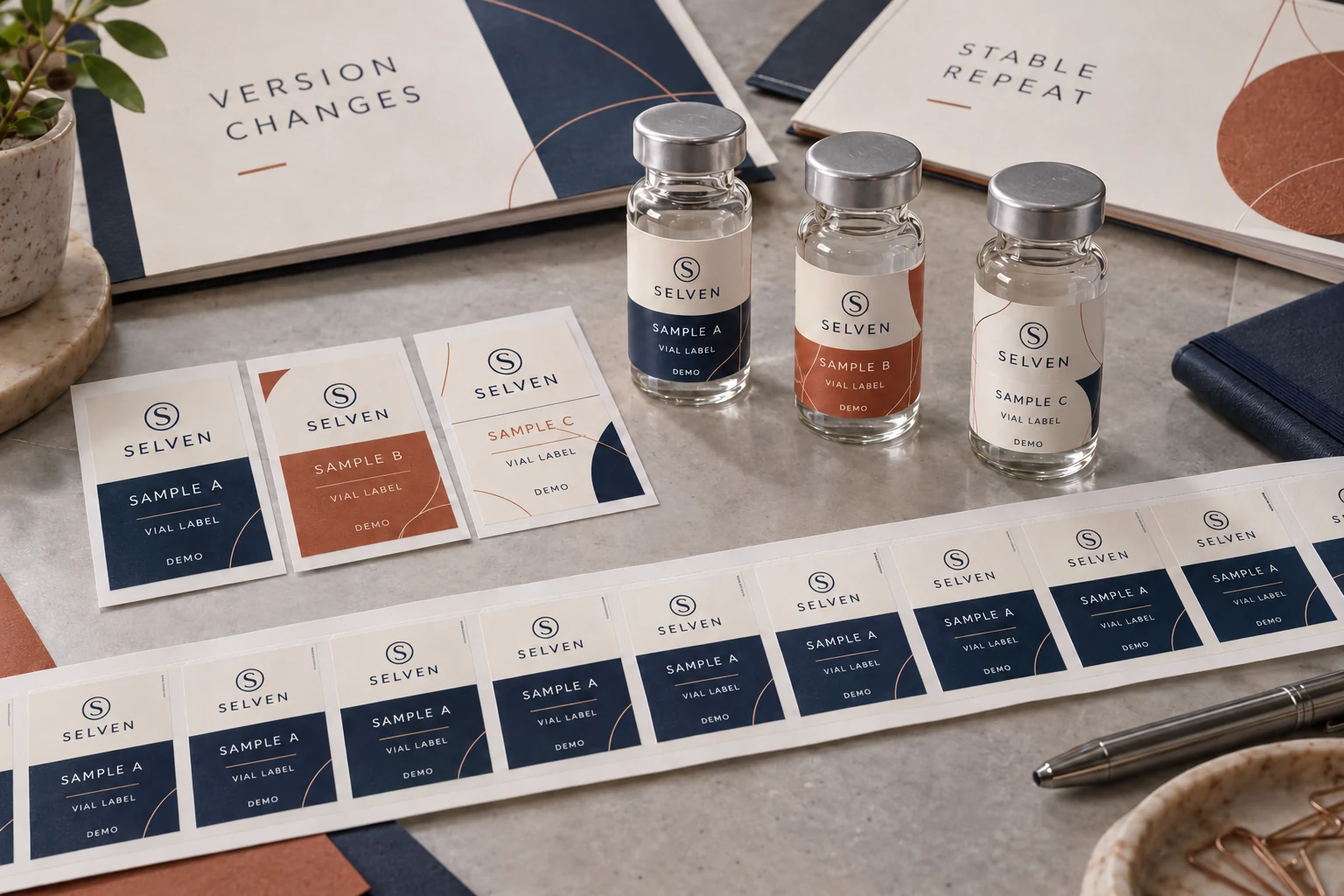
For the buyer, the practical question is what happens when an artwork changes. Which preparation needs to be repeated? Can the proposed job accommodate the design mix? What must be reviewed again? Obtain the answer for the actual system and quotation rather than assuming every printer in a category has identical capabilities.
Digital production also has real preparation, material and finishing requirements. Calling a job digital does not make all changes free or remove the need for approval. Flexographic proposals should likewise be judged on their actual arrangement, not rejected through a universal short-run rule.
Put each design and revision assumption beside the quantity
Separate one artwork repeated many times from several artworks sharing a layout. Identify which versions are approved and which may change. State whether the discussion concerns this order only or also an unchanged repeat. Do not promise speculative future volume merely to make a route look attractive.
For custom peptide vial labels, keep dimensions, proposed construction, application needs and quantity per design in the common brief. If a supplier offers a different material to fit its route, record it as an alternative construction requiring review.
There is no universal quantity in this guide at which one route becomes cheaper. The actual crossover, if any, depends on the quoted job. A number copied from another printer’s example can be misleading when the designs, finishing or production scope differ.
Compare the scope line by line
| Comparison item | What to ask both suppliers | What an incomplete answer hides |
|---|---|---|
| Preparation | What is included for each artwork? | Unstated assumptions about files or setup |
| Revision | What changes if one version is amended? | A route selected for artwork that will not stay stable |
| Construction | Which face, finish and supply format are proposed? | Unlike finished labels compared as one product |
| Sample or proof | What does the offered evidence represent? | A preview mistaken for a finished-production reference |
| Repeat | Which accepted inputs remain applicable? | An assumed repeat saving without a confirmed scope |
Keep timing and delivery on their own stated basis. A supplier’s general process description does not confirm a production slot for your order. Nor does a fast print operation establish how long conversion, finishing, review and shipping will take.
Ask for included, excluded and unconfirmed items explicitly. Do not invent preparation charges to make one route look expensive. The aim is a comparable purchase, not a spreadsheet designed to make a preferred technology win.
If a proposal includes preparation or tooling charges, the tooling and repeat-order schedule helps clarify the actual work, physical assets where applicable, reuse, retention and any useful handover conditions before relying on future savings.
Two illustrative ranges reveal the tradeoff
Imagine a new brand with several modest versions and wording still being refined. The relevant concerns include preparation per artwork, revision handling and the quantity actually needed for each version. A supplier’s digital proposal may deserve consideration if it addresses those needs on a suitable construction.
Now imagine an established brand repeating an accepted label with stable artwork and predictable requirements. A flexographic proposal may deserve consideration if its confirmed scope, preparation arrangement and finished result fit the order. The route should not be dismissed solely because the first brand had different needs.
A counterexample cuts across both situations: the preferred route cannot provide the required finished construction or suitable evidence. In that case, a favorable process story does not rescue the purchase. These examples are conditional comparisons, not reports of jobs produced on RP Labels equipment.
Release the result you have actually reviewed
Once a route is proposed, connect the accepted artwork to the offered material, finish and sample basis. If the route changes later, identify which assumptions change with it. A familiar filename is not enough to make a revised production proposal equivalent to the old one.
Ask the supplier what can be confirmed and what still requires a sample or further input. This guide does not establish that RP Labels offers every process described. A useful enquiry leaves room for the supplier to explain an appropriate available route without making the buyer guess the machinery.
Questions about digital and flexographic vial labels
Is digital always best for a small order?
No universal conclusion follows from order size alone. Compare the actual design mix, construction, preparation and finished scope. Ask how the proposal handles your particular changes and quantities.
Does a spot-color request mean the order must be flexographic?
Do not infer the production route from the color reference alone. Ask how the supplier proposes to reproduce the color and what its proof or sample can establish.
Can I use a fixed quantity to choose the cheaper process?
Only comparable actual quotations can answer the cost question for your specification. This guide supplies no general break-even quantity or price.
What should I send for a process comparison?
Submit the SKU list, quantity per design, approved and pending revisions, dimensions, construction requirements and repeat expectations through the printing enquiry form. Ask for the available route, its scope and the consequences of a change before selecting a process label.