Tamper-Evident Labels: Choose the Evidence You Need at the Actual Closure
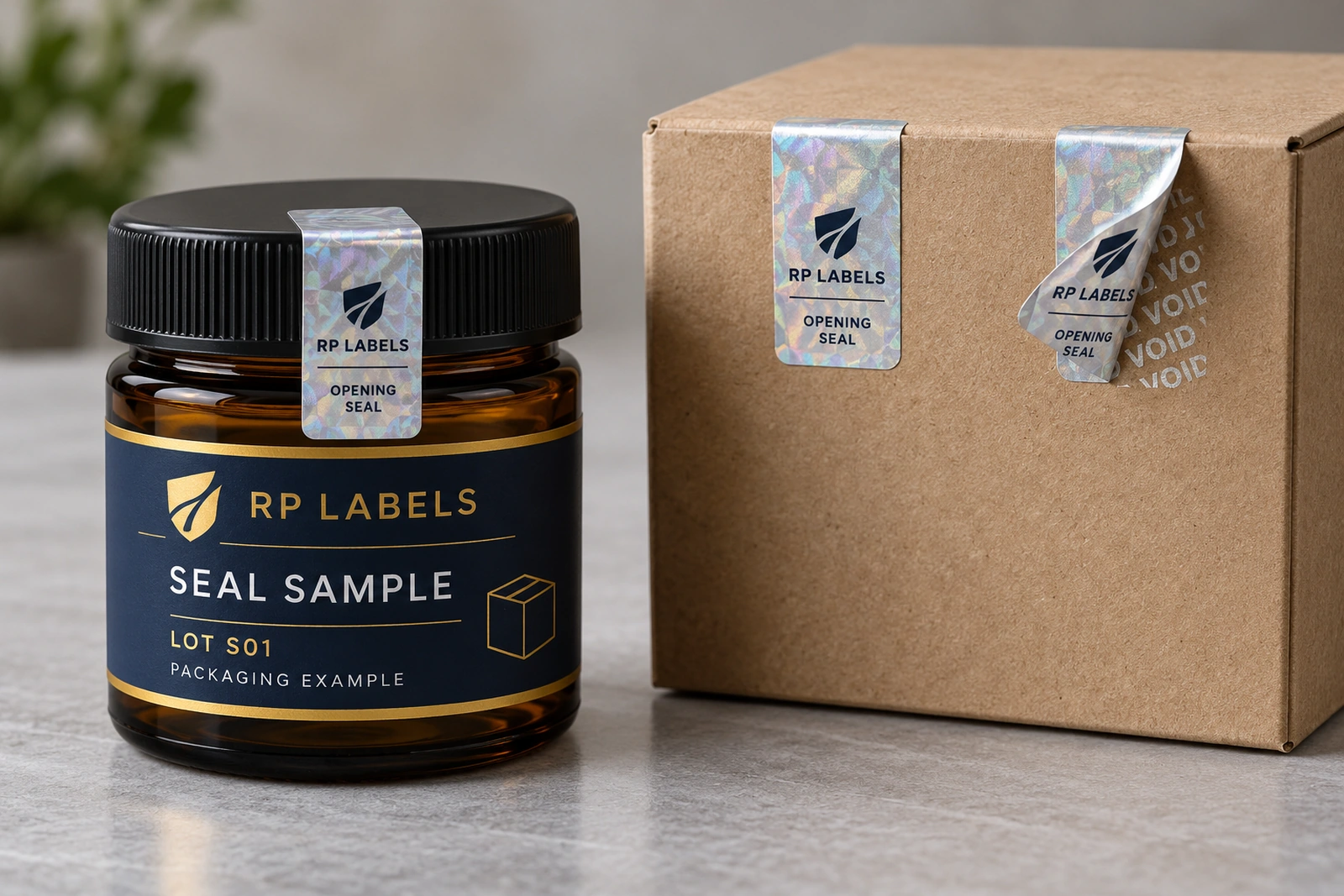
A reflective badge on the front of a bottle can look reassuring while saying very little about whether the cap has moved. Before discussing a security effect, I would ask the buyer to point to the opening they want monitored. The label must interact with that opening if the intended evidence depends on it.
The useful buying question is not “Which security sticker looks strongest?” It is “What visible change should staff or customers notice after the relevant action?” That answer affects material choice, placement and the sample review. An attractive finish cannot replace a defined inspection task.
Define the event and the observer
Describe the closure: a screw lid, carton flap, sleeve or another interface. Explain who applies the label, who later inspects it and what opening event concerns you. A warehouse colleague checking a seal close up has a different viewing situation from a customer looking quickly at a small bottle.
Also state what the label is not expected to establish. Visible opening evidence is different from proving the identity, contents or authenticity of a product. A decorative holographic effect does not independently provide those assurances. Keep packaging evidence and product claims separate in the purchasing brief.
Avery Dennison describes VOID and destructible label constructions within its specialty security solutions. These are useful categories to discuss. They are not interchangeable outcomes, nor evidence that an unspecified RP Labels construction has passed a particular security test.
Choose the kind of visible evidence
A VOID-style construction is intended to reveal a pattern or message when separation occurs. Depending on the specific construction, the visible result and transfer behavior can differ. Ask the supplier what the proposed material is designed to show and on which surfaces it is intended to work.
A destructible construction is intended to make removal damage the label rather than leave an intact reusable piece. That description still needs a real application context. The container surface, geometry and handling can affect whether the intended change is clear and distinguishable from ordinary damage.
For a closure seal, placement adds another requirement: the seal needs to interact with the relevant opening. Ask how the proposed shape crosses the cap-to-body area or flap, and whether it can be applied consistently. Do not treat “holographic,” “VOID” and “closure seal” as different names for the same specification.
Compare two hypothetical packaging jobs
Imagine a carton buyer who wants an obvious change when a particular flap is opened. There is enough flat area on both sides for a modest seal. The sample review can focus on that flap, the surface and the visible opening evidence, while also checking normal packing and handling.
Now imagine a small jar buyer trying to bridge a screw lid and curved glass body. The seal crosses different surfaces and an edge. A shape that worked on the carton might wrinkle or lift during ordinary handling here. The buyer needs to discuss dimensions, placement and material behavior on that actual package.
These examples illustrate procurement decisions, not verified performance. Neither package becomes secure just because a strip crosses a line in a drawing. Review representative applied samples and define the evidence you need before approving a construction or customer-facing claim.
Look for false alarms as well as visible opening
A seal that looks disturbed after normal distribution can create complaints even if nobody opened the product. Include ordinary packing, transport handling and inspection in the sample discussion. Explain expected moisture, temperature changes and contact with nearby packaging where relevant.
The inspection language matters. Staff should know what an acceptable intact seal looks like and which changes require attention. An ambiguous decorative foil shift should not be presented as opening evidence. Use photographs of representative samples to make the distinction clear in your own operating procedure.
Do not invent a formal pass grade or describe an informal sample review as a certification. If your market or product requires a specific tamper-evidence standard, identify it with the responsible technical team and arrange appropriate evidence. A label supplier cannot infer those obligations from the word “security.”
Make the sample request specific
Supply the actual package where possible, including its lid or flap. Identify the proposed seal position and explain any application constraints. Samples should represent the intended printed construction, not merely the same foil color on an unrelated substrate.
- Define the opening event and the visible result the observer should notice.
- Identify both surfaces and the geometry crossed by the seal.
- Confirm whether VOID-style evidence, label damage or another defined behavior is being evaluated.
- Review application consistency and ordinary handling before examining opening evidence.
- Record the approved construction, position and inspection criteria with the artwork revision.
Do not assume that making the adhesive stronger will resolve every weakness. The material, evidence mechanism, shape and placement work together. A decorative front label and a separate closure strip may have different jobs even when their artwork shares the same brand system.
Keep the main label and seal coordinated
Use the holographic label range to discuss appearance, while using the custom specification guide to record the functional requirement. State explicitly which part is decoration and which part is intended to show opening evidence. Avoid giving the packaging a broader assurance than the documented construction supports.
Request a closure-focused sample discussion from RP Labels with package photographs, dimensions, intended placement and quantity per design. Ask what construction can be evaluated for the use. The most useful first sample is one applied to the right closure, with a clear question attached.
Frequently asked questions
Does a holographic label prove that a package is unopened?
No. Reflective appearance alone does not establish opening evidence. Define the closure and intended visible change, then evaluate the actual construction and placement on the package.
Are VOID and destructible labels the same?
They describe different approaches to removal evidence. Ask what the proposed material is designed to show and how it behaves on your surfaces rather than treating the category names as equivalent.
Can a closure seal work on both a cap and glass?
It needs evaluation across the actual surfaces and geometry. Send the complete container and closure, and review representative samples under the intended application and handling conditions.
Can I claim certified security after checking a sample?
An informal sample comparison does not create certification. Identify any required standard and arrange the appropriate documented assessment before making a claim that depends on it.