Vial Label Tooling Charges: What Carries Over to a Repeat Order?
A preparation charge does not explain the next order
The first quotation contains a setup or tooling line. The buyer assumes the next vial-label order will avoid that cost, and perhaps that a physical tool can move to another printer later. Neither assumption is answered by the name of the charge.
I would ask what work and assets the line actually covers, then document the proposed reuse, custody and handover conditions. A preparation service, a print file and a physical production tool are different items. Agreeing the distinction before ordering makes the repeat comparison more useful.
This is a procurement checklist for clarifying proposals, not a statement of ownership under any particular agreement. RP Labels’ actual quotation must confirm its own included work and conditions; this article does not establish a tooling-storage or transfer service.
Identify the thing before discussing who keeps it
An offer might include artwork preparation, press setup, a job-specific plate, a cutting tool or several of these. Some production routes may not need the particular physical item a buyer expects. Ask the supplier to name the relevant work and any separately identified asset rather than demanding a generic set of tools.
For example, Weber Packaging’s published terms distinguish its preparation charges from ownership of physical printing plates and tooling. This is one supplier’s stated commercial arrangement, not a rule for every printer and not RP Labels’ terms. It illustrates why the invoice label alone is insufficient.
Keep authorized artwork and source-file delivery separate too. The editable-artwork handover guide covers files, linked assets and future editing tasks. Receiving a design package does not answer whether a particular physical plate exists, where it is kept or whether another production arrangement can use it.
Make a short tooling and repeat schedule
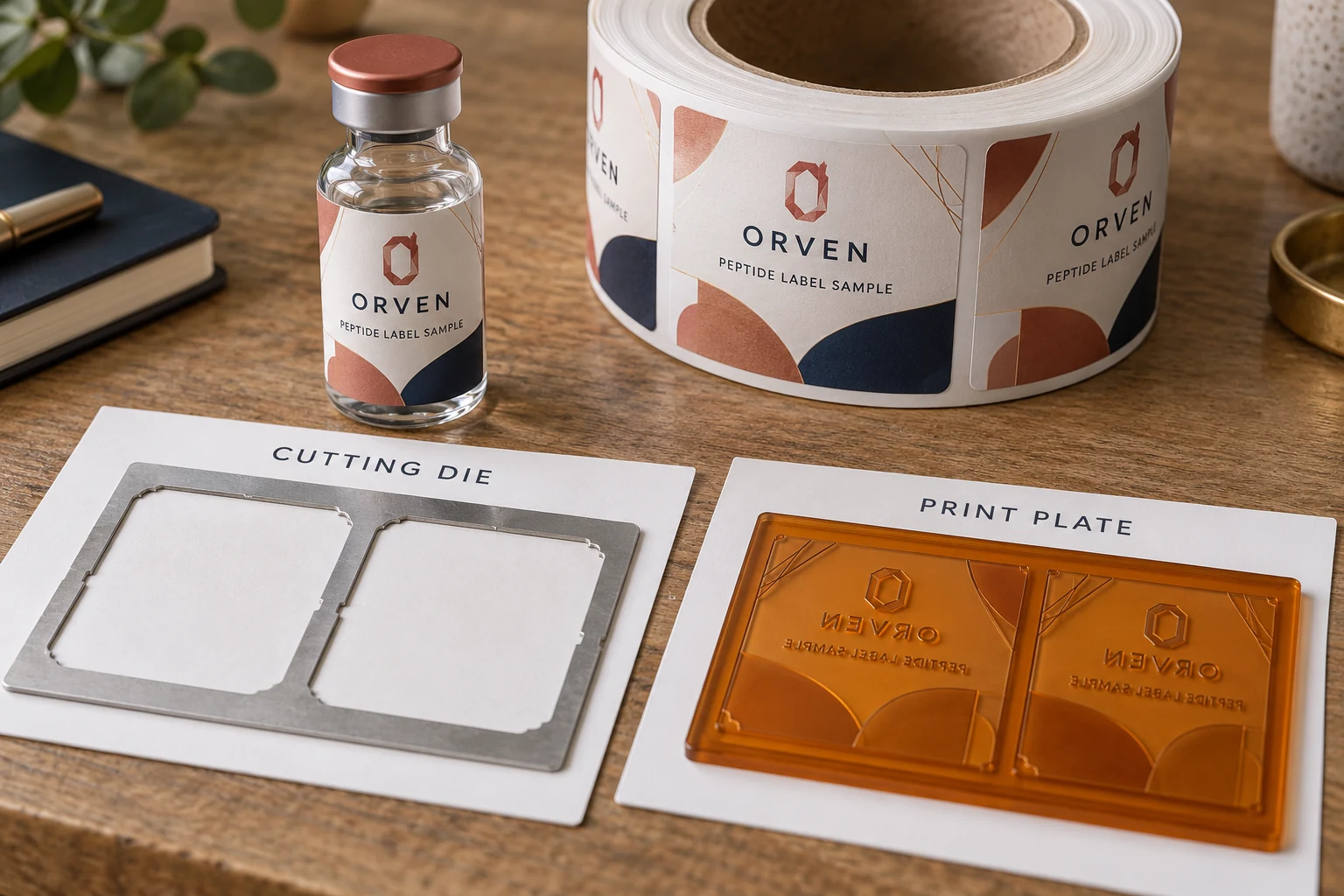
The image distinguishes finished labels, an illustrative cutting die and a raised-image print plate. It does not identify RP Labels production equipment, establish which tools your job needs or say who owns any asset.
| Proposal field | Clarification to request | Reason for asking |
|---|---|---|
| Item or work | Named preparation task or physical asset, where applicable | Separates labor from something separately deliverable |
| Reference | Design, dimensions, revision and relevant configuration | Defines what unchanged reuse would mean |
| Initial scope | What the quoted charge includes and excludes | Prevents unlike offers being compared as one fee |
| Custody and retention | Where applicable, who holds it and under what stated conditions | Makes later availability a question rather than an assumption |
| Repeat and change | What is checked, repeated, revised or charged next time | Distinguishes stable repeats from a new job |
| Handover | What may be supplied, when, in what condition and on what basis | Separates possession from useful portability |
Use this schedule proportionately. A straightforward proposal may require only a few written clarifications. The goal is to make the future purchasing task visible, not to create a long asset register for a route that has no separately reusable tooling.
If a supplier describes a charge as included, ask what that means for the initial purchase and an unchanged repeat. Included does not explain the asset arrangement by itself. Likewise, an itemized fee should not be treated as waste merely because another supplier embeds preparation in its total price.
Define unchanged more carefully than same label
A buyer may repeat the same product name while changing label dimensions, artwork, color output or production route. Ask which of those changes affect the proposed preparation or physical tooling. Keep the accepted references with the order so a future colleague can tell what actually remained unchanged.
Separate quoted repeat conditions from speculative savings. If there is no confirmed repeat price, mark it unknown. Do not spread an initial charge across imaginary future orders to make today’s unit cost appear lower. Compare the present purchase first, then record the assumptions behind any future comparison.
Our digital and flexographic printing comparison addresses how design mix and revision frequency enter the production-route discussion. Here the narrower question is what the quoted preparation leaves available, and under which stated conditions. A process category cannot supply that commercial answer.
Check useful portability before paying for it
If transfer matters, identify the intended receiving party and ask what it could actually use. Physical possession does not establish compatibility with another route or configuration. Relevant drawings, dimensions, condition and permission may need clarification before a receiving supplier can assess feasibility.
Ask the current supplier about any agreed release process, associated work and limitations. Keep that response with the actual proposal. Where terms conflict or an entitlement is disputed, have the responsible commercial or qualified legal adviser resolve the agreement; do not ask production staff to settle it through an informal message.
An alternative can be legitimate: retain the authorized artwork and specifications, then obtain a fresh production proposal elsewhere. That may be more practical than arranging movement of a tool the receiving route cannot use. Its actual costs and approval needs still require confirmation, not guesswork.
Two illustrative repeat strategies can both be sensible
Imagine an established brand with a stable design and a satisfactory supplier. Its priority is understanding the next unchanged order. A clearly documented supplier-retained arrangement may meet that task. Paying for extensive handover provisions solely because ownership sounds reassuring may add work without improving the intended purchase.
Now imagine a packaging buyer planning an alternative production source. It needs the preparation and physical-asset conditions visible before assuming transfer will simplify that change. It should ask both suppliers about technical feasibility and compare a legitimate new setup against any available handover route.
These are illustrative planning situations. They report no RP order, fee, dispute or tool condition. The useful difference is the buyer’s next task: an unchanged repeat versus an actual alternative-source plan. Neither justifies assuming that every first-order fee purchases a portable asset.
Questions about setup and tooling proposals
Does a digital proposal mean no preparation cost?
No. Ask what file preparation, setup and finishing work the actual proposal includes. The absence of a particular physical plate does not remove all preparation work or make every later change free.
Can a supplier promise indefinite storage?
Only its actual agreement can answer what it offers. Ask about retention, identification, condition and what happens after inactivity. Do not insert an assumed storage period into a repeat plan.
Should I demand ownership of every production item?
Start with the future task and actual available arrangement. Some items may be part of a supplier’s broader production system. Clarify what is relevant and negotiable rather than assuming every machine aid should become a delivered customer asset.
What helps obtain a useful quotation?
For custom peptide vial labels, send the itemized preparation or tooling proposal, designs, dimensions, quantity per design, expected stable or revised repeat and any genuine handover requirement through the project quotation form. Ask what is included now and what conditions apply next time. A clear answer is more useful than a cheap-looking setup line with an undefined future.